
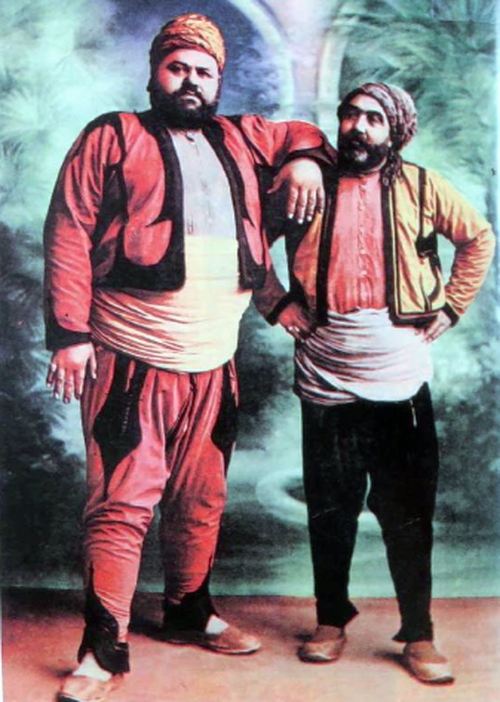
The original Terrible Turk, Youssuf was lost at sea before the American public got enough, and they eagerly awaited his successor. Promoters and managers saw a good thing as well, and threw all sorts of terrible versions of “Turks” in the ring. However there was no denying the genuine article was different than fans had seen up to that point. Today these men would still be considered very large, big enough for the NFL or WWE, but in their day, they were billed as superhuman freaks.
Adalı Halil: The Sultan’s Lion
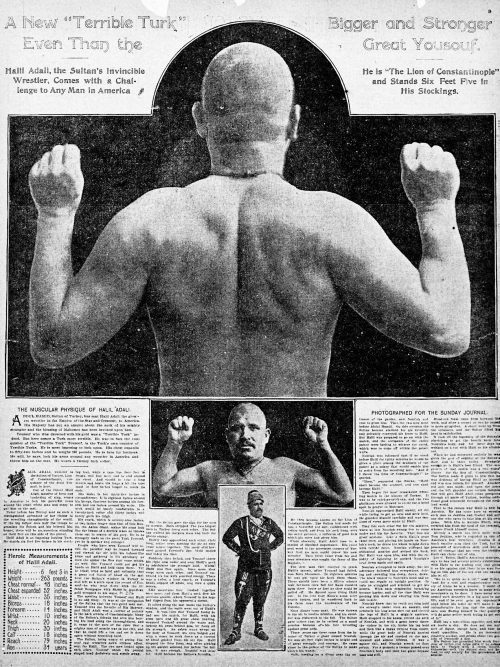
New York Journal: October 1898
Editor’s note: I apologize for the various spellings of the wrestler’s names. This all predates the adoption of the Latin alphabet for the Turkish language or even the requirement for surnames, so modern spellings differ from contemporary sources.
The immediate successor to the original Terrible Turk was another grand master, named Adali Halil (Halil Adali and various other spellings). At 6’5″ and about 300 pounds, he was considered a more intelligent and skilled grappler than Youssuf. He dominated the Kırkpınar tournament for 18 years, which included a legendary victory (or at least a draw) in a match against Youssuf. Adali would also join in the 1895 “Turkish Invasion” of Europe, starting in Paris, then beating all challengers in Vienna before returning to Istanbul.
Adali arrived in the United States with Youssuf’s former manager Antonio Pierri in September 1898, only three months after the loss of the original Terrible Turk. They nearly met the same fate on their way across the Atlantic, when the White Star liner Teutonic collided with another vessel en route to New York. Luckily the damage was so minor the passengers were unaware until they arrived in port.
The second Terrible Turk was better known as “The Sultan’s Lion” or the “Lion of Constantinople” in the press. This new terror from the exotic Ottoman Empire got many impressive write-ups in newspapers across the country. Adali was billed as being even more ferocious than the Terrible Turk, and said to be the only man to toss Youssuf in a match. The original Terrible Turk had a hard time grappling men so much smaller than himself, so how would this large but more agile wrestler fare in the squared circle?
Adali vs Tom Jenkins
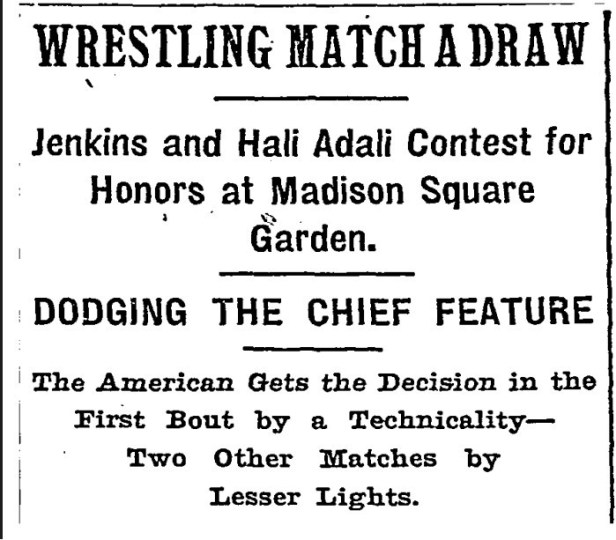
Adali Halil’s first American match was in November 1898 at Madison Square Garden, against American champion Tom Jenkins. The Catch-as-Catch-Can bout ended as a controversial draw due to Jenkins refusing to lock up against the big Turk. The crowd booed Jenkins mercilessly for his cowardliness, but was awarded the first fall when Adali accidentally fouled – by using a towel to wipe his brow. The next fall went to the Turk, after chasing his much smaller opponent for 45 minutes. Adali finally caught his wrist and got him down and crushed him with his weight for the pin.
A Turkish Trencherman
When I called on him he and his manager were at luncheon. If the Turk prove as good a wrestler as he is a trencherman he certainly is a wonder. He ate enough while I was present to satisfy four pretty hungry men and topped it all off with several plates of ice cream.
Deseret News: October 22, 1898
The sight of Adali entering your restaurant must have been nearly as scary a facing him in a match. One newspaper claimed he ate a dozen chickens a day. While training for the Jenkins match, Adali and manager Antonio Pierri visited New York’s historic Gilsey House Hotel for a meal that astonished the diners, the press and the kitchen staff. The New York papers reported he ate: 6 portions of turkey, 6 lamb chops, 6 soft-boiled eggs, 3 portions of potatoes, 2 whole pies, and 2 plates of ice cream. He washed this down with an entire pot of coffee, 3 beers and 6 glasses of water.
Ernest Roeber Defeats a Counterfeit Turk?

Boston Post: March 8, 1899
Greco-Roman champ Ernest Roeber would now meet the Terrible Turk’s successor, or at least someone claiming to be him. They met up at Boston’s Music hall in March 1899 to a crowd of 2500, which included several women (the press always pointed this out). Strangely, the size disparity was not as great between the two as would be expected. The two battled for nearly a half hour before Roeber got the Turk in a hammerlock. The threat of a broken arm was real, but Roeber refused to let go of the hold after “Adali’s” team conceded the first fall. The Turk’s second had no choice but to throw in the towel (it was actually a sponge), and the referee awarded the match to Roeber.
Did Roeber actually defeat Adali? The man who supposedly beat Youssuf? The day after the fight, reports came out that the real Sultan’s Lion was actually in Chicago, and Roeber fought an impostor. Instead of beating a Terrible Turk, it was a “Horrible Greek.” The Denver post reported the man playing the role of Adali was actually George Heraklides, the Greek wrestler who lost to Youssuf in quick fashion. This was not the only time a “fake Turk” had been foisted on an unsuspecting audience, and Adali’s manager challenged the impostor to face the real Sultan’s Lion.
The fake Adali was not the only bit of sketchy behavior on the part of Roeber that night. Before the match, Roeber and his brother were arrested for owing money to a former manager.
Handicap Matches and Other Gimmicks

Public Domain
In professional wrestling, it is not enough to defeat your opponent, the Turks had to learn you had to give the crowd a good show to make the most money. There were few wrestlers big enough for a fair fight with the Sultan’s Lion so he fought many handicap matches, where special rules applied. For a match in January 1899, Adali had to win four consecutive falls in 90 Minutes against John “the Giant Gripman” Rooney and Martin “Farmer” Burns, the Catch wrestling champ. Details are few, but Adali got to three falls, including one on Farmer Burns before the time limit passed.
An example of a “loss” was a match in May, 1899 to former Cornish and Catch-as-Catch-Can champion Jack Carkeek. The Turk had 90 minutes to defeat Carkeek three times. Each fall using a different style: Catch-as-Catch-Can, Greco-Roman, and Cornish. the Sultan’s Lion won the first two falls, but did not appear for the third round. The referee decided the match for Carkeek. This may have been another time when the rules were lost in translation, since the big Turk already won two out of three falls.
Possibly his most embarrassing “loss” was a match in St. Louis on February 16th 1901. Adali had to “throw” 6 men in 60 minutes or forfeit his share of the purse. He tossed the first man quickly, but the second proved to be a giant killer. George Baptiste was the smallest of the challengers and 100 pounds lighter, but held off the Sultan’s Lion for the entire time limit.
Competitions for the World Heavyweight Championship
Public Domain
Colorized
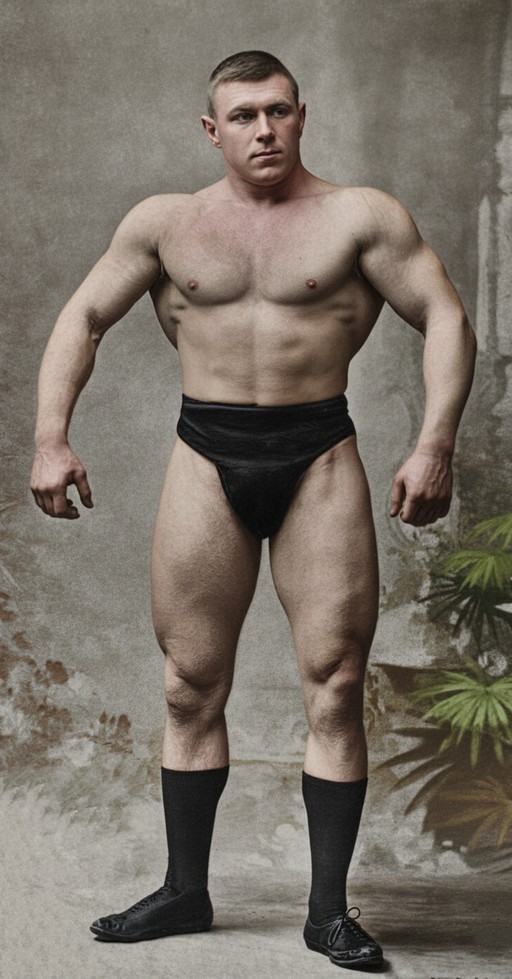
In March 1901, Adali traveled to Europe, where he placed first at the Greco-Roman Tournaments in Munich, Germany and Liege, Belgium. However, in May the Sultan’s Lion met his match in the finals of the World Championships in Vienna, Austria. On the final day he was defeated by the “Russian Lion” George Hackenschmidt, an Estonian strongman that today is considered professional wrestling’s first undisputed heavyweight champ.
The Turk Halil Adali, whom I consider the best of all my opponents, was even stronger than [French wrestler Paul] Pons. Adali possessed gigantic strength and staying power, but I was in pretty good form and drew on the first day after wrestling for an hour and eighteen minutes. Next day, after a contest of forty minutes the Turk gave in, being convinced that I must win. Indeed, I had wrestled in first-rate form, and had reduced the good man to a somewhat demoralized condition.
George Hackenschmidt: The Way to Live (1925)
Adali continued to wrestle in tournaments in Europe and Turkey until 1914, but was no longer the “undefeated” menace of the past. After returning to Turkey, he bought a farm with his winnings and lived until 1925. Adali Halil is buried at the Wrestler’s Cemetery (Pehlivanlar Mezarligi) in Edirne, where his grave is a pilgrimage site for Turkish oil wrestlers.
Nurullah Hasan: The Turkish Giant
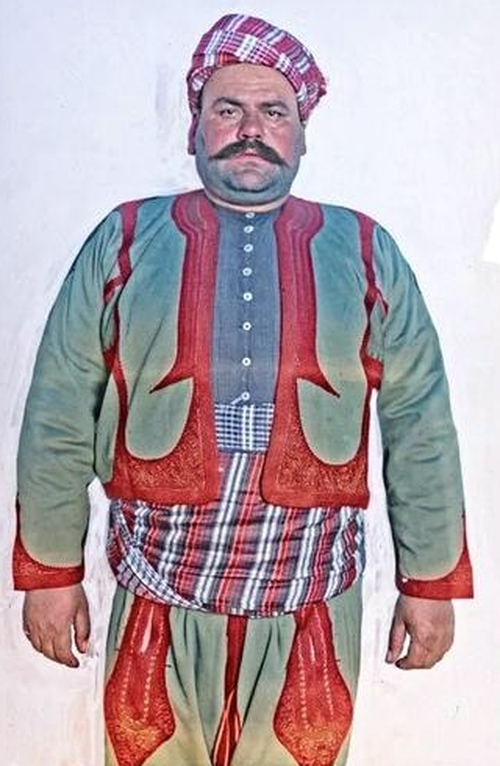
Public Domain
This photo is colorized using Kolorize.cc
If American wrestling fans thought Adali was big, they were in for a treat. Ali Nurullah Hasan (Nouroulah, Filiz Nurullah, Ali Hassan, various spellings) was the biggest of them all, standing at least 6’6″ and over 350 pounds. His size and weight seemed to change depending on who was measuring, but Dr. Sargent of Harvard University dubbed him the largest athlete in the world. Going so far as to declare Nurullah, who smoked over 35 cigarettes and drank two gallons of coffee a day, the standard for a “perfect man.” Standards have changed since then.
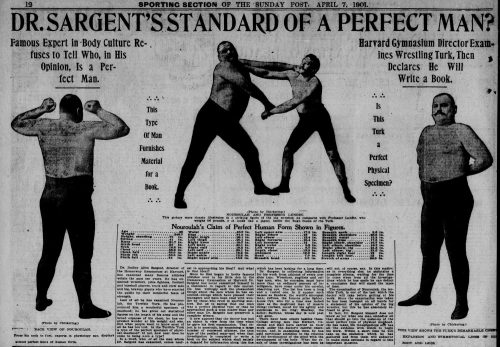
Boston Sunday Post: April 7, 1901
Nurullah was trained in Turkish oil wrestling at a young age, by none other than Youssuf. He also traveled with him to Paris as part of the original “Turkish Invasion” of 1895. As a giant among giants, he was more of a spectacle than a contender at the start of his Paris run. Nurullah was often used in a similar way to how modern giants like Andre the Giant and “Big Show” Paul Wight were used at points in their respective careers. Too big to compete convincingly, they were marketed to the crowds as freaks of nature. However, Nurullah continued to train in Greco-Roman and eventually Catch wrestling, to combine technique with his massive size. He was never a technically skilled wrestler, but really didn’t need to be to win most matches.
In January 1900, Nurullah challenged and defeated a series of wrestlers at the famous Moulin Rouge to win the Paris “Gold Belt” tournament. It was not long after that when Nurullah crossed the Atlantic to take Adali’s place and assume the mantle of the next Terrible Turk.
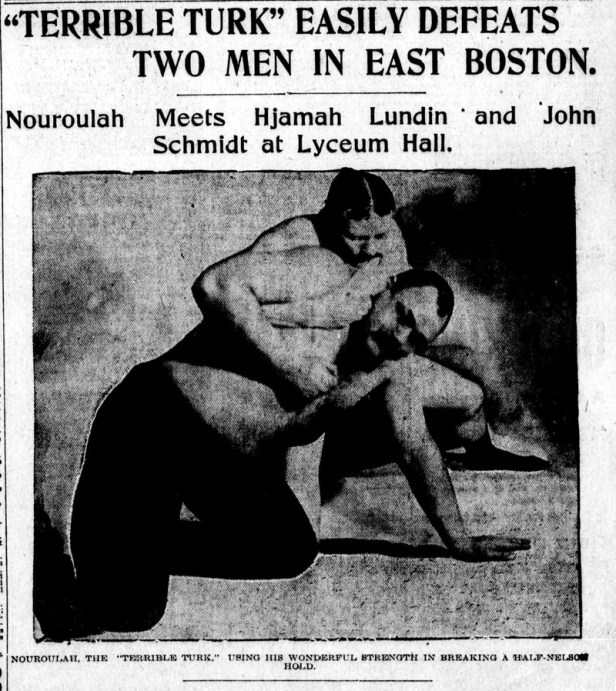
Boston Post: March 30, 1901
There is not a man in this country who practices wrestling who is not 150 or more pounds lighter than Nouroulah, and that is big enough handicap to beat a horse.
Boston Post: May 11, 1901
Nurullah arrived in the US under the management of Martin Julian, former manager of heavyweight boxer Bob Fitzsimmons. By March of 1901, Nurullah was in Boston making a name for himself by challenging anyone to last 15 minutes in the ring, for a $100 prize. One local fighter who tried to go the distance was a troublemaking heavyweight boxer, the “Chelsea Strong Boy” Sandy Ferguson.
Nurullah vs Sandy Ferguson: Boxing’s Stubborn Child
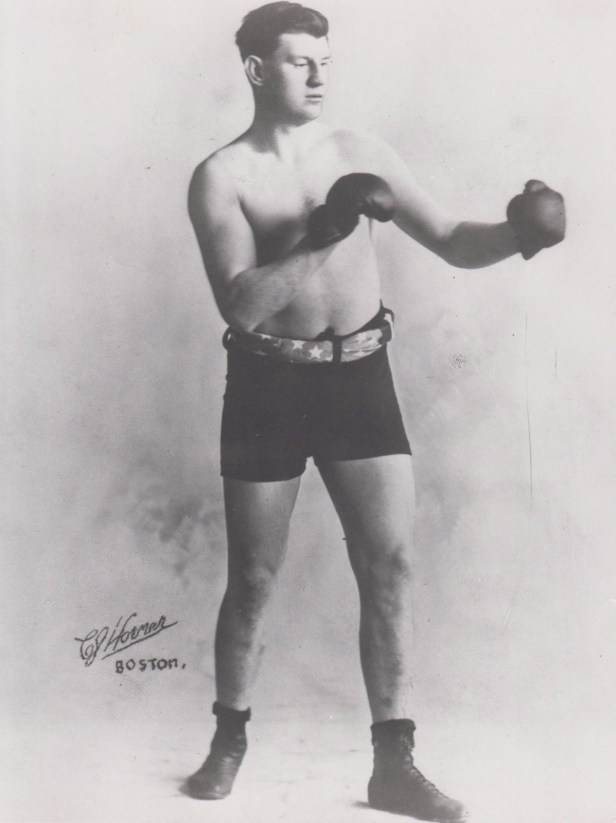
Public Domain
Big Sandy wasn’t so big in comparison to Nurullah, but at 6’3″ and over 220 pounds, he looked like someone that could give the giant Turk a challenge. Sandy certainly talked the talk in and out of the ring and challenged the Terrible Turk on April 4, 1901 at Boston’s Howard Atheneum.
Despite Sandy’s boasting, the press reported he tried to back out after seeing Nurullah easily manhandle some local wrestlers. Boxing’s “Stubborn Child” was visibly scared backstage and entering the ring, but the lure of a hundred bucks was too great. When the match started, Nurullah grabbed the heavyweight, gave him a bodyslam and quickly pinned him down until the referee told him to get off. This supposed “Great White Hope” of boxing lasted only 12 seconds against the Terrible Turk.
Nurullah vs Tom Jenkins
Lowell Sun: May 8, 1901
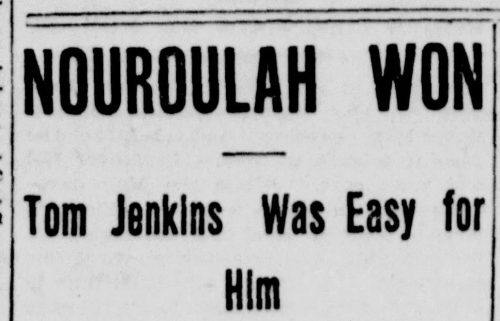
On May 8th 1901, Nurullah faced off against the world’s Catch wrestling champion, Tom Jenkins at Madison Square Garden. The crowd once again was nearing a riot status as the match was delayed until 11PM. The sides were debating how falls would be counted, since Nurullah was almost twice the weight of Jenkins. It was not an exciting contest as Jenkins could do nothing against the size and weight of the Terrible Turk, but not for the lack of trying. In the second round Jenkins was able to get Nurullah down on his knees with a headlock at one point. He technique was for naught, as the Terrible Turk got two falls and the win in under 10 minutes. About a year later, Jenkins would recall his bouts with the Turks:
Those big Turks were the toughest game that I have been against. Nouroulah was a better man than Yousuff. He threw me around as if I was a stick, and I still bear marks that I received when he threw me out of the rings into the orchestra.
Boston Globe: March 18, 1902
Nurullah vs Ernest Roeber: A Fixed Fight?
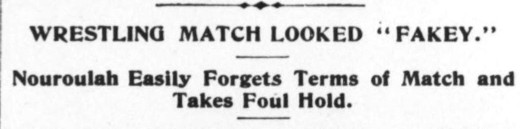
The big bout with Greco-Roman champ Ernest Roeber took place in New York on May 24, 1901. Only holds above the waist were allowed and Nurullah had to throw Roeber three times in an hour. After struggling with the smaller wrestler for over 20 minutes, the Terrible Turk illegally grabbed Roeber by the thighs, tossed him across the mat and crushed him for the pin.
The crowd went wild with the foul, which seemed staged to them and once again a near riot broke out. The cops chased Roeber out of the ring and one even cracked Nurullah on the head with a billy club – with little effect. The National Police Gazette, the original sports magazine reported the match looked “fakey” and that “It looked to many as if Referee O’Donnell received his instructions and was carrying out his orders.”
Was the fight fixed? It’s most likely the two wrestlers had an arraignment. The world learned after the match that Nurullah was already on a steamship to Europe. Roeber meanwhile, a champ already with a real win over a fake Turk, now had a fake win over a real one.
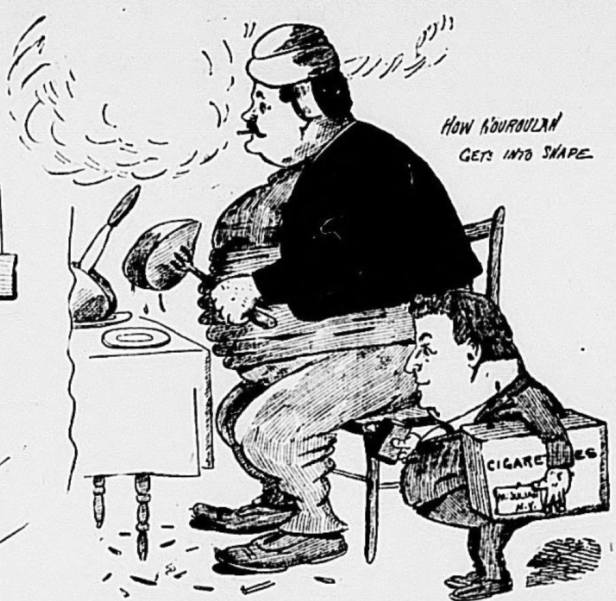
The small man holding cigarettes is manager Martin Julian
Public Domain
It was during this tour of Europe that Nurullah was said to have succumbed to German beer. Like the previous Terrible Turks, all devout Muslims, abstaining from alcohol was hard in the decadent West. Nurullah never trained much anyway and over time, his performance slipped. Although he competed very well in the 1906 heavyweight tournament held in St. Petersburg, Russia.
Nurullah continued to compete in Turkish oil wrestling and also became a famous trainer, until retiring in 1911. Big wrestlers do not generally have long lifespans and a lifetime of grappling, traveling, smoking and eating 2-4 porterhouse steaks a day, finally took its toll. Ali Nurullah Hassan died in 1912 in his early 40s.
Other Terrible Turks
Public Domain
Colorized
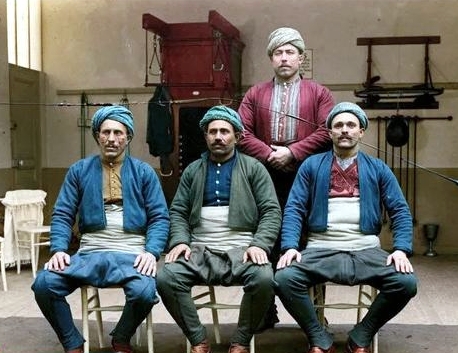
The “fake Adali” encounter was at the start of a cottage industry creating “Terrible Turks”. Some were Turkish, some Armenian or Greek, but many were homegrown “Turks” just using the gimmick. The press saw what was happening and called out this practice of manufacturing fake Turks for the sake of selling tickets.
The raw material for a first-class “Terrible Turk” is a man of any nationality who weighs over 300 pounds and is tall and muscular. A few weeks’ careful training in wrestling and, if necessary, in speaking English with a queer accent, together with a red fez and a feigned liking for Turkish cigarettes will do the rest.
Chicago Tribune: January 1901
Overall, the gimmick became diluted and lost its mystique with so many mediocre “Turks” claiming to be the heir to Youssuf. However there were several authentic wrestlers at the turn of the 20th century and into the 1920s that gained some notoriety as Terrible Turks.
Kara Osman: One of the originals from the Turkish Invasion that didn’t turn out to be as “terrible” as the others. Kara Osman was a champion in the Ottoman Empire, but his time in America was not very succesful. He arrived in the US in November 1899 to less fanfare than Adali Halil, but nearly as high praise from fellow wrestlers. He lost to Tom Jenkins in December 1899 after 45 minutes of hard fighting during which, he was hurt from a foul in the crotch. The ring doctor declared he was “ruptured” and could not continue. Jenkins denied the foul and called Kara Osman a quitter. A decade later, in 1911, he lost to former champion Frank Gotch. The Turk was thrown twice in 25 minutes by Gotch, who had been retired for a year until then.
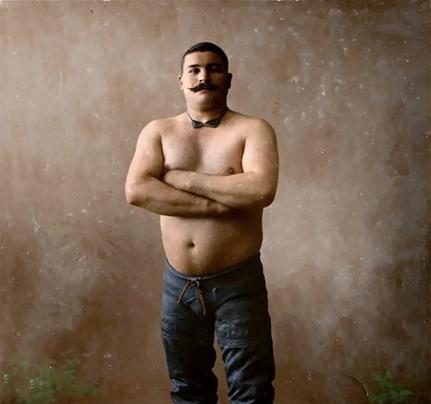
Public Domain
Colorized using Kolorize.cc
Kurtdereli Mehmet: A wrestler nearly as large as Ali Nurullah Hasan at 6’5″ and 325lbs. He was a champion (başpehlivan) oil wrestler, beating Kara Osman at Kırkpınar. He was part of the original Turkish invasion and dominated in Europe and US before returning to compete Turkey. He had a controversial loss to Gulam, the undefeated Punjabi wrestler, at the 1900 Paris Exposition. In 1911, Kurtdereli competed in 43 matches in 32 nights and was undefeated in the US. Although finding these records has proven difficult. He passed away in the city of Balıkesir in 1938, where today stands a bronze statue and the Kurtdereli Indoor Sports Hall.
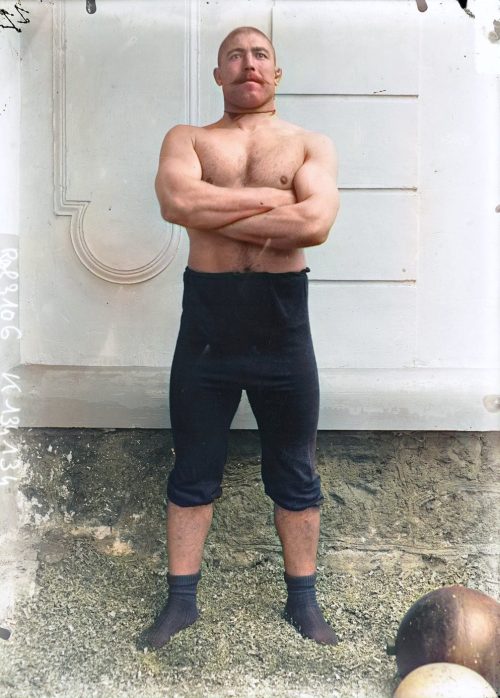
Public Domain
Colorized
Ahmed Madrali: Turkish wrestler and strongman that wrestled mainly in Europe and the UK. He is best known today for his loss in the 1904 London World Championship to George Hackenschmidt. The Russian Lion beat the Terrible Turk and dislocated his elbow in 41 seconds. A year later, Madrali would make quick work of American Tom Jenkins in London on his way to a rematch with Hackenschmidt. The Russian Lion easily defeated Madrali again in two straight falls in this highly anticipated but underwhelming rematch.
Legacy of the Terrible Turks
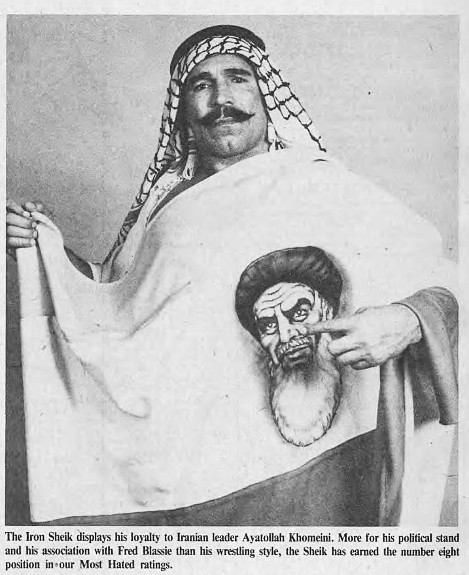
Champion Iranian wrestler turned pro wrestling’s Iron Sheik
Pro Wrestling Illustrated: May 1984
The original Terrible Turks are at the foundation level of modern professional wrestling, blurring the lines between sport and performance. Their size, skill and exotic origins drew in the public, spawning an entire genre of wrestling gimmicks centered on the “evil” foreigner. It’s a tried and true formula that still works, especially when it mirrors current events. You don’t get classic bad guys (heels) like the Iron Sheik, riling up the crowd with his foreign clothing and anti-Americanism, without first having the Terrible Turks.
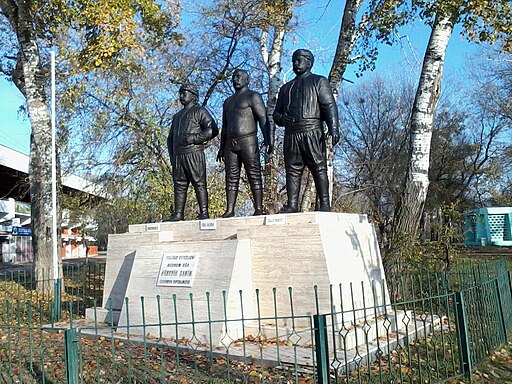
Kirkpinar Tournament Grounds: Edirne, Rep. of Turkey
Credit: Mirada, GFDL, via Wikimedia Commons
In Turkey however, the story of these wrestlers is very different. The Terrible Turks are true legends of the national sport of oil wrestling, enshrined in the cherished history of the Kirkpinar tournament. Many of the Terrible Turks have been immortalized with bronze statues at the tournament grounds in Edirne. Turkish oil wrestlers (pehlivanlar) hold these men in very high regard for their skill, and also the brutal conditions they competed under during the Ottoman era. There is a tradition for wrestlers and organizers to pay their respects at the grave of Adali Halil, and the Koca Yusuf monument before the opening of the annual Kirkpinar tournament.
The early days of professional wrestling and boxing are full of colorful characters lost to time. If you have enjoyed this two-part story on the Terrible Turks, and would like to see more stories like this, please let me know in the comments!
Sources/More Information
Desbonnet, Edmond. The Kings of Wrestling: Anecdotes and Stories of Wrestling from the Distant Past to Our Times. McFarland Publishers, 2024.
Eurozine: The Life and Death of the Terrible Turk by Graham Noble
Hackenschmidt, G. The way to live: Health & physical fitness. London: Health & Strength, Ltd. 1911
Halil Adali Wrestling Record – Pro Wrestling Historical Society
Kurtdereli Memet Biography (in Turkish)
Lundin, Hjalmar. On the Mat-and Off: Memoirs of a Wrestler. United States, Albert Bonnier publishing house, 1937.
Newspaper Archive: Accessed via Boston Public Library
ProQuest Historical Newspapers: Accessed via Boston Public Library
Turk Network Magazine: An Era of the Terrible Turks by Mehmet Ali Munir
Welcome to the Hippodrome Podcast
Yılmaz, Tayyip: Geçmişten Geleceğe Kırkpınar. Edirne, Rep. of Turkey, 1998

