
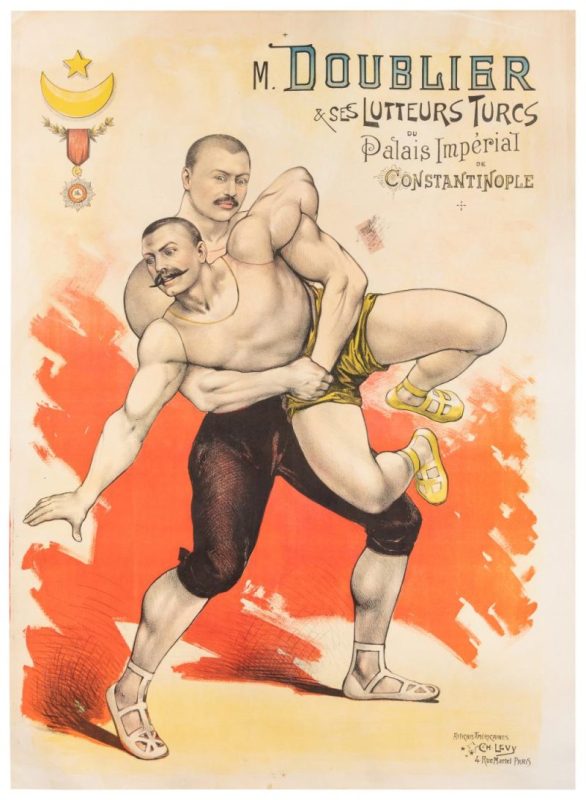
One of the classic tropes of professional wrestling is the stereotypical evil foreigner. Hailing from some far away exotic land, wearing traditional garb, and the more remote the more heated the crowd would get. The world is a much smaller place and today it seems a little silly, especially in the silly world of modern “sports entertainment.” However, there was a time when the wresting was real and so were the exotic wrestlers. The 1890s saw the arrival of the “Terrible Turks,” champion wrestlers from the Ottoman Empire who ran roughshod over the competition in Europe before invading North America.
America at the turn of the 20th century was a wild place and attracted the bold and reckless. The nation was coming of age, and it seemed like opportunity was everywhere. But for most citizens, life was tough either out on the farm, or working in the factories. America worked hard, and played hard as evidenced by what kinds of entertainment they liked. Rowdy crowds came out to forget about how hard they worked, by satisfying a little bloodlust in the form of “manly” competition.
It wasn’t just prize fighting that got people to the local auditoriums, wrestling matches were popular as well. Sometimes, the two genres blurred and for the right price, boxers turned to wrestlers. Wrestling champions from around the world began arriving, looking for big purses in the Land of Plenty. For some foreign athletes, or at least their promoters, American streets were truly paved with gold, making fortunes in the ring before returning home. The original Terrible Turks were not the first foreign wrestlers in the States, but were of a size and skill that most Western audiences had never seen before.
Wrestling Styles of the Terrible Turks
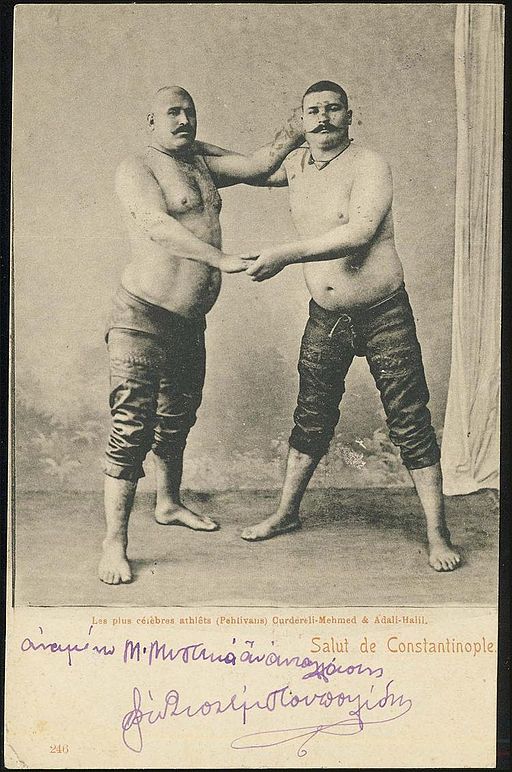
Wearing traditional Turkish wrestling breeches
Public Domain
The Turkish people have a two-fold history of wrestling: the ancient wrestling traditions of the central Asian steppe, and the classical wrestling traditions of their adopted home in Anatolia – modern Turkey (Türkiye). The Terrible Turks were originally practitioners of traditional Turkish oil wrestling – yağlı güreş. Regardless of actual ethnicity, wrestlers from all over the Ottoman Empire practiced oil wrestling and is still culturally important today to the Turkish people.
The center of the oil wrestling world is Edirne’s famed Kırkpınar tournament. Edirne was once the Byzantine city of Adrianople, conquered by Sultan Murat I in 1361. The Kırkpınar has been held there ever since and today is the oldest continuously held sporting event in the world. Each of the original Terrible Turks were not only wrestlers (Pehlivan), they were legendary champions (başpehlivan) of this tournament, their names still revered today. However, covering yourself in olive oil and grappling on the grass is not exactly a prime spectator sport. To compete on the international stage, the future Terrible Turks had to be trained in several other forms of professional wrestling.
Greco-Roman Wrestling
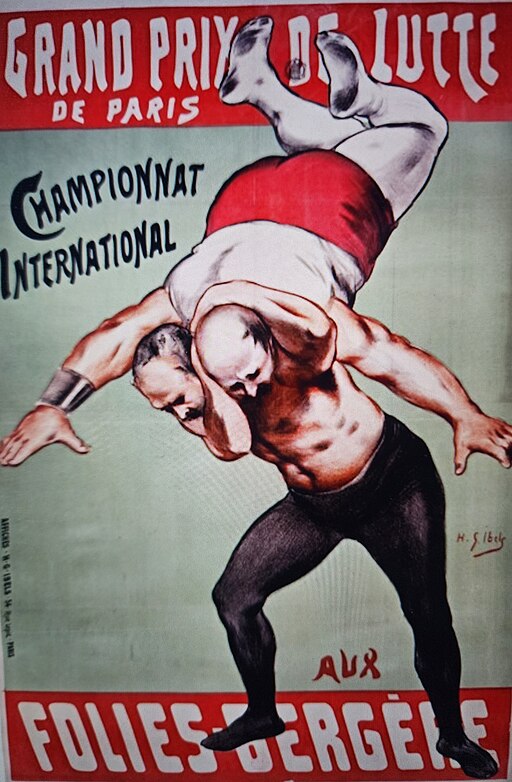
1899 World Wrestling Championship in Paris
Credit: Bibliotheque Nationale de France
Professional wrestling of this era was mainly the traditional Greco-Roman style, still seen in the Olympics. These professional matches lacked the decorum of the modern sport and were known for long and punishing matches. The first heavyweight titles were awarded in 1875, and eventually there would be both European and American titles. While Greco-Roman was the preferred style in Europe, it was less popular in the UK and US. The English-speaking world preferred something more exciting.
Different wrestling traditions from Europe such as Cornish wrestling and Irish Collar-and-Elbow were also popular in English-speaking countries. Around the same time all these disciplines were blending into a new, more exciting style that became known as “Catch-as-Catch-Can”. These matches also became a popular sideshow of traveling circuses, which spread the popularity of the new wrestling style across the Western World.
Catch-as-Catch-Can Wrestling
Public Domain
Colorized
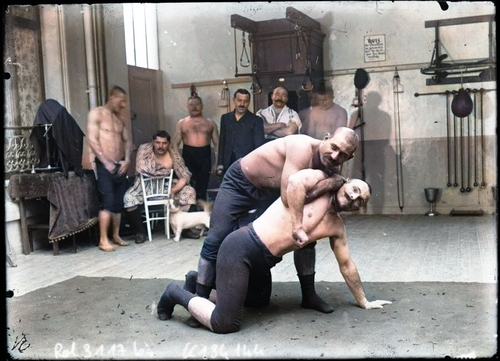
Catch-as-Catch-Can, also known as “Catch wrestling” was more popular than Greco-Roman style as a spectator sport. It would eventually gain full legitimacy and become an Olympic event in 1904. Catch matches were the MMA fights of their day in that you could use various techniques not allowed in classical wrestling. Leg locks, arm bars, full nelsons and various submission holds were now allowed, making for a more entertaining spectacle. Many professional wrestling contests featured a match of each style to make it an even contest.
The next decades saw Catch wrestling diverge on two different paths. By losing the submissions and chokes, it stayed an Olympic sport in the form of modern freestyle wrestling. The other side of catch wrestling would lose legitimacy as a sport as it devolved into the predetermined (fixed) bouts of professional wrestling. To be fair, there were questions about the legitimacy of professional wrestling matches even in the early days, including some matches involving Terrible Turks.
Long after pro wrestling adopted “worked” matches, there was still a role for real fighters. Up until the 1970s the various professional wrestling territories still kept an authentic Catch wrestler as their champion. These legitimate tough guys could “stretch” a competitor if say, a young upstart tried to change the outcome of the match and pin the champ.
The Turkish Invasion of the 1890s
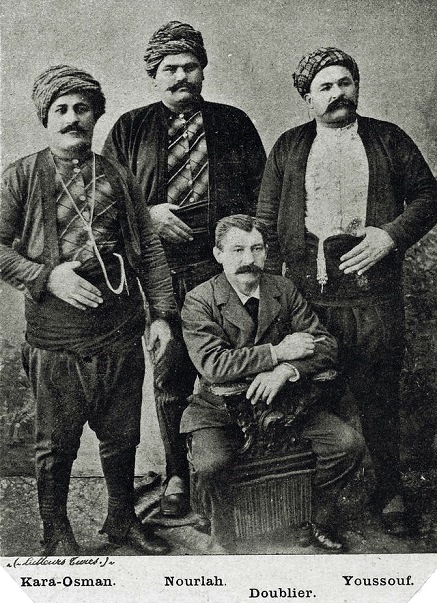
Youssuf Ismaelo was the original “Terrible Turk”
Seated is their promoter, French wrestler Joseph Doublier
Public Domain
Editor’s note: I apologize for the various spellings of the wrestler’s names. This all predates the adoption of the Latin alphabet for the Turkish language or even the requirement for surnames, so modern spellings differ from contemporary sources.
The Terrible Turks began their stories of fame and fortune in Paris, then a center for the young sport of professional Greco-Roman wrestling. There are varying stories about which wrestlers arrived first, but by early 1895 there had been 5 large wrestlers that came from the Ottoman Empire. They were trained in Greco-Roman wrestling and brought to Paris by a French wrestler named Joseph Doublier.
One version of the story is Doublier brought the Turkish wrestlers to France in an attempt to defeat Fernand Sabès, the unbeatable champion. Apparently he met some Turkish oil wrestlers while wrestling in Eastern Europe and convinced them to train in Greco-Roman style and join him in Paris. They would form what in modern professional wrestling is known as a “stable” with Doublier as their manager.
Modern professional wrestling is known for its outlandish characters and sensational plots, which can be traced back to these early days. This first wave of the so-called “Turkish Invasion” had a sensational storyline reported in French newspapers to build up how terrible these unbeatable Turks could be. Supposedly, this would be the first time the Sultan allowed his champion wrestlers to compete in Europe. If they were defeated, they would face the death penalty back home!
So who were these mysterious, exotically-dressed giants? Sources differ on who was first, but included Youssuf Ishmaelo, Ali Nurullah Hasan, Kara Osman, Katrancı Mehmet and Kurtdereli Mehmet. Each were champions in their own right and all of them were over 6 feet tall. The “Turkish Invasion” began in March 1895 at the Folies Bergère theater in Paris and became an instant success. The wrestling matches were originally a side show accompanying the circus and other performances, but quickly became the main event. The wrestling world, and Paris overall, had never seen wrestlers of such size.
When I landed in Paris, Filiz [Nurullah] and I could not find a suitable bed. We were ordered special beds from the factory. But we slept on floor beds for three days until these beds arrived. Hundreds of curious people, photographers, journalists, princes, counts, men and women, came to visit us every day. They published our photographs in various newspapers almost every day. The people would literally trample each other to see us. Filiz Nurullah would keep watch at the restaurant, worried that they would feed us pork.
Kurtdereli Mehmet (trans.)
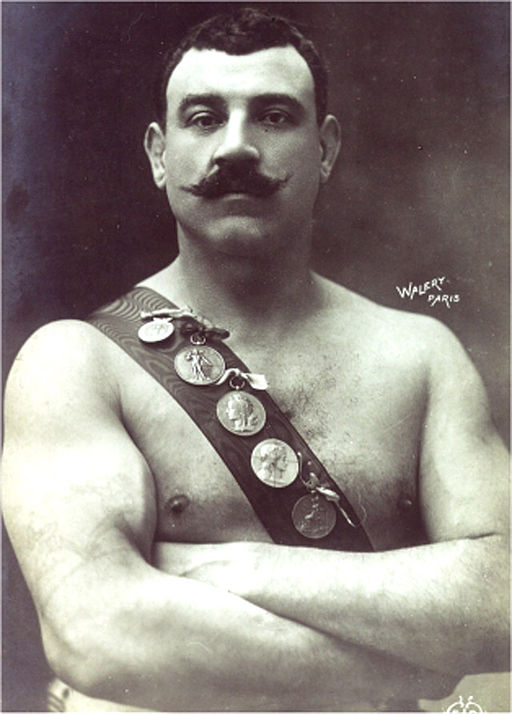
The French Colossus
Public Domain
The Turkish wrestlers took on Europe’s best: Fernand Sabès, Paul Pons, Tom Cannon and other Turks like Kara Ahmet and Ibrahim Mahmout. They made quick work of the competition, many of them going undefeated during their time in Paris. Their sheer size allowed them to often manhandle their opponents, who were shorter and lighter. A major exception would be the “French Colossus” Paul Pons, who was large and strong enough to go toe-to-toe with the biggest Turks.
The Turkish Invasion, made an immediate impact on the sport, filling venues, and making professional wrestling more popular than ever. The Terrible Turks were also responsible for a resurgence in Greco-Roman and Catch style wrestling and drew a crowd wherever they traveled on the Continent or the UK. After dominating the European circuit, it was time for the original Turks to invade North America, starting with the baddest of them all: the undefeated Youssuf.
Management of these Anatolian monsters of the mat changed hands once they began arriving in the US. Doublier apparently had a falling out with Youssuf, the leader of the other Turks, over their pay. Things got physical and Yousuf proved how terrible a Turk he could be. Antonio Pierri wrestled with and against the Turks in Paris, as the “Terrible Greek” and now became Youssuf’s manager. He partnered with notorious fighting and theater promoter William Brady to tour Youssuf along the US East Coast in 1898.
Youssuf: The First Terrible Turk
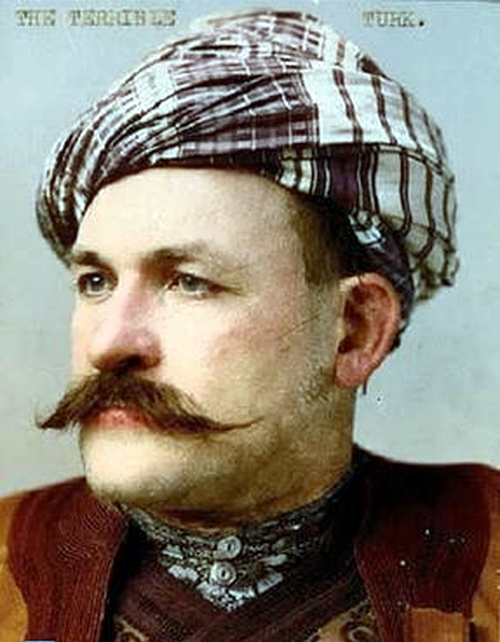
Public Doman
Colorized using Kolorize.cc
The first Terrible Turk was champion oil wrestler Youssuf Ishmaelo (Yusuf İsmail, Koca Yusuf). Youssuf was considered the leader of the Turks in Paris, billed as undefeated at home and abroad. An unconfirmed story says he defeated French champion Sabès in four seconds in his debut at Folies Bergère. His brutal match against fellow Turk Ibrahim Mahmout, in which the police were called in, cemented Youssuf’s reputation.
Youssuf’s size and strength, less than impressive physique and famous appetite became legendary. His boorish manners, and a training regimen that included club steaks, beer by the quart, and Turkish cigarettes added to his image as a Terrible Turk. None of this slowed him down apparently. He was described as having the agility of a cat and the power of a bear, in the ring.
His six month tour of the United States began in early 1898 at New York City’s London Theater. Promoter William Brady offered $100 to anyone that could pin the 6’2″ 300 pound Turkish giant in 15 minutes. The only taker was the lightweight wrestler George Bothner, who came in with a lot of bravado, especially for someone 100 pounds lighter. The Terrible Turk made quick work of him, leaving him injured in what is known in modern professional wrestling as a “squash match.” Youssuf declared that he was here to defeat the best America could offer, which he did, but not without controversy.
Youssuf vs Roeber: Near Riot in New York City
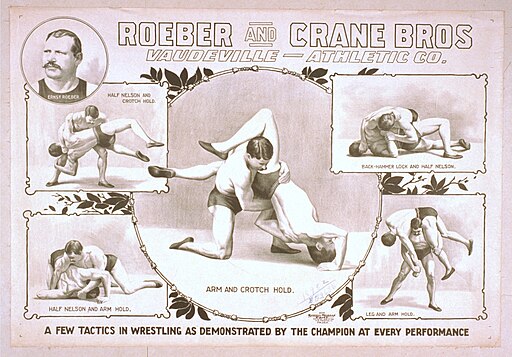
Roeber and Crane Bro’s Vaudeville-Athletic Co.,
Public domain, via Wikimedia Commons
In late March 1898, New York’s Madison Square Garden was literally packed to the rafters, to witness what should have been, the original Wrestlemania. Youssuf, the Terrible Turk was to face Ernest Roeber, considered the Greco-Roman world champion at the time. It was a no holds barred match, best two out of three falls, for $500 and 50% cut of the gate receipts.
From the start, a common problem arose: Youssuf was so much bigger than his American opponents that it was hard to lock up effectively. In this match, Greco-Roman rules applied so the Terrible Turk awaited the much smaller Roeber on the open mat. Roeber refused to meet Youssuf, instead he ran around the apron like the gladiator scene in Monty Python’s Life of Brian. Pinfalls only counted on the actual mat and Youssuf had enough of the German-American “champ” refusing to wrestle.
The trouble was caused by the fact that Youssuf, who is is known as the “Terrible Turk” almost frenzied, with anger at being unable to get his opponent to come on the mat and wrestle, gave him a push which sent Roeber flying off the stage to the ground, five feet below. Roeber was unconscious for a few minutes, but was finally revived, and it was discovered upon an examination that he was unable to continue, and the referee, Hugh Leonard, awarded the match to Roeber on a foul.
New York Times: March 27, 1898
The crowd went wild as only an 1890s crowd could. They screamed for blood and rushed the platform yelling “lynch him!”. The Terrible Turk continued to gesture to the crowd that is wasn’t his fault, but probably didn’t understand what “kill the Turk!” meant. The police held off the mob as he was rushed to his dressing room. This was the Terrible Turk’s only recorded loss on his American tour.
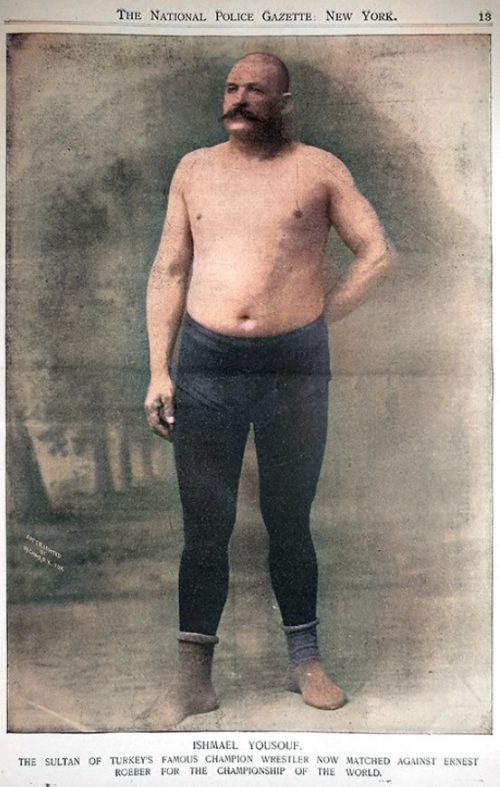
From: National Police Gazette (1898)
Public Domain – Colorized
A rematch on April 30th, at New York City’s Metropolitan Opera House was declared a no contest. Youssuf was getting the upper hand when things got chippy. After getting knocked post to post, Roeber took an illegal swing at the Terrible Turk and hit him in the nose. Their trainers and even the timekeeper, heavyweight boxer Bob Fitzsimmons, got involved and started fighting the Turk’s manager. The police were called once again, and restored order after a fight broke out in the crowd.
Terrible Turk Squashes Horrible Greek
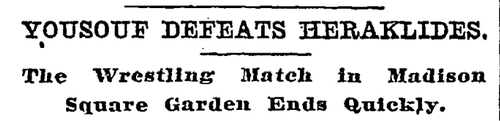
Youssuf’s final matches were less controversial, making quick work of George Heraklides the “Modern Titan”. The Greek strutted out to the ring like a modern “babyface”, he was just missing the entrance music. The Terrible Turk crushed him Greco-Roman style in 37 seconds. When the Greek recovered, he was beaten in a Catch style match in 3 minutes. About a year later, Heraklides would show up again during a Terrible Turk encounter…but as an imposter Turk!
Final Match: Evan “Strangler” Lewis
What is known today as a “sleeper hold” was once known as the “strangle hold” and was supposedly invented by Evan Lewis. He was the original “strangler” of wrestling and was the American heavyweight champion when he took on the original Terrible Turk at the end of June 1898. It was high stakes in front of a capacity crowd, best two out of three falls, with the strangle hold barred. However, it seemed something was lost in translation as Youssuf apparently used it anyway. Regardless, the Strangler, one of the most feared wrestlers of his day, admitted “the Turk is the better man.”
Lost at Sea: La Bourgogne Disaster
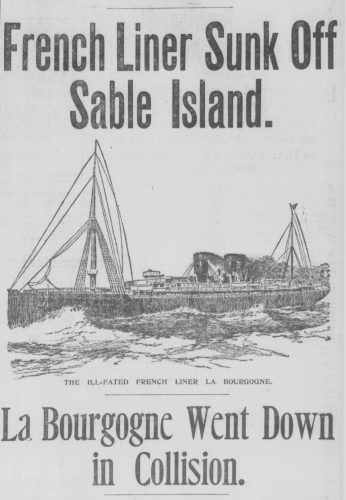
Youssuf Ishmaelo did not appreciate the treatment he received in the States, with possibly the exception of eating six meals per day. He had saved most of his American winnings and planned to return to Turkey to open a cafe. He would never make it, as the original Terrible Turk was lost at sea in July 1898, during one of the most horrendous sinkings in modern times.
When the French liner La Bourgogne struck another vessel off Cape Sable, Nova Scotia, the crew saved themselves and took the lifeboats. Meanwhile, male passengers drew knives and forced their way to the boats. 725 people were aboard, 163 survived, including half of the crew. The most shocking of all was out of 200 women passengers, only one survived and no children.
After the tragedy, and the report that “Youssuf the Terrible Turk” was aboard, apocryphal stories emerged about his last desperate moments. When La Bourgogne was sinking, he was one of the dagger wielding men tossing women and children aside as he attempted to board a lifeboat. A survivor described to the Associated Press his encounters with the Terrible Turk during the voyage.
After the collision Liebre says, he saw Youssuf struggling in a crowd of drowning passengers, beating them off with a stiletto and shoving them aside trying to reach a boat. He failed, however, and went down.
Boston Daily Globe: July 8, 1898
Victims of the sinking were still being reported months after the tragedy. The Boston Globe ran a story on August 20th 1898 about a Cunard freighter finding floating bodies and wreckage. One body of “exceptionally large size” was assumed by the crew to be the Terrible Turk.
Dragged Down by His Winnings
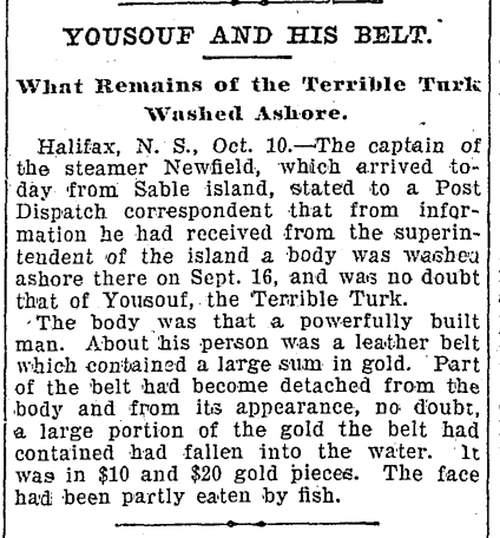
Later stories, spread by his manager William Brady, told how Youssuf was very suspicious, demanding to be paid in gold coins, which he carried at all times in his money belt. He was also very cheap, spending little of his winnings and amassing potentially up to 40 pounds in gold coins. This huge wrestler, along with his gold ballast, jumped aboard an already full lifeboat, knocking everybody overboard. The Terrible Turk sunk like a stone, weighted down by the thousands of dollars in gold coins around his waist.
The story of the money belt became part of sporting myth, many researchers eventually dismissed it. However, as I was going through newspaper accounts (thank you Boston Public Library) I found a story that seems to corroborate the money belt story:
The press did not mourn the Terrible Turk’s demise. They reported the stories of his final moments as a fitting end to this prototype “evil foreigner” character. Things are different in his homeland of Turkey however, where his wrestling exploits are still remembered and respected. The original Terrible Turk is a legend of the Ottoman-era Kırkpınar contests and better known today by the honorific title: Koca Yusuf.
The cat was out of the bag: Americans would pay good money to see these “devious” foreigners in the ring. No time was lost in getting more Turkish wrestlers to the US. Shortly before Youssuf’s demise at sea, stories were spread by his former French manager, that more Terrible Turks would be arriving. The next one, it was said, was an even better wrestler, the only one to defeat Youssuf in competition.
Part II will explore the exploits of the next Terrible Turks: Adali Halil – the “Sultan’s Lion” and the giant Ali Nurullah Hassan.
Sources/More Information
Eurozine: The Life and Death of the Terrible Turk by Graham Noble
Hackenschmidt, G. The way to live: Health & physical fitness. London: Health & Strength, Ltd. 1911
Halil Adali Wrestling Record – Pro Wrestling Historical Society
Kurtdereli Memet Biography (in Turkish)
Newspaper Archive: Accessed via Boston Public Library
ProQuest Historical Newspapers: Accessed via Boston Public Library
Turk Network Magazine: An Era of the Terrible Turks by Mehmet Ali Munir
Welcome to the Hippodrome Podcast
Yılmaz, Tayyip: Geçmişten Geleceğe Kırkpınar. Edirne, Rep. of Turkey, 1998

