
Editor’s Preface: This is part four on how and why Gloucester, Massachusetts lost so many fishermen in the 19th century. Be sure to read parts one, two and three.
The drifting vessel was coming directly for us; a moment more, and the signal to cut must be given! With the swiftness of a gull she passed by, so near that I could have leaped aboard, just clearing us, and we were saved from that danger, thank God! The hopeless, terror-stricken faces of the crew we saw but a moment, as they went on to certain death. We watched the doomed craft, as she sped on her course. She struck one of the fleet, a short distance astern, and we saw the waters close over both vessels, almost instantly, and as we gazed, they both disappeared. Then we knew that two vessels of the fleet would never again return to port.
Fisherman’s Memorial and Record Book (1873)
Of all the fisheries during the darkest years out of Gloucester, the winter fishery on Georges Bank was the worst of all. What made it different, both out at sea and within the community was the suddenness of extreme tragedy. Long before the existence of reliable weather forecasts, Georges Bank had the potential to decimate Gloucester’s fishing fleet overnight. It was like a bomb going off, bringing death, financial loss and untold collateral damage among the fishing families.
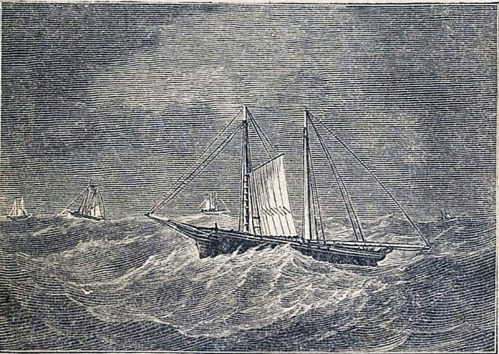
These perils have made of Georges a vast burial ground, where the bones of the fishermen are moved with the changing tide, or lie buried far beneath the sands of her treacherous shoals. A vast sepulchre, swallowing up many a young man in the pride of his youth, many a middle-aged toiler upon whoso earnings a loving family were dependent, and many an aged one whose voyage of life, at best, would not have continued but a few years longer.
Fisherman’s Memorial and Record Book (1873)
It was the fresh halibut industry that started the fishing boom on Georges Bank, but eventually they would dwindle while cod seemed limitless. Halibut fishermen eventually left for more distant grounds, and Georgesmen now mainly caught cod. Another branch of the industry opened up in the 1860s with the arrival of a lucrative winter haddock fishery. Fresh fish, with the exception of halibut, was mostly centered in Boston, while Gloucester was dominant in salt fish, mackerel and fresh halibut.
With strong market forces at play, captains and crews needed to strike while the iron was hot. Tales of quick trips, loading up on prime halibut, cod or haddock, enticed fishermen to risk winter fishing on Georges Bank. Big money, in the form of two-months pay in ten days, could be won or lost by how fast the fish were caught and landed.
As for the fishermen, they often had to go against better judgment for the sake of job security. In 1866, Gloucester had over 340 fishing schooners with about 4,600 resident fishermen, not counting the numerous transients that passed through. Getting a site on one of the best vessels was difficult. Missing a trip, for whatever reason could mean the loss of a job for a fisherman, but especially due to sickness or injury. You had to prove not just your ability but your reliability as well. With these factors, the toll on men and property would only escalate as many had no choice but to fish in deadly conditions.
The extreme schooner designs, especially by the 1860s, were dangerous enough on their own, at least in hindsight. Add in the giant waves, shallow water and tidal currents of Georges’ best winter cod grounds and the danger grew exponentially.
The Georges Handliners
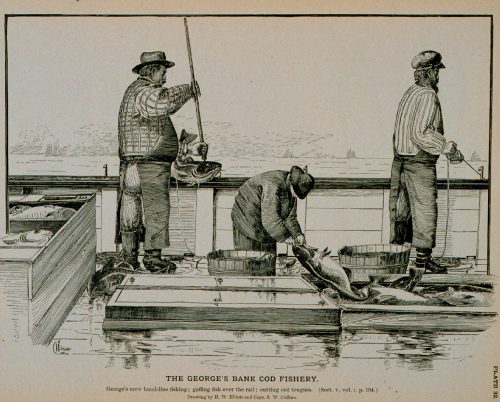
From: The Fisheries and Fishery industries of the United States (1884)
The Georges Bank fishery was originally seasonal, starting in February when the vessels could obtain an insurance policy. By the late 1870s, the fierce competition compelled both the fishing and insurance companies, to allow the vessels to fish year-round on Georges. It was pursued most intensely in winter and early spring, when cod arrived in vast numbers to spawn on the “winter fishing grounds”.
This was the territory of the Georges handliners, an area far too dangerous to set out the dories used in other fisheries. Skippers with nerves of steel needed to fish in the most dangerous spots, often cheek to jowl with the competition as the spawing cod moved along this section of rocky or “hard” bottom.
Some skippers direct the crew to stop fishing when a vessel comes along making inquiries of this nature, so as to mislead them. There is some justification for this practice in winter time, since the greatest peril arises from too much crowding, and there are plenty of men in charge of vessels who are reckless enough to anchor “right on top” of another vessel if they should see the latter haul in half a dozen fish.
Fishermen’s Own Book (1882)
Each year, no matter how many vessels and men were lost, the competition grew along with the market’s demand for both fresh and salt fish. Gloucester had 163 schooners in their Georges Bank fleet in 1880, catching over 27 million pounds of cod and over 1.1 million pounds of halibut in 1,430 trips. An incredible amount of fish, especially considering the primitive methods used on Georges.
The Georges fleet were of the latest designs, but fished in the same fashion as the earliest colonial fishing boats: eight to ten men lining the rail, managing several lines of baited hooks, in sight of breakers, 100 miles offshore. The men fished along the lee rail, allowing the current to push the hooks out from the schooner to avoid tangling. Keeping the fishing lines untangled and on the bottom was a constant chore, even in fair weather. As the tide and wind worked against each other, the schooner’s hull would swing and sway on the anchor cable.
On a strong tide, it could take a fishermen over 20 minutes to haul in a cod or two and almost twice as long for a large halibut. It took a special breed to be a successful Georgesman: strong, single-minded, and fearless. The early 1880s saw Georges attract about 1200 of the best, if not the brightest fishermen among the Yankees, Canadians, Irish, Portuguese and Scandinavians.
Each handline had two baited hooks separated by a “spreader” and a large lead sinker to keep it close to the bottom. Handline fishermen then hauled in those heavy, weighted lines against the current, hopefully with two large codfish hooked. The catch was cleaned, with the “tongues” and livers saved as secondary products.
Early Tragedies on Georges Bank
The big disasters on Georges Bank began with three vessels and 21 men during the April Gale of 1837. It may not have been the very first incident on Georges, but it is the first that that has been recorded with any detail. The schooners FAIR AMERICA, BENJAMIN FRANKLIN, and VESTA each had a crew of seven, including the captain. The practice of insuring these “Georgesmen” was just beginning as two out of the three lost vessels were insured.
Early on the disasters on Georges were infrequent, they wouldn’t reach staggering numbers until the winter fishery was in full swing. During the 1840’s annual losses on Georges Bank were small, however the 1850’s started with the loss of 39 men from four schooners in. The next year the Georges fleet was spared somewhat, with the loss of only vessel and her crew of eight. 1852 saw five vessels and 32 men go down on Georges, four of them in gales during March and April. It was the only branch of Gloucester fishing that had losses of life that year. The year 1854 is an early example of how the vessels and crew sizes were starting to increase, as 21 men lost their lives on Georges, but from only two schooners.
The 1860’s are arguably the deadliest decade in American history, with Gloucester already losing men before the first shots were fired at Fort Sumter. Out of 73 lives lost in 1860, 48 were from five vessels lost on Georges Bank. By the time of the Civil War, the disasters were becoming an almost yearly occurrence. During the war years, a man from Gloucester had a better chance of surviving the battlefield than winter fishing on Georges.
Georges Bank Disasters of the 1860s
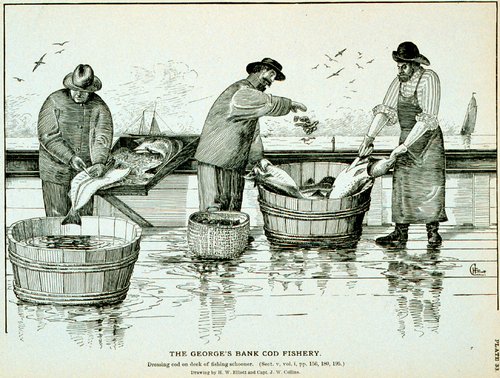
From: The Fisheries and Fishery industries of the United States (1884)
On Monday evening, February 24th, a terrific gale from N.W., suddenly burst upon out fishing fleet on George’s, where there were about seventy sail, anchored in close proximity to each other. Not having sufficient warning of the blow, they were unable to heave up, and it is expected that the missing vessels came in collision with each other and went down with all on board.
Cape Ann Advertiser: March 28, 1862
The 1862 February gale took out 13 schooners on Georges, each with a crew of 9 to 10 men. Among the 120 men lost in this storm were some of Gloucester’s best skippers. Two vessels, the BORODINO and QUICKSTEP were abandoned at sea and due to how close the schooners were to each other, the crews were able to be rescued by “narrow escapes.” Those vessels that did survive the storm were lucky to get out alive.
Nearly every vessel met with more or less disaster, losing cable and anchors, booms, masts, or were so badly stove up as hardly to be able to get back to port. One by one they came along until the number narrowed down to thirteen, who with their crews had left port for their last fishing trip.
Fisherman’s Memorial and Record Book (1873)
Two months into 1862, Gloucester had lost 138 fishermen, creating 70 widows and 147 fatherless children. All but nine of these men were lost on Georges. 1863 was favorable to the Georges fleet, the Confederate raider TACONY proved the real threat, sinking six vessels in June. There were two bad storms on Georges in 1864. The February gale took two vessels and 18 men, followed by 57 men from eight schooners during the March 22 storm. 1865 was a reprieve for Gloucester, as no lives were lost in the Georges Bank fleet.
1866 was another favorable winter the Georgesmen, Two vessels sank in the warmer months with no losses, but one vessel was lost in October with a crew of eight. 1867 saw an early hurricane or tropical storm arrive offshore on August 2nd with 18 men lost. The 1860s on Georges Bank ended with five vessels and another 31 men lost, most of them in the gale of March 1869.
Georges Bank Disasters of the 1870s
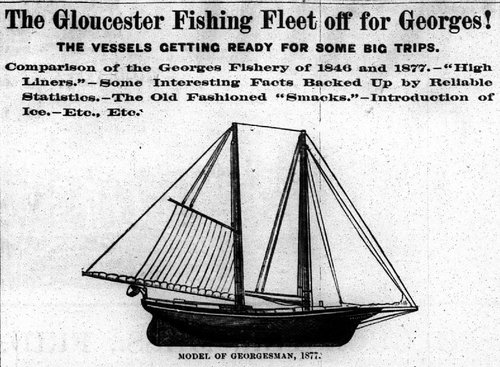
Cape Ann Advertiser: February 2, 1877
The new decade continued the trend of losses on Georges Bank with four vessels and 30 men, plus another seven washed overboard from other schooners. The March gale was the scene of an amazing tale of survival for one of the Georges fleet. The scenario described was quite common in a storm on Georges, the fact the crew survived however, was nothing short of a miracle.
The gale of March 13th, 1870, proved quite severe on Georges, and the schooner AUSTERLITZ, of this port, was so badly disabled that it became necessary to abandon her on the Banks. On Sunday night, about eleven o’clock, she was boarded by a heavy sea, when the cable parted, and the schooner falling suddenly astern, brought so great a strain on the rudder as to break the braces, and it was forced up through the arch-board, badly damaging the stern, and causing the water to pour in rapidly, when the vessel settled into the sea. No time was to be lost, as the schooner was fast filling, and the crew went speedily to work and shifted the fish forward to lighten her aft as much as possible. The bulk-head in the cabin was then cut away to get at the leak, and all the bed-clothing stuffed into the apertures, which checked the flow of water considerably. By active work at the pumps the vessel was kept afloat until morning, when the schooner RIVERDALE was spoken, and, on learning their condition, took off the crew.
Cape Ann Advertiser: March 25, 1870
1871 was a true disaster as ten vessels, many only a few years old, were lost on Georges Bank during a series of storms. Gales in February, April and September sent 63 men down with their schooners, while another six fishermen were washed overboard during the year.
By 1873, the Fisherman’s Memorial and Record Book records 93 schooners and 708 lives lost in the Georges Bank fishery. This macabre tally was more than half the total losses for Gloucester over the previous 42 years. This would be more than enough for any fishing town, but sadly, Georges was not done taking Gloucester schooners and their crews to the bottom.
The February Gale of 1879
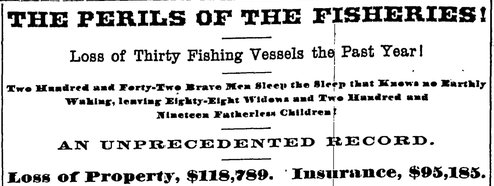
Cape Ann Advertiser: December 12, 1879
The February Gale of 1879 was something Gloucester had never seen before or since. A single storm took out over 140 men on 13 Georges Bank schooners, leaving 56 widows and 150 fatherless children. A disaster this great made newspapers far inland, who attempted to explain the plight of these fishing families. Over $28,000 in donations came in to help the families from across the nation, but the losses kept mounting. Another 100 Gloucestermen would be lost in other branches of the fisheries before the year was out.
Georges Bank Disasters of the 1880s and 1890s
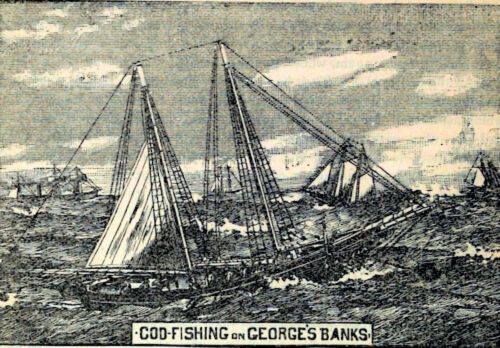
From: Fishermen’s Own Book (1882)
The new decade started off favorably for the Georges fleet with only one vessel sinking, but the crew were taken off. 1881 saw a single fisherman lost on Georges, a 24 year old from Cape Breton was washed overboard while dressing fish. The next years would not be so gentle.
Five Gloucester schooners and 64 men were lost on Georges in 1882. Three vessels were lost in a February gales and two more in a storm in March.The next year, five vessels were lost on Georges in the November Gale. There was a memorial service held in mid-December for the lost fishermen, but was held too soon. A gale hit Georges Bank on December 28, 1883 that sent four more vessels down. About 140 men were lost on or near Georges by the end of the year.
Improved fishing schooner designs began to turn the tide, but the fact that schooners anchored so close to each other meant the danger was still there. Fewer vessels were going down with all hands during the winter storms, but there were still many of the older, more dangerous clipper schooners fishing. Big winter gales were still taking out these older vessels into the 1890s. The losses continued, but the days of multiple vessels going down in a Georges Bank storm were thankfully ending.
High Risks for High Rewards
In 1865, schooner EVERETT STEELE, Capt. Cash, brought in 75,769 pounds codfish, and stocked $2,824.55, the largest stock ever made in a single trip to Georges. The cook realized $184.04 as his share. A pretty good fortnight’s work. Average share of crew $130.
Fisherman’s Memorial and Record Book (1873)
As of 1873, this was the best single trip to the most dangerous fishing ground in the days of sail. About $2500 in 2026 dollars for two weeks of perilous work. Most vessels did not approach these numbers on a single trip, nor was there a guarantee that future trips would be so profitable. All things considered, a dedicated fisherman on Georges could give his family a comfortable existence over a harsh New England winter. All he had to do put his life on the line.
Of course looming over their shoulder was the acknowledgment that the next trip could be their last. True in every aspect of fishing, but all the more likely the more winter trips these men took. But Gloucester fishermen, and the Georgesmen especially, were well aware of the risks and took them anyway. Not all of this of course was due to simple economics, the culture of those who work the sea has much to do with winter fishing on Georges.
A fisherman, like all seamen have to do all the things landsmen have to do and much more, just to make a living. Especially in the age of sail, this bred a certain sense of superiority and many took on needless risk simply for the challenge. Many Georges fishermen started off when young and single, but continued the same lifestyle once married with children. If the challenge proved successful and profitable, there was no reason to stop. Now with a family dependent upon that next big trip, there were even more reasons to continue.
At what a fearful sacrifice this branch of the fishing business is prosecuted, and yet there is no probability that it will be discontinued. There are bold men who will be willing to pursue this hazardous occupation, as the chances for success are such as will lead them to run the risks; and then again, these men cannot afford to be idle, and the hope of good weather and big trips are such, that they cannot resist the temptation, in spite of the many dangers which encompass the business.
Cape Ann Advertiser: April 15,1864
Sources/More Information
Cape Ann Advertiser, Gloucester Daily Times. Digitized by Sawyer Free Library/Advantage-Preservation
Down to Sea: Men Lost Fishing From Gloucester in the 1800s
Fitz Henry Lane Online by Cape Ann Museum
Dearborn, H. A. S. “Correspondence of Gen. Dearborn No. VIII.” Boston Courier, 4 Feb. 1839. Nineteenth Century U.S. Newspapers. Gale Primary Sources.
Goode, G. Brown: The Fisheries And Fishery Industries of the United States. Government Print. Office, Washington 1884-87.
Morris, John: Alone At Sea, Gloucester in the Age of the Dorymen (1623-1939). Commonwealth Editions, Beverly, MA 2010.
Nineteenth Century U.S. Newspapers, Gale Primary Sources via Boston Public Library
NOAA’s Historic Fisheries Collection/NOAA National Marine Fisheries Service
Proctor Brothers: The Fisheries Of Gloucester – From the First Catch by the English in 1623 to the Centennial Year 1876. Proctor Brothers Publishers, Gloucester MA 1876.
Proctor Brothers: The Fisherman’s Own Book. Proctor Brothers Publishers, Gloucester, MA 1882.
Procter, George H. The Fishermen’s Memorial And Record Book. Proctor Brothers, Gloucester, MA, 1873.
Smith, Sylvanus. Fisheries of Cape Ann: a Collection of Reminiscent Narratives of Fishing And Coasting Trips, Descriptive Stories of Sandy Bay And the Harbor, Also Some Interesting Comment On Fisheries Legislation And Cause of the Decline of the Fisheries, With a Prophetic Glimpse Into the Future. Gloucester, Mass: Press of Gloucester Times Co., 1915.

