
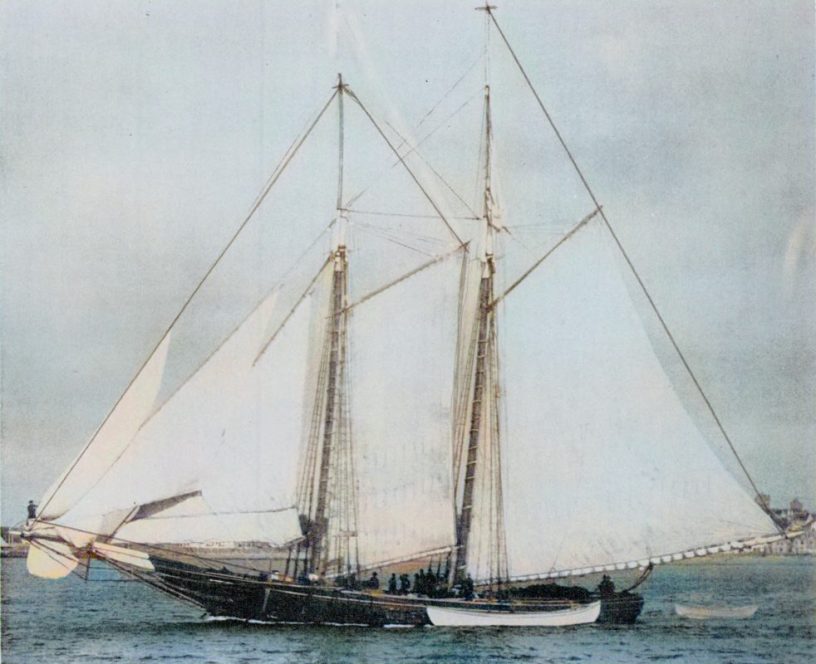
Editor’s Preface: This is part three on how and why Gloucester, Massachusetts lost so many fishermen in the 19th century. Be sure to read parts one and two.
Fishing schooner design had remained virtually unchanged since its 17th century origins. There was little need for change, since fishing methods remained mostly the same. With new fishing grounds, new fishing methods and new markets arriving in the early 19th century, the old designs became economically obsolete. In every branch of the New England fisheries, most of it now centered on Gloucester, sailing speed was becoming a major factor in schooner design. The symbiotic relationship of the Gloucester fishermen and the Essex shipbuilders at this time cannot be overstated, as their contributions to sailing vessel design and construction transcends the commercial fishing industry.
The market forces that urged Gloucestermen to seek new grounds, were influencing schooner desing by the 1830s. The growing mackerel fishery saw more American vessels fishing in Canadian waters, often in violation of treaties. Americans used their fastest schooners, mostly nimble double-ended pinkies, to poach mackerel before patrol vessels could seize them. These “clipper pinkies” were an early attempt to construct fast sailing fishing schooners for the Gloucester fleet. Their double-ended hulls were made sharper, especially in the bow, but still retaining a seaworthiness that is legendary.
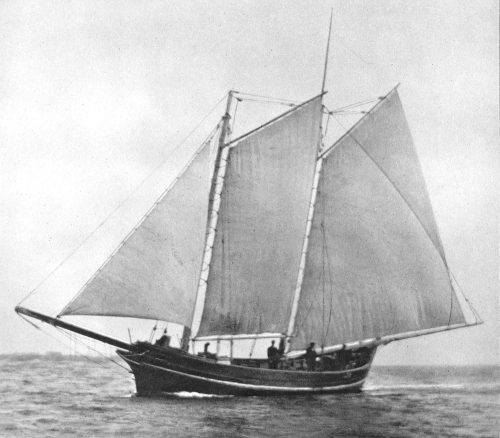
She was active until the mid-1920s
The clipper pinkies were considered fast for their era, but were considered “clumsy” decade later. Fishing was changing, and Gloucester fishermen stopped ordering pinky schooners by 1845. Vessels of this era retained the older, late-Medieval concept known as the “codfish head and mackerel tail” philosophy of design. A buoyant hull, built for capacity, not speed, with a very full bow, almost barrel shaped. It was a proven, but very slow way of sailing for profit that hadn’t changed much since the days of Columbus.
The salt bankers of the 1830’s had evolved from the earlier schooner design known to later generations as a “heeltapper.” The “bankers” had higher bulwarks and a lower quarter deck than the heeltappers, which better suited hand line fishing off the rail. However they shared the very full, bluff bows and stubby spars of the earlier designs.
1846 saw Gloucester’s vessels first use ice instead of salt to preserve the catch of now-valuable halibut. By 1848 there was a full-fledged ice industry to supply the fresh fish fleet. The bankers and pinkies were not up to the task of making quick trips for fresh fish. As the Gloucester and Boston markets demanded more and more fresh halibut and cod, new designs emerged to meet the challenge.
The Sharpshooter Schooners
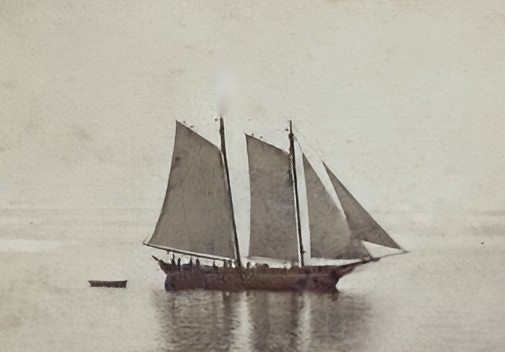
Restored image from 1865 stereograph card
In 1847 Essex shipbuilder Andrew Story attempted to improve the performance and looks of fishing schooners. He departed from the traditional banker and pinky designs with his schooner ROMP. The design somewhat resembled the hull of a Baltimore Clipper, with a sharp bow, shallower draft and much finer lines typical fishing schooners. Their raked masts, huge main booms and long bowsprits, complete with jib-booms, gave them a speedy appearance as well as performance. For their time, they were considered very extreme and were later known as sharpshooters.
ROMP may not even have been the first “sharp” schooner built in Essex. The shipbuilders had many customers on Cape Cod at this time, particularly Wellfleet, ordering fast, shallow-draft centerboard schooners for oyster freighting. Essex was insular, but they didn’t build vessels in a vacuum. Their customers did business along the entire Eastern Seaboard and beyond, leading to possible cross-pollination with fast Chesapeake schooner designs.
The ROMP was so extreme for her time, there is a story about how once the vessel was finally sold, it was hard to find a crew for the first trip. This apocryphal story has been passed down by noted maritime historians, even Howard Chapelle, without any evidence. What is most-likely is that Story built ROMP on speculation, a common practice among Essex shipbuilders.
Reports from the shipyards in the Gloucester Telegraph considered ROMP to be the finest vessel built for the fleet. The firm of Giles & Wonson purchased the vessel as she neared completion in Story’s shipyard. Once fitted out, She was fishing and quickly proved much better all-around than the old designs.
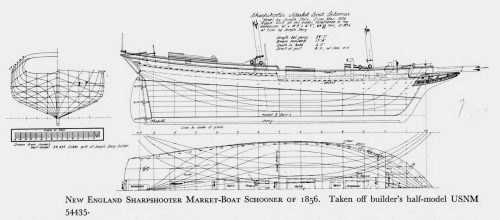
Source: The American Fishing Schooners, 1825-1935
Soon, new subspecies of fishing schooners known as a “market fishermen” and Georgesmen were built to bring fresh catches quickly to market for high prices. With a faster schooner loaded with ice, and a high demand for fresh fish, they would now race to port with the intent of “setting the market”. As with any soft commodity market, prices drop quickly as supply increases, so the spoils went to the swift. The chance for a big payday on a trip lasting days, not months, accelerated the growth of the fresh halibut fleet. As halibut were being fished out on Georges Bank, fresh cod and haddock for Boston took its place.
The high stakes and fast designs naturally led to impromptu “fishermen races” for both the best price and bragging rights among their peers. Captains didn’t have to just out-think the fish, they had to out-think the compettion. Getting to market with just the right amount of fish, at just the right time, could make a crew living legends and bestow a Captain with the coveted title of “Highliner”. Even the salt fish fleet of the distant banks was not immune to this influence of speed, soon the Grand Banks schooners sported the sharp bows and raked masts of the sharpshooters.
The Clipper and Extreme Clipper Schooners
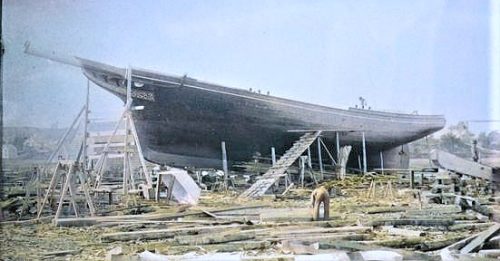
Willard Burnham shipyard, Essex, MA 1882
Colorized
The early sharpshooters were, by contemporary accounts, superior to all the previous fishing schooner types in terms of sailing ability and speed. The design would become very popular among American and Canadian fishermen within a few short years. However innovation was coming rapidly to the fisheries as competition to be first to market intensified. It would not be long before the sharpshooter design was eclipsed by designs with more extreme characteristics.
The early 1850s saw the first “clipper” style fishing schooners. In similar fashion to the famous clipper ships, the hulls of clipper schooners had sharper bows, with long, straight keels to get the most speed from their extensive sail area. Clipper fishing schooners exaggerated the traits seen in the sharpshooter to produce a larger, longer vessel with a shallow draft. Their low freeboard, large heavy bowsprits and tall spars made for an impressive sight when under full sail.
The idea was to eke out as much speed as possible, with the technology available at the time. Naval architecture was still a novel concept and debates still raged about what made for a good fishing design. While the early yachtsmen could sit and ponder at the drafting table, the Gloucester fishing fleet was evolving and experimenting with novel concepts in real-time. The best vessels didn’t catch more fish on their own, they also attracted the best captains and crews to the numerous outfitters and processors. This virtual arms-race to be the fastest to market was fierce in all branches of the New England fisheries, but felt the strongest in the mackerel fleet.
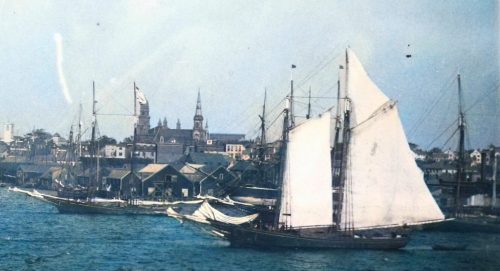
Colorized
The mackerel schooners, as a rule, spread more sail in comparison with their size, than any other vessels in the world, except perhaps the extreme type of schooner rigged yacht, which is essentially a development of the fishing schooner.
In consequence, every effort has been made by the builders to construct swift sailing schooners and the result is that many of the vessels composing the mackerel fleet are quite able to cope successfully with first class yachts of the same size.
Materials for a History of the Mackerel Fishery (1883)
Within the mackerel fishery, the need for speed was twofold: fishermen first had to find a school of fish to set their net before another crew. Once caught, the schooner had to out sail the competition to ensure a profitable trip before oversupply dropped the price. This meant the mackerel fishing fleet had economic reasons to further develop fast, shallow and heavily canvassed fishing schooners. The end result was the extreme-clipper style of fishing schooner with a wide deck and low freeboard to quickly get the catch aboard.
The mackerel and fresh halibut fisheries pushed the envelope as schooners got longer, faster, and manned by larger crews. While the mackerel fishery was pursued in generally mild weather, the best fishing on Georges Bank for halibut and cod, was in winter. Howling gales, a swift tide, and very shoal water began to expose the dangerous flaws in these new designs.
Fast, Beautiful, but Deadly
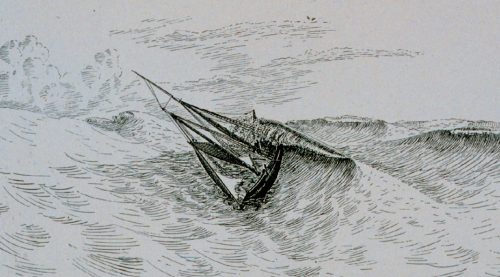
Drawing by H. W. Elliott and Capt. J. W. Collins
Credit: NOAA National Marine Fisheries Service
As the losses of men and vessels mounted on Georges Bank, local in Gloucester began to question, quietly at first, what was wrong with these new schooners? It was not their construction, as most of them were built of solid white oak by the master craftsmen of Essex. It was not their maintenance since owners, by and large, kept their vessels in very good condition. Eventually, it was shown the biggest culprit for Gloucester’s fishing losses in the 1860s and 70s, was the design itself.
The long, wide and shallow hulls of the later clipper designs had initial stability, but much less secondary stability. They were designed to sail more upright and did not heel as much in a strong wind as designs before and since. When conditions got bad on the banks, it was easy for this type of schooner to get knocked down on her beam end. If capsized, the vessel’s high center of gravity and top-heavy rig would not allow it to right itself and would go down. In the accounts of survival that were published, most of the vessels had to have their rigging and masts cut away after a knockdown to have any chance of making it.
The design of these clipper schooners also lacked good windward ability so it was difficult to ride out a storm or escape a lee shore. Even if a skipper on Georges Bank hauled anchor in the face of a howling northeaster, chances were his clipper schooner would not be able to sail off into deeper water. Like runaway freight trains, fishing schooners could be driven downwind, and into the rest of the fleet,
It was not only on this famously dangerous fishing ground that clipper schooners proved dangerous, it was anywhere they encountered severe winter weather. Cod and halibut schooners on the Grand Banks became top-heavy if the hull and rigging iced up. In this state, either anchored or attempting to “jog” in a storm, the shallow-hulled schooners were easily “tripped” by a boarding sea, and sent to the bottom. Fishermen called these waves “combers’ as they rolled across the deck.
It is hard to imagine how taking this kind of financial risk could be profitable to vessel owners – who could lose thousands of dollars per lost vessel. These fast yet dangerous fishing schooners would have been far less profitable if not for insurance.
The Role Insurance played
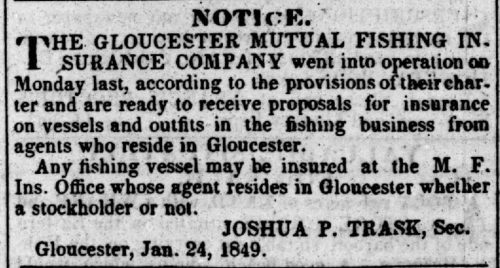
Gloucester Telegraph: April 28, 1849
The Gloucester vessel owners and outfitters created mutual insurance companies starting in the early 1840’s. This was in response to the difficulty of insuring the fishing fleet using traditional marine insurance. Now the owners of the vessels, who knew the actual level of risk involved, could cover their inevitable losses. It should be noted that these insurance companies first arose with the rise of the Georges Bank cod and halibut fisheries, years before the arrival of sharpshooter and clipper schooners.
The insurance practices towards these fast and dangerous clipper schooners, encouraged the further development of profitable, but inherently dangerous designs. Otherwise, it is difficult to imagine fishing companies surviving economically without good insurance to recover the ever increasing losses. It is also difficult to imagine how a traditionally conservative-minded industry like commercial fishing, would throw money and men away without some financial security.
An insurance policy could from the Mutual Fishing Insurance Company would recoup most of the hull’s value. A schooner valued at $4,000 in 1861, would typically be insured for $3,300 to $3,500. The fleet owners then went to the Essex shipbuilders, would start building a replacement with a handshake and a modest down payment. Most vessel owners didn’t fish by this time and with insurance, they had little to lose by ordering faster fishing schooners.
Meanwhile, the chance to make a year’s pay in a few months ensured plenty of men were willing to risk winter fishing on Georges Bank. When a vessel went down with all-hands, the lost crew cost the owners nothing. Waves of Irish, Azorean, Nova Scotian, Newfoundlander and Scandinavian immigrants were arriving in town just in time to fill that void. For many an immigrant arriving in the early 1860s, your choices were either to risk death fighting Confederates, or risk death fighting Mother Nature. For those that chose the latter, they discovered it could be more deadly wearing oilskins than a Union Army uniform.
Fish or Freight Bait
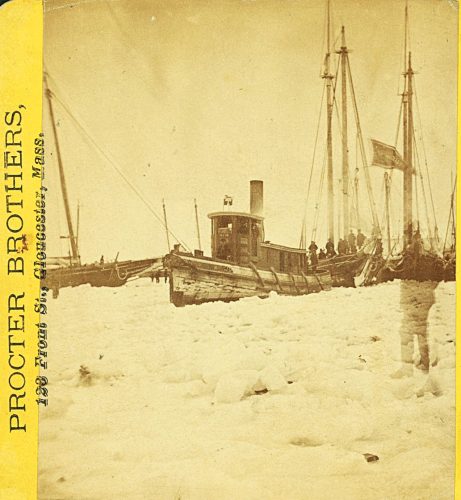
Gloucester Harbor ice to deliver bait (1875)
Detail from Proctor Bros. stereograph card
The insurance companies considered some vessels, especially the extreme clippers of the mackerel fleet, too risky for winter fishing. There was still a role to play, if they were insurable, by the late 1850s and the arrival of dory fishing, the need for bait greatly increased. The solution was to sail to Newfoundland with skeleton crews, where barrels of frozen herring were brought back as bait.
This herring industry enables our vessels to prosecute the Bank fisheries in February and March, when vast schools of fish resort thither, and the largest fares are brought in; it furnishes a valuable article of nourishing food for the New York, Boston and other markets, at a low price; and within the last year it has opened a profitable commerce with Sweden, from which the best of results are anticipated.
Cape Ann Advertiser: February 23, 1877
The Newfoundland frozen herring trade was critical for the Gloucester fishing fleet as it supplied most of the bait for the Banks fleet. However this lifeline of the fisheries had its own perils, and several fishing schooners went down freighting bait back to Gloucester.
There were some extreme clipper schooners of the late 1870’s deemed so risky, that they were uninsurable once the weather turned. These owners of these vessels had no choice but to tie up for the winter until being overhauled in the spring for the start of mackerel season.
The Push for Safer Fishing Schooners
For too long the owners, the press and the public in Gloucester took the increasing tragedy as the price of doing business. The vessels were insured and men were willing to take the risk, so there was little incentive to change. But after the tragic winter of 1879, even the fishermen were becoming reticent to fish when gossip told of an oncoming gale. The murmurs along the wharves and shipyards eventually made its way into a public forum and helped begin another pivotal moment in schooner design.
A Debate on Design
The Proctor Brothers had become the de-facto voice of the Gloucester fishermen with their memorial books and their newspaper, the Cape Ann Advertiser. It was natural for any kind of debate about fishing vessels would be printed here first. They published a series of opinion pieces in 1882 regarding the seaworthiness of the Gloucester fishing fleet.
One of these experts was Captain Joseph W. Collins, the outspoken head of the US Fish Commission. The former Gloucester halibut fisherman had seen first-hand, how these “improved” clipper designs were so dangerous. Captain Collins was an advocate of the old Pinky schooner concept, stating that in the 15 years of pinkies fishing on Georges Bank, only two were lost. He compared that to the 34 “modern” schooners that were lost between 1864-1871.
An anonymous rebuttal by “Sea Horse” in April 1882 supported the extreme clipper models then in style. However there really wasn’t much of an argument, unable to provide much proof beyond anecdote and poetic turns of phrase.
“Vidas” meanwhile, was obviously a shipbuilder and most likely Dennison J. Lawlor of Boston. Lawlor was highly respected as a builder and designer, creating many fast and stable pilot schooners along with the more extreme styles favored by the fishing industry. He laid out the problems with clipper style fishing schooners in an anonymous op-ed on April 28, 1882:
Thirty to forty years ago our fishing schooners from 60 to 70 tons were built about 7 1/2 feet deep in the hold and 17 or 18 feet wide. We have since gone on increasing the length and breadth, without increasing the depth, till now our schooners of a hundred tons and rising are only of about the same depth that our 60 ton schooners used to be.
Vidas continues, explaining how this wide but shallow design gives a false sense of security:
The increased stability of these vessels in smooth water allows greater length of spars to spread more canvas to increase their speed, but we overlook the fact that this may be the means of their destruction in a rough sea. When one of our wide, flat schooners capsizes, the weight of her spars and top-hamper is so great that there is not leverage enough in the ballast to raise them from the water, and she lies helpless on her side, and fills and sinks…
Vidas stated that adding two feet of depth to the design would allow for deeper ballast, and for the same sized masts to sit deeper in the hull. This would bring the center of gravity down enough that the schooner would right itself if knocked down.
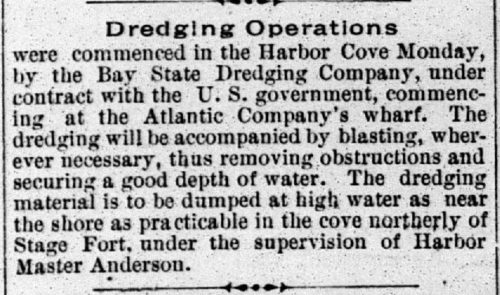
Vessels would often sit in the mud at low tide
Cape Ann Advertiser: February 8th, 1889
The conservative nature of fishing kept schooner design stagnant until the late 1840s. Now, that same conservative approach was keeping schooner design dangerous to their crews. Much like the arrival of ROMP in 1847, a radical change was needed to shock the system. But within the high risk/high reward world of commercial fishing, any change that improved safety, could not sacrifice profitability.
1880s: The Marriage of Speed and Stability Under Sail
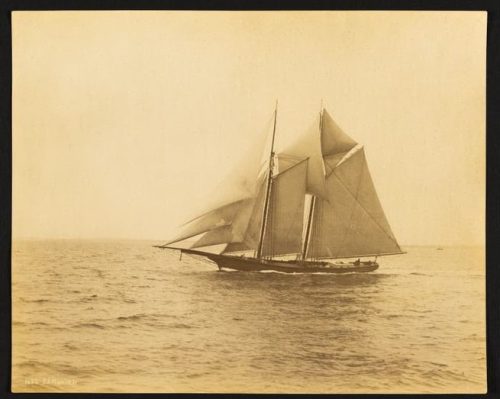
Her lofty clipper style sailing rig is accompanied by a deeper hull for stability.
Change in the fishing industry can be like an avalanche. There seemed to be little to no movement toward safer fishing schooners until the mid 1880s, and then change washed over the fleet in the blink of an eye. Not only did the next generation of fishing schooner become safer, they got larger, and faster. Finally, the Gloucester fishing schooner would have performance that matched its beauty. This begins the famous era of “flying fishermen” that created some of the most beautiful working sailing vessels of all time.
The latest in schooner design would be incorporated into the GRAMPUS, the new US Fish Commission research vessel. However, before she was finished several, deep draft fishing schooners were already completed along the lines first suggested by Dennison Lawlor. The first was Lawlor’s ROULETTE in 1884, which caused a stir when she arrived in Gloucester for her first mackerel season. The Essex shipbuilders were quick to notice this and several other schooners, based on ROULETTE, were launched in the next few months.
Plumbstem Schooners
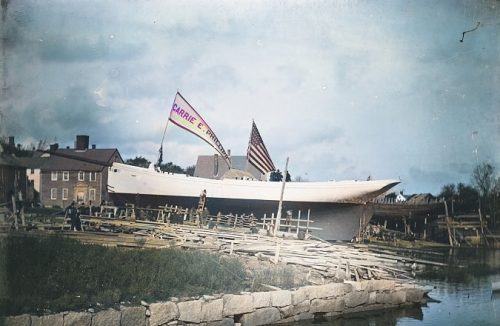
Note the straight or “plumb” bow, lighter spike bowsprit and deep hull.
Colorized
Another change besides hull depth, was to the look and shape of the bow. Lawlor’s well-regarded pilot schooners did not carry the clipper bow, heavy bowsprit and jibboom of fishing schooners. Instead, they had nearly straight or “plumb” stems and a much lighter bowsprit. These “plumb-stemmers” also did not carry the elegantly carved trailboards at the bow, giving the vessel a much less top-heavy appearance.
One of the earliest of these plumb stem schooners was the ARTHUR D. STORY, designed by Lawlor and built by A.D. Story. She was powerful and sturdy and ride out a storm nearly as well as an old pinky schooner. The STORY had the performance and carrying capacity to help start a new branch of the Gloucester fishery: sailing to Iceland for halibut.
In 1887, the famed racing yacht designer Edward Burgess, had his plumb-stemmed CARRIE E. PHILLIPS built by A.D. Story. She introduced the lighter “spike” bowsprit into the fishing fleet along with the use of steel cable for standing rigging. The PHILLIPS was the latest word in fishing schooner design for two years, when Burgess married these improved schooner lines with the looks of the classic clipper style.
Fredonia Style Schooners
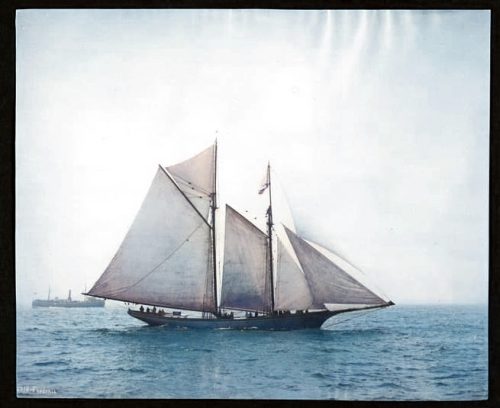
Built in Essex by Moses Adams for J. Malcolm Forbes
Schooner yacht later converted to fishing
Colorized
Before the end of the decade another new design arrived that married looks and performance to another level. An entire generation of yacht-like, deep draft fishermen were inspired by the Burgess-designed FREDONIA. The deeper hulls, fairer lines and better buoyancy were now giving fishermen a fighting chance against mother nature. They looked like yachts, they sailed like yachts, sometime they even raced like yachts, but there was no denying these were built to be working vessels.
The vessels of the Gloucester fishing fleet were handsome, fast, profitable, and safer than ever. However even with more seaworthy designs, the loss of life did not suddenly stop. Fishing out of Gloucester remained a very dangerous occupation, but the years when the fleet could be decimated in a single storm were over, for the most part. Unfortunately, by the 1890s most of the damage had been done, in a span of about seventy years over 3,700 Gloucestermen were lost. Gloucester’s home grown sons as well as her newest arrivals paid the heaviest price to work in a cold and angry sea.
Sources/More Information
Cape Ann Advertiser, Gloucester Daily Times. Digitized by Sawyer Free Library/Advantage-Preservation
Chapelle, Howard Irving. The American Fishing Schooners, 1825-1935. United Kingdom, Norton, 1973.
Down to Sea: Men Lost Fishing From Gloucester in the 1800s
Fitz Henry Lane Online by Cape Ann Museum
Goode, G. Brown, Joseph W. Collins, R. E. Earll, and A. Howard Clark. Materials for a History of the Mackerel Fishery. Washington: Government Printing Office, 1883.
Goode, G. Brown: The Fisheries And Fishery Industries of the United States. Government Print. Office, Washington 1884-87.
Morris, John: Alone At Sea, Gloucester in the Age of the Dorymen (1623-1939). Commonwealth Editions, Beverly, MA 2010.
NOAA’s Historic Fisheries Collection/NOAA National Marine Fisheries Service
Proctor Brothers: The Fisheries Of Gloucester – From the First Catch by the English in 1623 to the Centennial Year 1876. Proctor Brothers Publishers, Gloucester MA 1876.
Proctor Brothers: The Fisherman’s Own Book. Proctor Brothers Publishers, Gloucester, MA 1882.
Procter, George H. The Fishermen’s Memorial And Record Book. Proctor Brothers, Gloucester, MA, 1873.
Story, Dana A. The Shipbuilders of Essex: A Chronicle of Yankee Endeavor. Ten Pound Island Book Co., Gloucester, MA, 1995.
 The Historical Vagabond