
In February of 1996 I was getting blown around Prague’s Old Town Square on a cold and blustery day. My traveling companion suggesting getting out of the wind behind the famous astronomical clock of Town Hall. This is where the remaining vendors from the Christmas fair were selling crafts and food. Over steaming mugs of hot chocolate we explored the kiosks for souvenirs, the exchange rate was so incredible back then that we could afford to bring back some cool trinkets. It was the smell of charcoal and sound of smithing led me down the line to get may favorite Czech souvenir.
A smith was literally minting replica coins using and old-school die. Not only was it cool to watch, but it was nice and warm by his small fire. He stamped out a heavy bronze coin and punched a hole in the top to make it a necklace. He handed it to me and it was still warm when I held it. His wife put a leather cord around it and I wore it the rest of my trip.
This is the Joachimsthaler, originally a large silver coin that is the basis for the all-mighty US Dollar and every dollar before or since. Although it had a relatively short lifespan compared to later dollars, its influence and its etymology has come down to us today. The word dollar is interesting in that its origins really have more to do with geography than money or currency.
Details of a Joachimsthaler
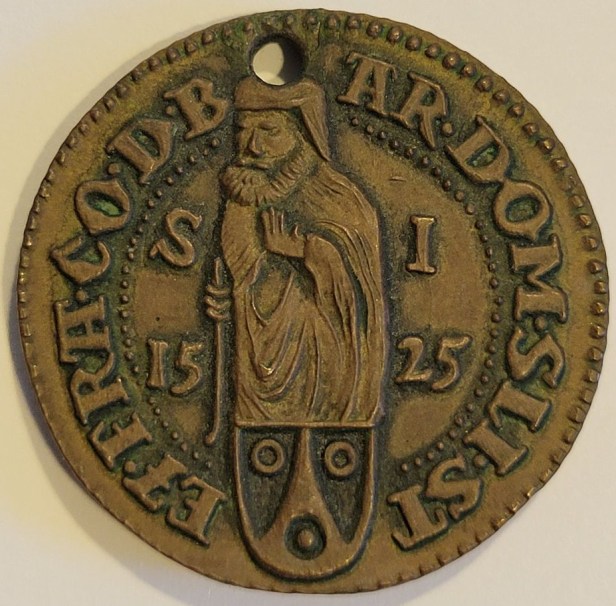
My replica 1525 Joachimsthaler has details that differ from what I can find online. Whether this reflects the various styles, or just artistic license, I’m not sure. It also has variants of the mottoes seen on the authentic coins. After finding some obscure numismatic information I think it may have to do with my replica being of a smaller denomination and not a full Joachimsthaler.
Credit: Historical Vagabond
I have seen conflicting information on what side of the coin is obverse. I will call this side the obverse which has Saint Joachim, father of Mary marked by the S and I. He is standing atop a coat of arms. The motto around the edge reads:
AR•DOM•SLI•STE7•FRA•CO•D•B
– Arms of the Lords of Schlick, Stefan and his seven brothers, Counts of Bassano

Credit: Historical Vagabond
The reverse side shows the crowned Lion of Bohemia. The motto declares under whose rule this coin was made.
LVDOVIC•PRIM•DEI•GRA•REX•BOEM
– Louis the First, by the grace of God King of Bohemia
The design and mottoes on the coin have a pretty interesting story behind them and shed light into the origins of the Joachimsthaler.
The Silver Mines of Joachimsthal – Jáchymov
In the early 16th century a large silver deposit was discovered in a Bohemian valley. The valley, or “thal” in contemporary German, was named in honor of Saint Joachim and became known as Joachimsthal. Today the area is known by its Czech name Jáchymov, but arguably better known for its historic uranium mines and spa.
By 1518, the Konstantin silver mine was in operation and producing large, fine, silver coinage for the Kingdom of Bohemia. Since the coins were being minted in this valley, they took on the name Joachimsthaler in German and Jáchymovský tolar in Czech. Joachimsthaler simply means “of the Saint Joachim Valley”.
Svornost Mine

Credit: Mejdlowiki, CC BY-SA 3.0 , via Wikimedia Commons
The mine that started it all in 1518 is still in operation and is the oldest operating mine in Europe. The original silver mine was renamed in 1530 to Svornost and continued to supply silver and later cobalt until the 19th century. Then the mine switched to extract uranium, which ceased in 1949, but is still a source of radioactive water for the local thermal spa.
The Counts of Schlick
The mines of Joachimsthal, located in the Ore Mountains were under the auspices of the Schlick family, Counts of Bassano. The original Joachimsthaler coins were minted by Counts Stephen and Hieronymus along with their brothers, as mentioned on the coin, and bore the family coat of arms. My replica only has the family arms, not their other holdings, which may mean I have a half thaler or even a quarter thaler.
In the midst of silver there was a great shortage of silver coin and small change. The Schlicks therefore were very anxious to set up a mint. They summoned a mint-master from Nürnberg, and an experienced die-cutter, Ulrich Gebhart, who made some specimens. They applied to King Ludwig of Bohemia and to Markgraf George of Ansbach as an intermediary.
-Schlick of Bassano
Coinage for King Louis II

Credit: Public domain, via Wikimedia Commons
The Joachimsthaler was minted as coinage for the Kingdom of Bohemia, during the reign of King Louis I, who more famously ruled Hungary as Louis II. The young King inherited two kingdoms in financial crisis along with the looming threat of Ottoman Sultan Suleiman the Magnificent. Louis was a teenager when the Joachimsthal silver deposit was found and he didn’t live long enough to see if these newly minted silver coins would have made a difference in his Kingdoms. Sultan Suleiman took advantage of the sorry state of the Hungarian forces and their inexperienced ruler.
In 1526, the 20-year old King died, along with Count Stephen and most of the Hungarian Royal Army during the Battle of Mohacs against the Ottoman Empire. It was a disaster, and opened the doors for further conquests by the Turks. In the aftermath of Mohacs, Louis’ well-circulated Joachimsthaler was used, in at least one case, as a symbol of vengeance.
A Symbol of Hungarian Resistance

Credit: Public domain via Wikimedia Commons
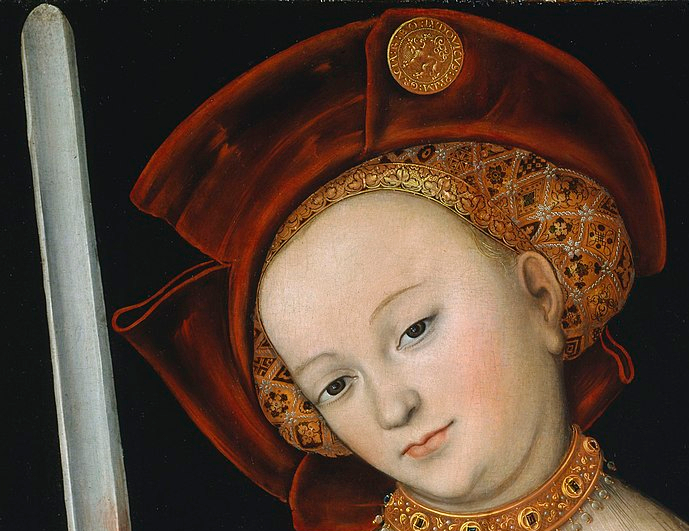
The Old Testament motif of Judith with the Head of Holophernes was popular among Renaissance artists going back to Donatello. The German artist Lucas Cranach the Elder made several different versions of this subject, one of which has a Joachimsthaler showing the side with the Lion of Bohemia, attached to Judith’s hat like a pin. For those living with the threat of an Ottoman invasion, or for those who kept up the fight, there was nothing subtle about the message being conveyed.
The Currency of Empires
Joachimsthaler coins continued to be minted in Bohemia, but competition arose. As more silver deposits were discovered, the convention of naming the coin after the “thal” it was minted in, took shape. In time the various large silver coins were generalized into the thaler and later into taler.
The Bohemian Joachimsthaler weighed in at a hefty 29g of silver but was just one of several thalers widely used within the larger sphere of the Holy Roman Empire. After the various German realms of the Empire began regulating coinage, the Reichsthaler became the dominant silver coin shortly after its introduction in the 1560’s.
The Reichsthaler’s popularity outside Germany spawned numerous national currencies based on the thaler, all of which contained about 25g of silver. The rijksdaalder of the Dutch Republic and rigsdaler of Norway and Denmark are such examples. It is from the Low German dialects that the original thaler becomes daler and later, dollar in English.
Credit: Pubic Domain – Wikimedia Commons
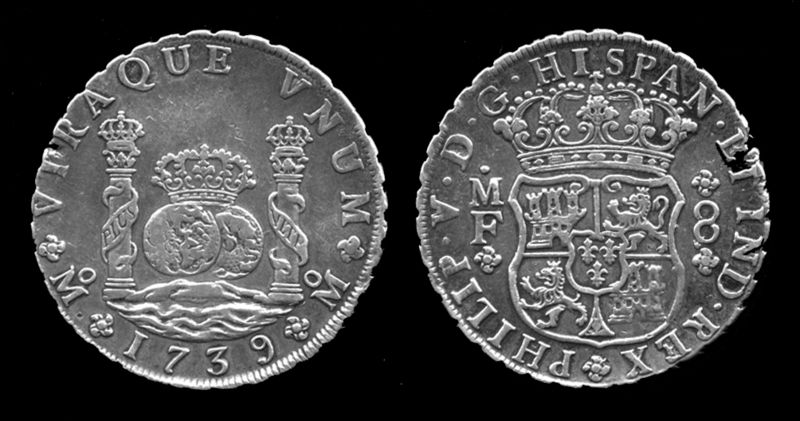
English speakers would use the word dollar for any silver coin equivalent to the thaler. For American colonists, more often than not, that coin was the Spanish piece of eight, or peso. This is one of the world’s most famous coins, and went by many names, including the Spanish dollar. These Spanish coins, minted in New Spain, would remain legal tender in the United States until the Coinage Act of 1857.
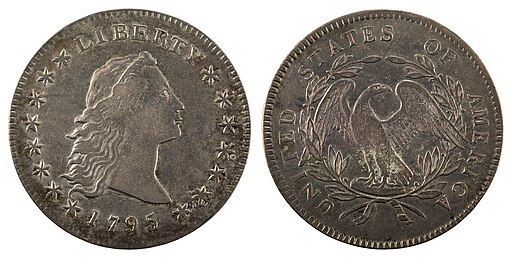
American colonists were well accustomed to using dollars and so adopted them as a final break from England. The first US silver dollars were first minted in 1795 to be divided into 100 cents and on par with the Spanish dollar in value.
The original Joachimsthaler was not the first big silver coin used for trade in Europe, but it certainly has the longest legacy. Although currencies are no longer backed by silver or gold, the Joachimsthaler coins set a standard for reliability that all dollar currencies have attempted to emulate…some more successful than others.
Sources/For More Information
Dollar from Online Etymology Dictionary
Louis II of Hungary from Wikipedia
Shaw, William Arthur. The History of Currency, 1252-1894: Being an Account of the Gold And Silver Moneys And Monetary Standards of Europe And America, Together With an Examination of the Effects of Currency And Exchange Phenonmena On Commercial And National Progress And Well-being. 3d ed. — New York: Putnam, 1896.
Svornost Mine from World Heritage Association
Václav Němec, Hana Gernešová: The Czech State of Jagielons (in Czech)
 The Historical Vagabond
Seriously good tour through time and culture! 💯
Thanks!
Thanks for this history of the dollar coins.
My pleasure, thank you for visiting.