

Did you consider yourself a “mack” during your New Jack Swing phase in the early 1990’s? Did you wear your baggy jeans backwards and call yourself “daddy mack” like those kid rappers from Kris Kross? Well, I’m pretty sure you didn’t know back then, that this old euphemism for a pimp, might be based on a small fast swimming fish: the mackerel.
So, how did this flashy little fish become associated with prostitution? Much like a previous post on haddock, this legend may stem from old European folklore on sea life.
Mackerel Etymology
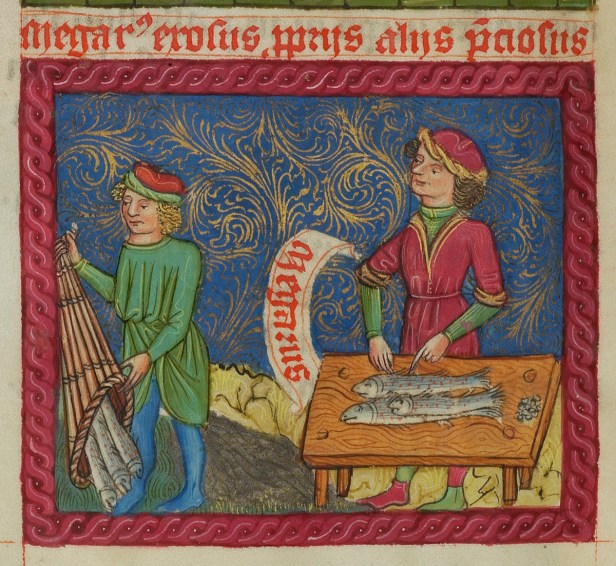
Morgan Library & Museum
It shouldn’t surprise anyone that the origins of the word mackerel are obscure. The Medieval Latin name for mackerel was megarus, as seen in the bestiary detail above. According to Wiktionary, the modern form of mackerel comes from Middle English makerel, which derives from Old French maquerel. This in turn is from Middle Dutch makelare or makelaer meaning “broker” or “peddler.”
The Online Etymology Dictionary goes into a little more detail and comes to a similar conclusion but also adds another French connection. Old French maquerel most likely derived from the Latin macula, meaning “spot” or “mark”. This describes the various mackerel species pretty accurately since some are striped but others have spots.

French to English Dictionary – 1570.
Credit: Internet Archive
The older French word for mackerel would evolve into the modern maquereau and picked up some baggage along the way. Somehow, at some point, this fast, flashy, spotted fish took on a name with a double entendre associated with prostitution. Maquereau became a slang term for “pimp” in French. But why would mackerel have an association with sex peddling in medieval and early modern Europe?
Prostitution in Medieval Europe
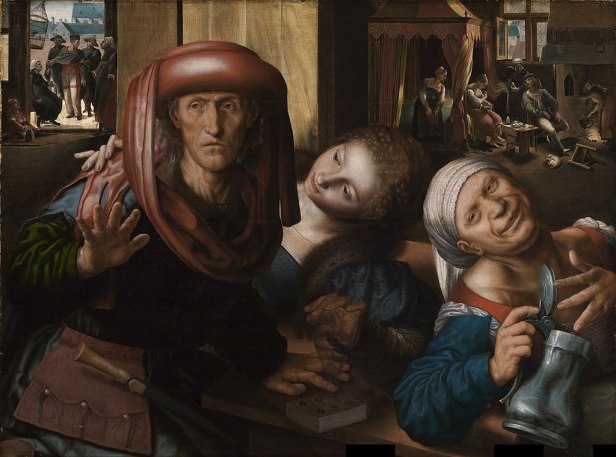
Public domain, via Wikimedia Commons
Both the Catholic Church and large urban centers throughout Western Europe had an uneven, but often pragmatic view on prostitution. It was often seen as a minor, but “necessary” evil. The rules and regulations were in a state of flux and varied from region to region. Generally speaking, it seems that the Continent was more lenient to prostitution than the Kingdom of England.
To set prostitutes apart from “decent” women, they were often restricted to certain parts of town today known as Red Light Districts. The Catholic Church also required prostitutes to wear special attire to set them apart, with each local government choosing the distinctive garments.
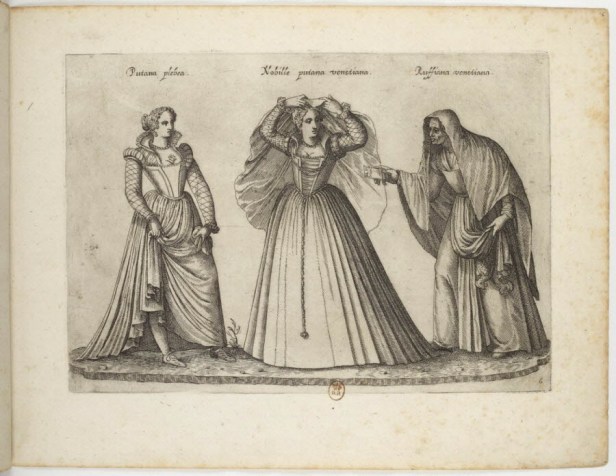
From Recueil de costumes étrangers… by Jean-Jacques Boissard ca 1580.
Credit: Bibliothèque nationale de France
For example, in Milan the garment of choice was a black cloak, while in Florence prostitutes wore gloves and bells on their hats (Richards, 119). According to Bullough, a citizen who found a prostitute clothed in anything other than the official dress had the right to strip them on the spot (Bullough, 182).
Prostitution in the Middle Ages – Decameron Web
Many cities during this time actually owned the brothels, which they leased to a brothel-keeper. These individuals could be either a women, known as a procuress, or more humorously, an abbess. Before the word “pimp” arrived in English, men who kept brothels were usually known as bawds, but the term could be applied to both sexes. In French speaking areas, maquereau/maquerelle was used for male and female bawds.
The Brothel-Keeper
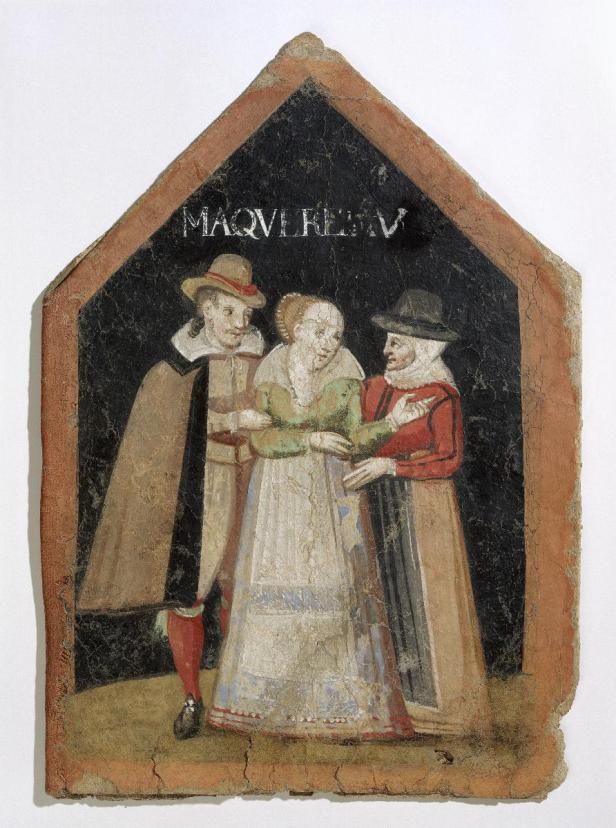
Credit: MAH Musée d’art et d’histoire, Ville de Genève
Brothel-keepers typically operated with 2-3 prostitutes and depending upon local laws and circumstances, could become very successful financially, if not socially. The social status of even the most successful pimps and madams, meant they could be guilty of violating various sumptuary laws. Consumption of finer food or more conspicuously, flashy clothes made of finer materials could be seen as evidence for attempts to rise above their station. You couldn’t buy your way into a higher social class.
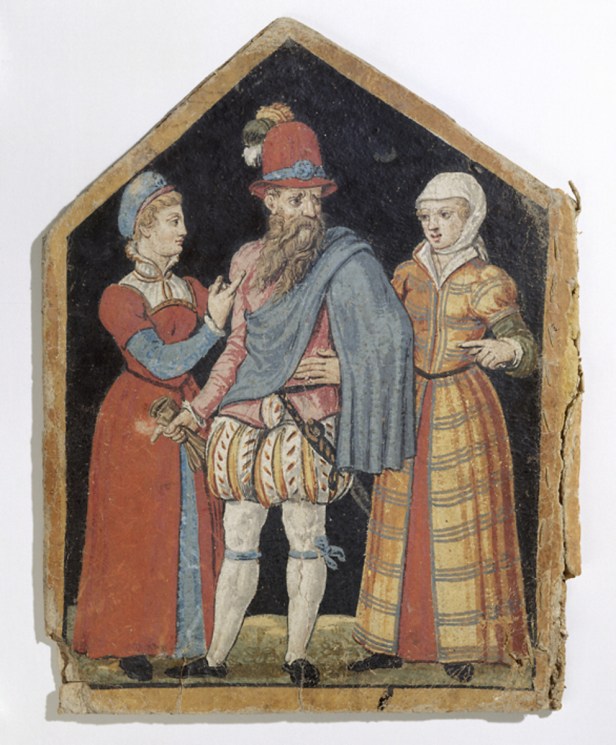
Credit: MAH Musée d’art et d’histoire, Ville de Genève.
Protestantism, especially of the John Calvin variety, took a harsher tone on prostitution in the 16th century. The crime of pimping was called maquerelage. If pimps and madams violated local laws, they would be subject to various punishments and fines. In 16th century Geneva, the heart of Calvanism, a convicted maquereau or maquerelle would have to wear a distinctive badge on their clothing similar to the examples shown above.
Mackerel as Sea Pimps
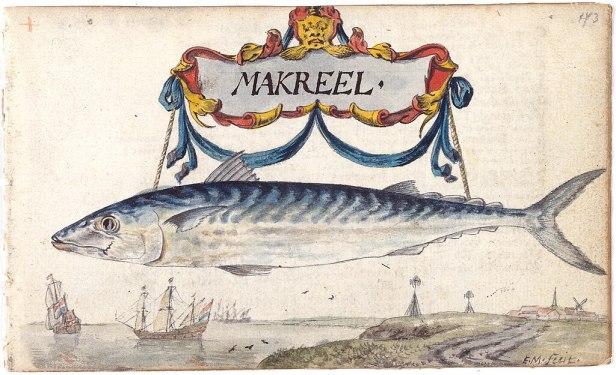
Successful and finely dressed pimps and madams, dressed as flashy as mackerels in Renaissance/Early Modern styles, seems like a plausible basis for some fishy folktales.
Mackerel species are migratory and so were important as a food fish when in season. Mackerel can be elusive and prone to boom and bust cycles. The people along the North Sea and the Mediterranean coast have awaited the springtime arrival of these fish for centuries. When abundant near the British Isles, mackerel was second only to herring in importance.
Without knowledge of the undersea realm, and nothing on TV for the next few centuries, Medieval and Early Modern Europeans had no problem filling in the gaps with vivid imagery. Some of this was carried over from texts surviving from Classical times, other tales may mirror aspects of life people saw in the cities.
Apparently the schools of brilliantly stripped mackerel looked as though they were herding more drab colored herring species into the shore. Somewhat resembling the well dressed pimps and their prostitutes in regulated attire. Below is a version of the mackerel myth from Ireland:
The French name ‘maquereau’ also means ‘pimp’ which most people associate with the mackerel’s brilliance of colours. There is, however, also a more entertaining explanation: As soon as Spring comes, the maquereau follows the young shad (marine fish related to herring that spawn in rivers), that are commonly called virgins, and brings them to their males and so they make a bawd of this fish. Unfortunately, this very precise and logical explanation doesn’t seem to be true.
It is a fun legend, based on seasonal fish migrations and overactive imaginations. After all, having this shifty and ostentatious fish be the pimp of the sea, would only mirror what people were seeing of God’s Hierarchy among the brothels of big European cities. Like a well-dressed maquereau, the small striped mackerel was low on the food chain, obviously living above his station and most likely on borrowed time.
There is no real telling when these legends arose, or when mackerel became synonymous with the sex trade, but legends of about flashy mackerels pimping out fish may have started in Medieval France or perhaps the Low Countries. This stretch of coast covers the Dutch/French language border, now in modern Belgium, making the Middle Dutch makelare (peddler/broker) a possible source for the French maquereau.
Geographically, this area was at the crossroads of trade routes. It was the center of the textile trade, where much of that expensive colored cloth was coming from. Both mackerel and herring were landed in the very same ports and were traded far and wide by the famed Hanseatic League. Ports are historically notorious for prostitution, with merchant sailors being a key demographic for brothels.
Seems like all the ingredients were in place. It wasn’t just wool and fish that were exchanged. At some point in time, the French alternate meaning of mackerel/maquereau must have jumped the English Channel to give a colorful backstory to the already colorful fish.
Mackerel Becomes an English Double Entendre
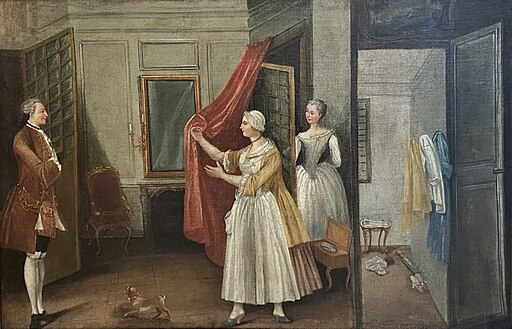
French School, 18th century.
Credit: Public Domain
Green’s Dictionary of Slang gives a fascinating and detailed chronology of the slang use of mackerel/maquereau/maquerelle in English. The earliest printed use of “mackerel” to mean a bawd in English was in the early 15th century, but only in reference to its use in French. How the use of the term arrived in English may have been thanks to printmaker William Caxton and his dubious translations.
William Caxton and England’s First Printing Press
The merchant and diplomat, William Caxton is claimed to have brought the printing press to England in 1476. Previously, Caxton was established as a printer in Bruges where French, Dutch and English could all be heard among the busy textile markets. It was here that Caxton began producing English translations of contemporary as well as classical works. He was a man of many talents, but his rushed translation style may have led to many French words being adopted wholesale into English. One example is the use of maquereau/mackerel for pimp in a 1483 translation of the works of Cato the Elder.
Nighe his house dwellyd a maquerel or bawde.
Slang And Its Analogues Past And Present – 1896
Considering how popular Caxton’s works were at the time, this may be the jumping off point where maquereau and mackerel take on the double meaning.
From the French Maquereau to the American “Mack”
Maquereau/mackerel’s pimping image eventually arrived in America, by way of English or more likely, from French. From maquereau, the French often shortened it to “mac”, which would have been just one of many French, Spanish and Creole words Africans would have been exposed to during the slave trade era. In the early years after emancipation, the concept of the “mac” became one of the many ingredients that found its way into American Black culture. Like music and fashion, the French maquereau underwent a metamorphosis and reemerged in a much cooler form, as the Black American pimp – the “Mack”.
It seems likely that the term originated from the French maquereau, a pimp. Probably the evolution of this term occurred in New Orleans, one of the origin cities of Black pimping in America, where French language influences remain strong.
Black players : the secret world of black pimps
From New Orleans, the term and its connotations could have easily traveled up and down the Mississippi in the time of French Louisiana. Real mackerel don’t swim in fresh water, but the “macks”were well established in St. Louis in the 19th century.
Lee Shelton aka Stagger Lee – The OG American Mack
When it comes to the American pimp, there is one mack who set the standard with his fancy clothes and badass ways. “Stagger” Lee Shelton, immortalized in American folk music after convicted of murder, was the archetype of every flashy movie pimp, gangsta rapper, and an untold number of horrible Halloween costumes.
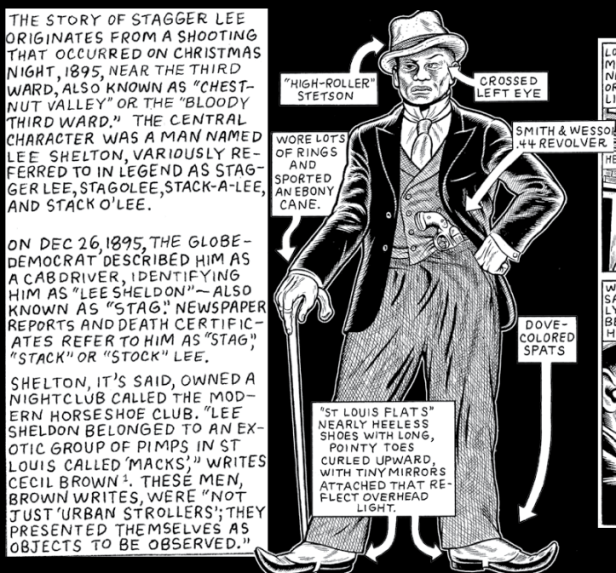
Credit: The Story of Stagger Lee by Timothy Lane/Riverfront Times
Stagger Lee and his fellow macks created a look still emulated today. The roguish flair, that menacing casualness, is the essence of the pimpin’ lifestyle. The style, the swagger, the brashness of the maquereau has transcended the world’s oldest profession. Today, a “Mack” in common English has more to do with the style and the attitude than the sex trade.
Don’t let that fool you though, plenty of pimps are out there keeping it real. In fact some of these mackerels school together for an annual celebration called the Player’s Ball.
So there you have it, the long migration of a small fish, dressed in flashy colors, being the source for the Mack Daddy and the garish image it conveys. Just remember, pimpin’ ain’t easy whether your on the streets hustling, or swimming in the lower end of the food chain.
Sources/More Information
Cotgrave, Randle. A Dictionarie of the French And English Tongues. London: Printed by A. Islip, 1611.
Farmer, John Stephen, and William Ernest Henley. Slang And Its Analogues Past And Present: A Dictionary, Historical And Comparative of the Heterodox Speech of All Classes of Society for More Than Three Hundred Years. London 1904.
Grose, Francis, A Classical Dictionary of the Vulgar Tongue. 3d ed., London: Printed for Hooper and Wigstead, 1796.
Grose, Francis, and Hewson Clarke. Lexicon Balatronicum: A Dictionary of Buckish Slang, University Wit, And Pickpocket Eloquence. London: Printed for C. Chappel, 1811.
Harper, Douglas. “Etymology of mackerel.” Online Etymology Dictionary, https://www.etymonline.com/word/mackerel. Accessed 8 August, 2024.
History of the Mackerel from Trinity College Dublin
Miege, Guy, A New dictionary French and English: with another English and French. T. Dawks, London: 1677
Milner, Christine; Milner, Richard. Black Players: The World of Black Pimps. New York London, 1973.
Prostitution in the Middle Ages – Decameron Web from Brown University
The Story of Stagger Lee: Riverfront Times/Timothy Lane. June 27, 2007
 The Historical Vagabond
Fascinating. A new term to me to add to my vocabulary. Is the son Mack the Knife related to prostitution?
A friend asked me this when I was doing the research. Mack the Knife was originally a German song about an English murderer named Macheath. My old German professor played us the original in class one time.
Interesting, I didn’t know.any of this. In fact I am so ‘not cool’, that I didn’t know about its use in 90s hip hop. 😊 Maggie
It was a lot of fun researching all of this. Thanks for reading
Very interesting!
Great job! Well researched. I had no idea, but am fascinated.
Thanks!
This is amazing, thank you!
Thanks for reading and please spread the word! I’ll make sure to check out your YT channel.