

When I was in 8th grade, we had to do an assignment on the Holocaust. There was a box of books to choose from and most of the class picked Anne Frank. If you don’t know already, I’m different and I usually have no interest in following the herd. I wanted another book and I found one in the pile that caught my attention.
It was called The Hiding Place and told the story of the ten Boom family from the city of Haarlem in the Netherlands.’s. While the Franks were hiding in Amsterdam, this Dutch Christian family risked their lives to hide Jews and Dutch Resistance fighters during the Nazi occupation. I remember enjoying the book and doing a report on it, but hadn’t thought on it again until 2001.
We were in Haarlem, on a daytrip from Amsterdam when we learned of the Corrie ten Boom House Museum. My girlfriend, now wife, had seen the movie years ago and as we walked past the unassuming building it jogged our memories. We decided to visit, but had to wait for the next scheduled tour, so we killed time checking out Haarlem’s main square. The entrance to the museum is down a side street and we joined a small group for a guided tour.
Looking back, this was one of those quirky, small museums that makes travel so much fun. I often have better, or at least more vivid memories of places like this than the big museums like the Van Gogh or Rijksmuseum.
The House and Clock Shop on Barteljorisstraat

Credit: Boer, Cees de (1918-1985), Noord-Hollands Archief
The house itself was built around the year 1600 by the Bailiff of Haarlem and is located on Barteljorisstraat, a main thoroughfare. Between 1837 and 1945, three generations of the ten Boom family lived in the house starting with Willem ten Boom. He owned a clock and watch shop on the first floor and his family lived above. At the start of World War II, Willem’s son Casper lived in the house and operated the clock store with his children: Betsie, Willem, Nollie, and Corrie ten Boom. In 1921 Corrie gained notoriety as the first female licensed watchmaker in the Netherlands.
A Christian Family of Distinction
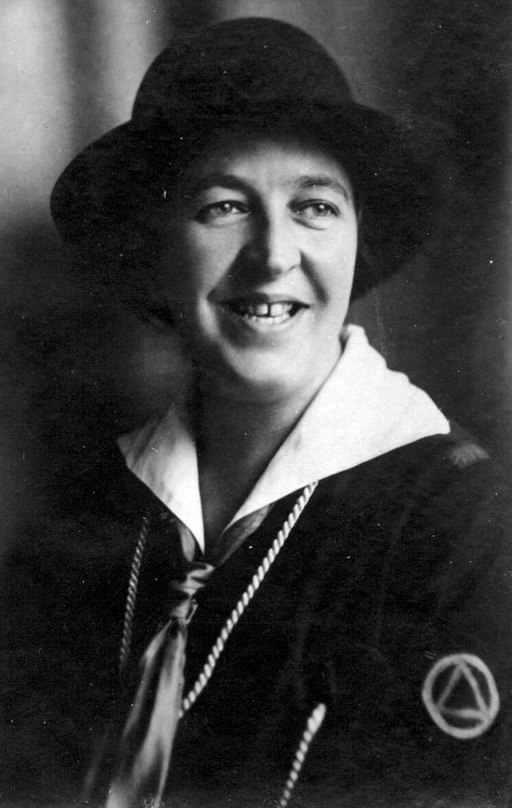
One thing that is central to the ten Boom family is that they took their commitment to the Dutch Reformed Church very seriously. They were also early fighters of antisemitism and supporters of a Jewish homeland. Grandfather Willem began a prayer group in support of the Peace of Jerusalem back in the 1840’s. In 1928 his grandson, Willem Ten Boom was awarded a Ph.D from Leipzig University for his thesis on racial antisemitism.
According to the Museum’s website, Corrie was deeply faithful at a young age, giving her life to Jesus at the age of five. The family’s faith and convictions would be put to the test after the Nazi occupation of the Netherlands in 1940.
Dutch Jews Under Nazi Occupation
The situation for Dutch Jews grew progressively worse as the occupation continued. Jewish registration began in 1941, followed by forced segregation as worker’s strikes led to the Nazi’s tightening their grip. Approximately 30,000 Dutch Jews would begin to go into hiding, often with the help of the Dutch Resistance.
The German authorities and their Dutch collaborators segregated Jews from the general Dutch population, and incarcerated 15,000 Jews in German-administered forced-labor camps. The Germans then ordered the concentration of Jews in Amsterdam and sent foreign and stateless Jews to the Westerbork transit camp in the northeast part of the country. Some of the remaining provincial Jews were sent to the Vught camp. As of April 29, 1942, Jews were required to wear a yellow Star of David on their clothing.
– Holocaust Encyclopedia
The summer of 1942 saw the first deportations from the Netherlands to Auschwitz. Over 100,00 Dutch Jews were deported, less than 6,000 survived. For those that went into hiding, most survived, but even still, a third were captured and murdered. Less than a quarter of the Kingdom’s original Jewish population survived.
For most Jewish fugitives, there really was nowhere to run. The ten Booms, starting with Betsie and Corrie began to aid Jewish families in finding safe houses in 1941. Soon the family went further, by creating their own safe house.
The Hiding Place
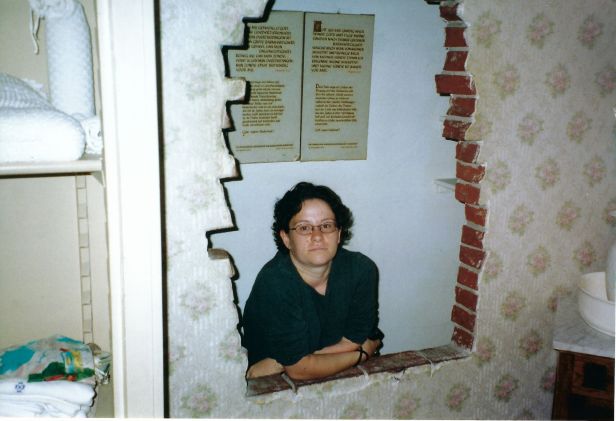
Credit: The Historical Vagabond
The hiding place was built slowly and secretly in an upstairs bedroom. I remember from the book how some members of the Dutch Resistance would pose as customers of the clock shop, but were sneaking in bricks in their briefcases. The new wall and a dummy window on the outside of the house concealed a small space that could conceal about six adults. Access to the hiding place was through a trap door inside a linen closet.

Credit: Historical Vagabond
An electric “panic button” was installed in a secret panel by the stairs to get the refugees to safety in case the Security Service came knocking. On the side street a window in the clock shop would display a triangular placard to let fugitives know the coast was clear. The house, family and coworkers became known as the “BeJe” – (bay-yay) Corries nickname for their address on Barteljorisstraat.

Credit: The Historical Vagabond
From 1943-44, the ten Boom family would have 5-6 fugitives living with them. While many were Jews hiding from the Security Service, the Hiding Place was also used by the Dutch Underground resistance movement. Sometimes it was a quick stopover, for others an extended stay, but the ten Booms did their best to live “normal” lives under Nazi occupation. They kept the mood light by playing music and at one point the housemates performed a play. During the time the Hiding Place was active, as many as 800 fugitives were saved.
Betrayal and Arrest
It is truly incredible the risks Corrie ten Boom and her family were willing to take because it was the right thing to do. The family paid dearly for their convictions as they were betrayed by a Dutch informant named Jan Vogel. On February 28, 1944 the BeJe was raided by the Nazi’s intelligence agency: the Sicherheitsdienst or SD. Among the 30 arrested besides Casper, Betsie, and Corrie were their brother Willem, sister Nollie and nephew Peter. Most of the arrested were later released, but Casper, Betsie and Corrie were taken to Scheveningen Prison.

Credit: The Historical Vagabond
However there was just a sliver of good news, as the security forces did not find the secret hiding place. Even after a two day search, the SD didn’t find the Hiding Place. While in prison, Corrie got a message:
All the watches in your cabinet are safe
Six refugees – four Jewish men and women and two Dutch Resistance fighters escaped detection and were moved to other safe houses. Three of the four Jews would survive the war, while one of the Dutch underground was later killed.
Imprisonment at Ravensbrück
Ten days after the arrests, Casper ten Boom age 84, died in Scheveningen Prison. Betsie and Corrie were also there, but Corrie was held in solitary confinement for months. The sisters were later transported to Camp Vucht, for political prisoners before transfer to the notorious Ravensbrück Concentration Camp in Germany.
Ravensbrück was an all women concentration camp located in the north of Germany. Life at Ravensbrück was almost unbearable, and it’s a section of the book that was really eye-opening for me as a student. I’m not a religious person, but I understand how faith can get you through the worst life can throw at you. For Betsie and Corrie, they wore their faith like suits of armor as they shared Jesus’ love with their fellow prisoners. The ten Boom sisters were like a single candle burning when all the others went out, which led to many of their fellow women prisoners converting to Christianity. Sadly, Betsie succumbed to the brutality of Ravensbrück at the age of 59. Corrie was able to endure a 12 days longer and was released. According to the book, her release was actually a mistake – or a miracle. She was scheduled for the gas chambers along with the rest of her age group.
Aftermath
Corrie ten Boom returned from Ravensbrück Concentration Camp during a severe famine at the end of World War II. This is sometimes known as the “hunger winter” of 44-45. I’ve talked to people who grew up during that time and food was so scarce that some families were eating tulip bulbs to survive. She picked up where she left off, now alone but still dedicated to do what was right in the eyes of God. She took in the disabled when they faced the threat of execution during the famine. After the war, she showed her country what real forgiveness looks like – creating a rehabilitation center to help the former Dutch co-conspirators, who were now ostracized and jobless.
Corrie traveled all around the world, to over 60 countries sharing her story and words first said by her sister Betsie while they were imprisoned.
There is no pit so deep that God’s love is not deeper still.
God will give us the love to be able to forgive our enemies.
After more than three decades of dedication, Corrie ten Boom passed on after suffering a stroke on her 91st Birthday.
Creation of the Corrie ten Boom House Museum
In 1983 the Corrie ten Boom Fellowship, a non-profit 501(c)(3) corporation purchased the BeJe house and began to restore it. The Museum was opened to the public in 1988 and continues to operate as a charitable organization in the spirit of Corrie ten Boom.
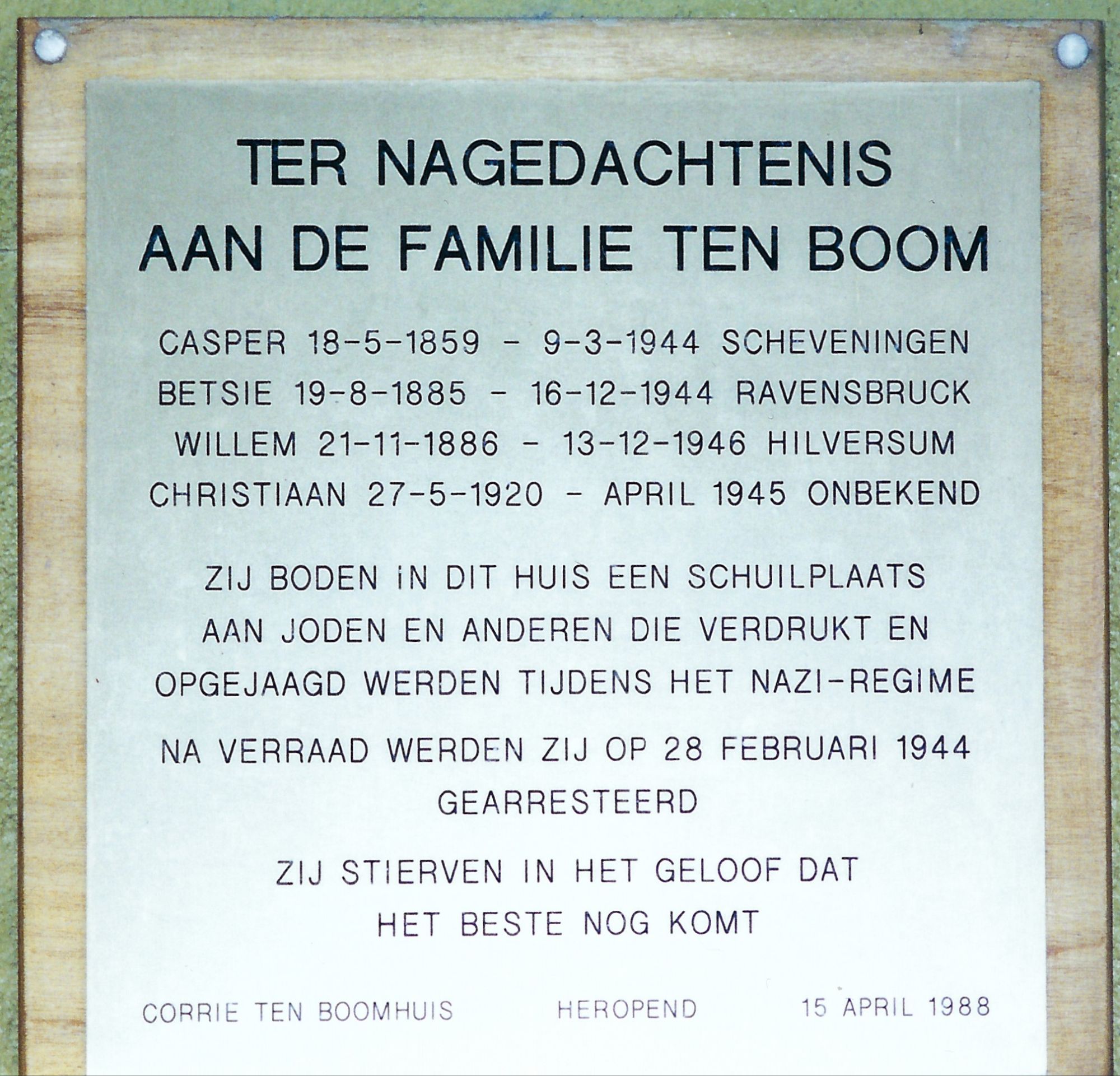
The ten Boom Museum is more than just a memorial…it reflects the spiritual strength and the active life in faith by means of exhibiting documents, photographs and other mementos. The house has been partly restored in the setting of that period, and carries a message for today.
Corrie ten Boom House Museum Official Brochure – 2001 edition
As we get further removed in time from the atrocities of the Holocaust and World War II, museums like the Corrie ten Boom House become much more important. Unfortunately it is all too easy to forget the lessons learned by past generations. This small Dutch home has a big story to tell: how the absolute worst cruelty humanity is capable of, often co-exists, and combated by, the most incredible acts of human kindness. Religious or not, we can all learn something from the selflessness of the ten Boom family.
Sources/More Information:
Corrie ten Boom House Official Website
Corrie ten Boom entry on Biography
 The Historical Vagabond
What a wonderful, selfless family. I’ll look for the book. Thanks for introducing it Maggie
Thank you for visiting!
Thank you for the photos and description of the ten Boom home and description of their amazing courage. I had read the memoir by Corrie ten Boom, and I was glad to get a refresher on the details.
My pleasure, and thank you!
It’s fascinating how our beliefs shape our actions — some are willing to risk their lives for people they may not even know (I doubt the Booms personally knew all 800 people they hid — or did they?), while others choose to betray, putting countless lives in danger — and what for?
The ten Boom family’s selflessness should be a lesson to us all. Thanks for reading!
Thank you for this! I always loved the Ten Boom family story. For school I have to do a presentation on museums form world war ll. Corrie’s legacy first came to mind. It was nice to re-remember this families courage and dedication in speeding the gospel despite the difficult times.
My pleasure, and thank you for visiting my site!
This is massive history. My daughter just finished the book and we are working on the project. We are going to Amsterdam this summer and I would never have thought about Haarlem . Now I am definitely going to see it. Thank you for this.
So glad to hear this. Haarlem is a great and easy day trip from Amsterdam. Make sure you book your Ten Boom house tour ahead of time. Also visit the church – it has an incredible organ once played by Mozart.