
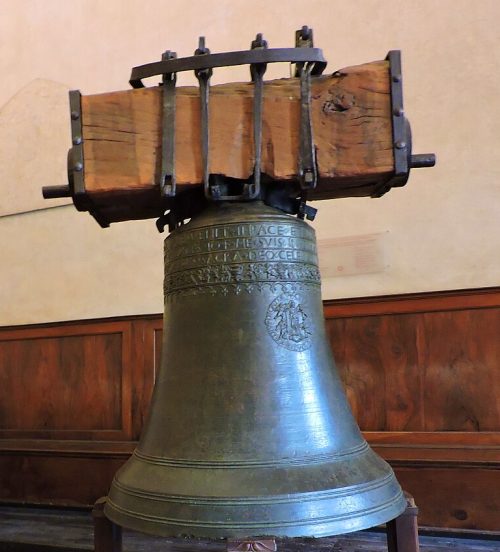
During our 2001 visit to Florence, the San Marco Museum was the third church complex we visited on day one, according to my very sparse notes. Among the world famous frescoes of Fra Angelico, there are many other works and artifacts worth examining. Volumes have been written about the works of Fran Angelico, but comparatively little about another important piece in the collection. It is an old, banged-up church bell, with an impressive pedigree and a dark history known as the Piagnona. The story of this bell, and its subsequent criminal record is one of the most interesting, and yet obscure stories I’ve heard from the Renaissance.
Museo di San Marco in Florence
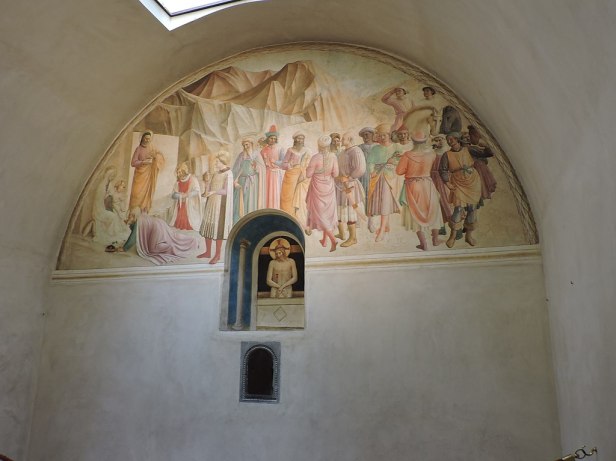
The convent and basilica church are located in Piazza San Marco, just around the corner from Michelangelo’s David at the Accademia. The site had been home to monastic orders since the 11th century, but the present complex is the work of the pioneering architect Michelozzo. In 1437 he was commissioned to create a new Dominican convent by Cosimo di Medici- il Vecchio, patriarch of the family’s financial empire.
CC BY 2.0 , via Wikimedia Commons
The Dominican convent is pretty much the personal art gallery of the brothers that lived there. Most notably Fra Angelico, a Dominican brother also known as Beato Angelico, and Fra Bartolomeo who continued the tradition. At San Marco much of the best art is in situ – on the walls, including the cells of the monks. As you explore you are seeing the early days of the Renaissance unfolding within the monastic complex, just as the brothers would have experienced. Although most of the historic portions have been converted into a museum, the Dominican Order still occupied the church and other sections of the property until fairly recently. In 2018 the four remaining Dominican friars were removed to the nearby Santa Maria Novella.
San Marco has another, darker chapter besides its beautiful artwork. This one involving its most infamous resident, and the monastery’s original church bell.
Who was Savonarola?

Public domain, via Wikimedia Commons
In 1490 Lorenzo di Medici invited invited a Dominican preacher to San Marco named Girolamo Savonarola. His earlier sermons in Florence fell on deaf ears but were now gaining in popularity throughout northern Italy. It was was suggested to Lorenzo to bring this itinerant friar to San Marco to increase its reputation. Little did il Magnifico realize that after his death his family would be exiled, with both the convent and Florence itself, under the de facto rule of the radically conservative Prior of San Marco.
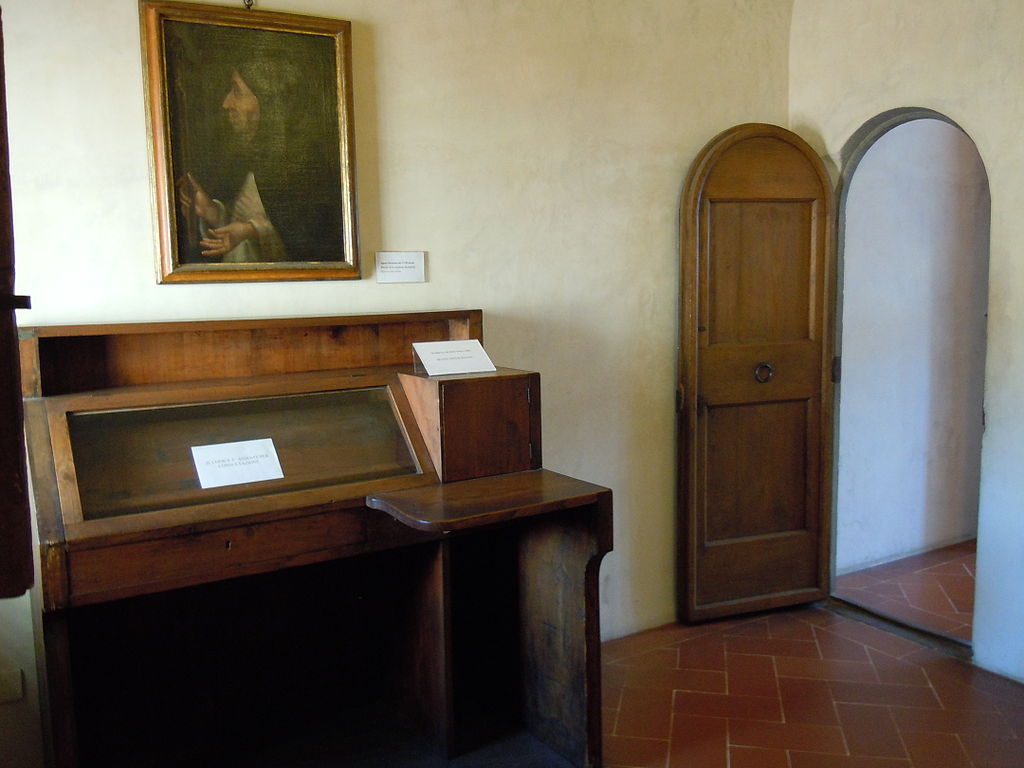
Fra Girolamo Savonarola’s rise and and subsequent fall was like a meteor shooting across the sky of history. Shortly after arriving at San Marco in 1490 he became the Prior, and instituted reforms to bring the convent into conformity to the original Rule of the Order. As a preacher and prophet, he developed a large following, saved Florence from a French invasion, and exiled the Medici.
Credit: TheBoxagon, CC0
Savonarola railed against the evils of secular art, cosmetics, fornication, sodomy and public drunkenness. Even if you never heard of Savonarola, you might be familiar with the term “bonfire of the vanities“. He was not the first Italian priest to hold one, but Savonarola’s bonfires became the most famous. The citizens of Florence were “encouraged” to throw their symbols of vanity into the flames, by the most passionate of Fra Girolamo’s followers.
A new theocratic republic emerged, operated by Savonarola through his Frateschi, which held sway over the Signoria (ruling council) of Florence. Before the decade was out, he had fallen out of favor with the people of Florence and the Pope. After a riot broke out at San Marco, Savonarola and two followers were arrested, tried, hanged and then burned at the stake in May of 1498.
The Piagnoni: Savonarola’s Wailers

Credit: Houghton Library, Harvard University
In the early days of his influence, critics of Savonarola called his flock the Piagnoni (wailers or weepers). They accepted the insult and owned the epithet, keeping the name long after Savonarola’s execution. The Piagnoni were summoned to San Marco either for Fra Girolamo’s sermons or tasks, by the ringing of its church bell. These critics meanwhile, took on the name of the Arrabbiati – the angry ones.
Florentines began to refer to San Marco’s church bell the same as Savonarola’s followers. The church bell began to be called la Piagnona – the feminine form of wailer/weeper. It was the Siren song to gather in his most fanatical disciples, and was accused of being put to that use in April 1498.
La Piagnona: Church Bell of San Marco
San Marco’s bell was commissioned by Cosimo di Medici for the new basilica and is believed to be an early work of Verrocchio. The bell in a monastic community, especially before modern timekeeping, kept the whole operation running. The large bell scheduled the community’s day: From when to wake, the start of the work day for the lay brothers and marked the Liturgy of the Hours for the priests. For the Dominicans of San Marco, their entire monastic life was dictated by the tolling of this bell. The impressive bell did its job in nameless obscurity until the 1490’s, when Savonarola held sway through his rabid followers.
Savonarola’s fall from grace was swift after he botched a Trial by Fire on April 7, 1498. The next day, Palm Sunday, the people converged on Piazza San Marco, where violence erupted and spilled into the San Marco Basilica. As the Arrabbiati demanded Savonarola and his most ardent followers, brothers from San Marco began ringing the church bell – either to alert the Florentine authorities, or to summon the piagnoni.
The Signoria did eventually send guardsmen to the scene of the riot, but not to help the besieged Dominicans. They came to arrest Savonarola and two of his staunchest companions. The execution of Savonarola six weeks later at the end of May 1498, was followed by the prosecution of San Marco’s lone church bell a month later.
Removal and Exile
In June 1498 la Piagnona, an inanimate bronze bell, was put on trail in a bizarre example of late medieval civic justice. The trial was held by a committee made up of members of the Signoria, who obviously had an axe to grind with Savonarola and his Frateschi. They accused and eventually convicted the bell of being used as a weapon to incite insurrection by the Dominican brothers of San Marco. Instead of ringing the bell for help during the riot, the prosecution charged the friars were trying to summon the Piagnoni. True or not, the civic leadership of Florence took the opportunity to rid themselves of the Piagnoni‘s political influence.
The Signoria of Florence issued decrees to have the bell punished. La Piagnona was roughly removed from the San Marco’s belltower and strapped to a donkey-cart. The bell was paraded through the streets where the it was beaten and whipped by the city’s hangman, as if it were political rebel on their way to exile.
Credit: Sailko, CC BY-SA 3.0 , via Wikimedia Commons
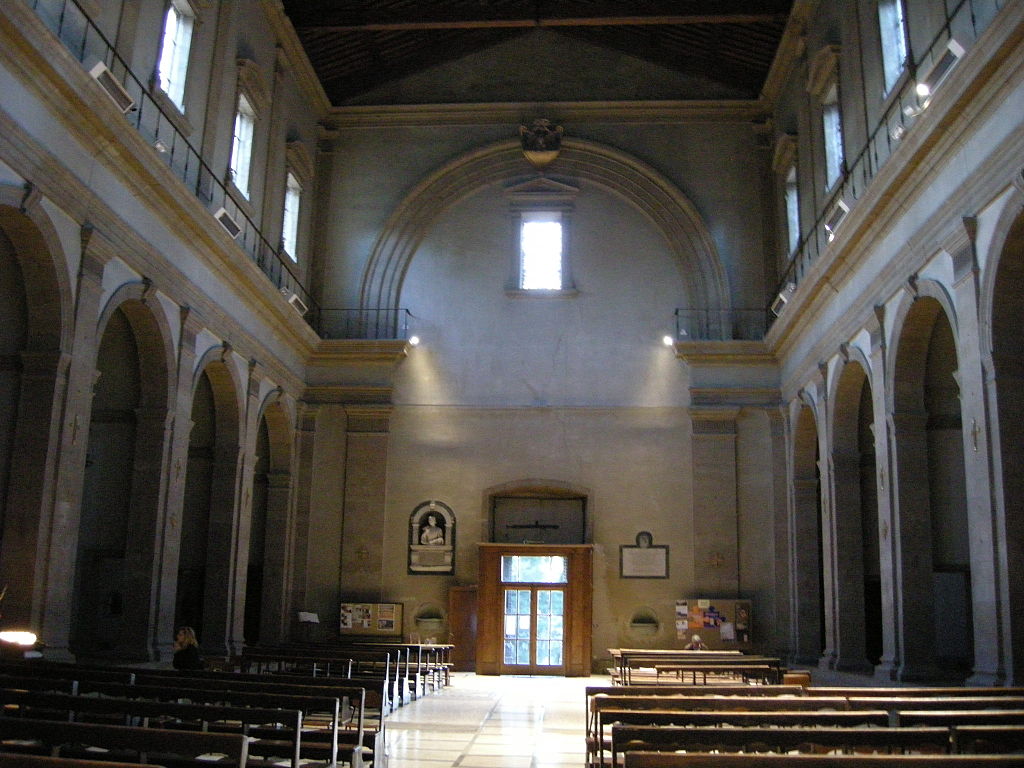
The punishment carried the piagnona all they way to the monastery of San Salvatore al Monte, a Franciscan monastery across the Arno. Here, the architect Simone del Pollaiuolo, known as Cronaca was rebuilding the bell tower. The bell’s crown was too damaged to hang, due to its hasty removal from San Marco. It was also missing the clapper, which was later brought to San Salvatore. The bell may have needed recasting, but Cronaca crafted an iron harness around an oak beam to allow the bell to hang correctly. However, it is unknown if the the piagnona was ever hung in the campanile, let along rung.
It may seem ridiculously excessive to go through all this just to get rid of a bell. However for the Signoria and the Arrabbiati overall, they wanted to make a statement and humiliate San Marco and Savonarola’s followers. The Order was losing its privileges in the city to the Franciscans at San Salvatore al Monte. One decree had the Franciscans, along with the Hangman actually come to San Marco and seize the bell before beating it all the way to its new home. They made sure the new Franciscan complex would get a bell worthy of their new status, while simultaneously humiliating and silencing the Dominicans at San Marco.
San Marco would also be forced by decree to replace Piagnona with a much smaller bell, certain to be drowned out by the larger bells in Florence. In a time when every citizen could identify the numerous religious and civic bells in Florence, this was a further insult. It didn’t go unnoticed.
Numerous letters from high ranking nobles and clergymen were sent to the Signoria in attempts to rescue the bell. Pleas from Ludovico Sforza, ruler of Milan and Francesco Mei, General of the Dominican Order fell on deaf ears. Even the Pope expressed his wish (if not his command) that the bell be returned to San Marco. The Signoria in response, stuck to their guns, claiming the monks of San Marco and Savonarola’s followers were rebels, thus making this a civil matter and fully within their power. As far as they were concerned, the bell ceased being a religious implement and became a weapon of revolt the night of the riot. The same fate would befall anyone who attempted to bring the bell back within the city.
Savonarola’s Revenge?
In the early 16th century a local legend began to spring up surrounding la Piagnona and the only time it ever rang at San Salvatore. An early version attributed to Pacifico Burlamacchi (also referenced today as Pseudo Burlamacchi) tells a pro-Savonarola story of what befell one of his rivals, Tanai de Nerli, who in fact died shortly after the bell was punished and exiled.
The story says that Nerli’s son had found his deceased father dead from strangulation in his bedroom. Supposedly strangled by the devil as punishment for his role in Savonarola’s execution. Nerli was buried at San Salvatore al Monte where the Piagnona rang during his funeral. This story says the bell tolled for the “first and last time” that day as the Pope commanded the bell be returned to San Marco.
Versions of this story are still known today and is most likely a mix of half-truths that have been embellished. For instance, it is unknown just how forceful the Pope demanded the return of the Piagnona, but we know Signoria didn’t listen anyway. Tanai de Nerli died in 1498, the bell stayed at San Salvatore for at least a decade but it is hard to determine if the bell was ever used after all this pomp and circumstance.
La Piagnona Returns to San Marco
Contemporary observers mention the bell was returned to San Marco in 1509. The return was celebrated in Florence in conjunction with the announcement of a treaty that brought Pisa back under their sway. The Piagnoni didn’t just disappear after Savonarola, they held political influence for many years and used it to get their symbol back. However, it seems the bell would remain a mute symbol, and would not toll again for centuries. In my research I could not find anything that says the bell was rehung in the San Marco bell tower.
The Bells of Florence Project: 2010
After all this time I think it is safe to say the convicted bell has been fully rehabilitated. Florence is now free from the influence of the Piagnoni (unless Dan Brown has another novel in the works) but sadly, San Marco is also no longer an active Dominican monastery.
In 2010, before the last friars were moved out, the non-profit Friends of Florence, sponsored a program that brought the Piagnona back to life. As the centerpiece of the project, the bell was restored and rung, possibly for the first time in 512 years.
Friends of Florence, in conjunction with Florentine musician and composer Anthony Sidney, produced The Bells of Florence project, which captured and recorded information on every church bell in the city, including historical details, photographs, and – perhaps most importantly – sound recordings of their actual chimes. A DVD documenting the project, including the tolling of the bells, was produced and copies have been sent to the most important regional libraries of Italy, including La Biblioteca Nazionale di Firenze, for their archival use.
The Bells of Florence’ DVD Project – Friends of Florence
Here is a recording of la Piagnoni from the Bells of Florence Project:
Sources/For More Information
Catholic Encyclopedia: Girolamo Savonarola
Delaney, John K., et al. Verrocchio : Sculptor and Painter of Renaissance Florence. Edited by Andrew Butterfield, National Gallery of Art ; Princeton University Press, 2019.
Godkin, G. S. and G. Barbèra. The Monastery of San Marco. Florence: Printed by G. Barbèra, 1887.
Lawrence, Alexandra. For Whom the Bell Tolls. The Florentine, November 10, 2010
 The Historical Vagabond
We were in Florence a couple of years ago but totally missed out on the San Marco Museum. The story of the bell is intriguing.
At the time I was more focused on the Fra Angelico frescoes, but later learned the story of the bell.
Cool story. Hope you’ll pardon my joke, guilty as bell. ; )
Puns and Dad jokes are encouraged here…