
I don’t know much about traditional Sicilian folk music, it was one of the many parts of our culture probably lost to my family over the years. It’s fair to assume that my family and others brought traditional songs with them to the US, but I’m not familiar with any. I was probably born ten years too late to have met people in my community that would have known.
In 2009, I was helping out my friend Sal Zerilli with his documentary: No Pretty Prayer,. When the team was working on the soundtrack, I was introduced to a Sicilian folk song so hauntingly beautiful, that I had to learn more. This is the story behind Surfarara– The Sulfur Miner’s Song. A traditional Sicilian folk song that musicologist Alan Lomax once said was “as wide, high and lonely as the Sicilian sky”.
Sicily’s Sulfur Industry
Sulfur has been a sought after mineral since ancient times, and with Sicily obviously positioned close to Vulcan’s furnace, the island was blessed with rich deposits. Greeks, Carthaginians, Romans and every conqueror afterward, took advantage of Sicily’s sulfur. However, it was not until relatively modern times that the sulfur was mined intensively.
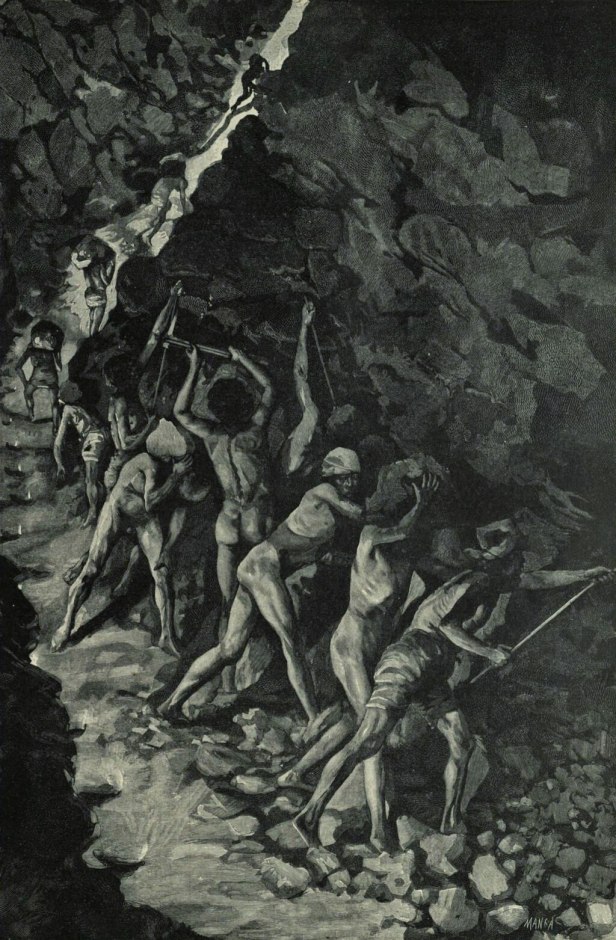
Sicilian sulfur mining took on a more industrial level in the early 19th century primarily for the production of gunpowder, sulfuric acid and soda ash. These sulfur mines were open pits where the ore was harvested with tools the Romans would be familiar with. As mining intensified, the open pits were replaced with shaft mines deep underground to follow seams of ore. The work got harder, hotter and deeper underground, but was still mined with primitive tools until the mid-20th century.
The life of sulfur miners did improve in the 20th century, but that is a relative concept – it just was not as bad as it used to be. Prices and demand for Sicilian sulfur steadily dropped as cheaper alternatives were found. The Sicilian sulfur industry finally came to an end in the 1970’s with the closure of the last of the large mines.
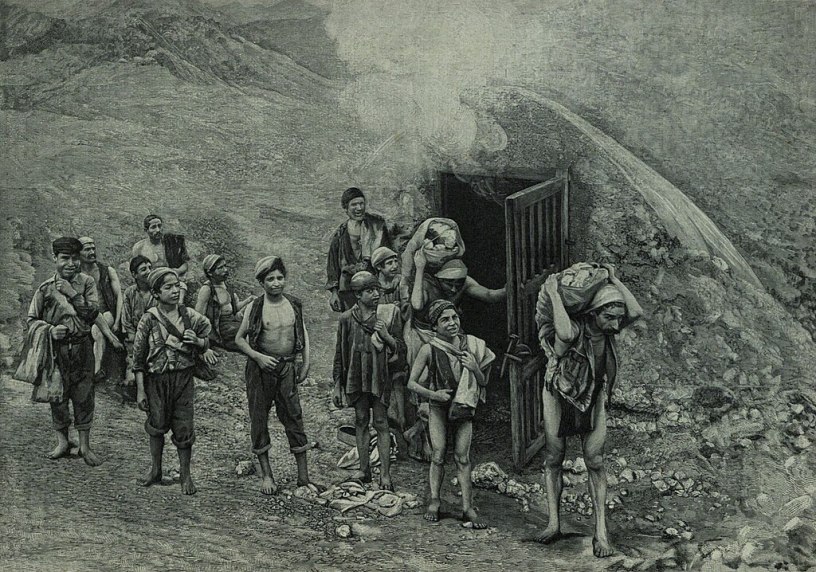
The miners did not own the mines, they rented space to work in extreme heat, darkness and toxic fumes from dawn to dusk to earn enough to survive. The ore was brought to refineries where furnaces processed it into pure sulfur. Miners, known as a zolfo or picuneri were assisted by child laborers who had no choice but to endure these hellish conditions.
The Plight of the Carusi
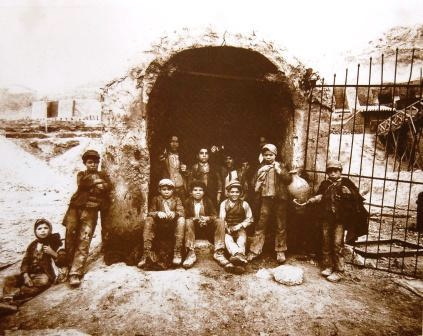
The Sicilian surname Caruso may originate from the sulfur mining industry. Caruso means “boy” and was the term used for the laborers taken at a young age to work in the mines. Today many of these poor souls are anonymous to history, simply known as carusi in cemeteries or in whatever records actually show their existence. Their status was not much different than a pack animal, their lives short and brutal, their bodies deformed from a life of carrying heavy loads.
Carusi work for a sulfur miner who worked with a pickaxe. The carusi, being small and nimble aided the miner in the hellish conditions below ground. The boys would carry the ore on their backs to the surface in temperatures over 110F, from dawn to dusk. These kids were 6-10 years old when they started. In oral histories, the last surviving carusi say they were required to carry 100 kilos (220 lbs) of sulfur ore per day to get paid. As a parent, this is gut-wrenching to contemplate. They were treated like human wheelbarrows
Indentured Servants or Slaves?
These boys were often part of a cruel and eventually illegal type of indentured servitude. This was known as soccorso morto – dead rescue or dead aid – the impoverished families were given money in exchange for their child’s labor. With soccorso morto, once the family accepted the money, the miner was not liable for the death of the carusi.
The family had to pay off the original amount to end the contract, which was rare considering the dire poverty that forced them into the situation. The carusi were paid a pittance for their labors, but could actually save up to pay off the debt themselves. The term of indenture was about ten years, and at the age of 17 a caruso could become a miner. The human wheelbarrow could now become the human pickaxe. Thus the cycle continued as picuneri would then need a team of carusi to work the mine.
American educator and former slave, Booker T. Washington was horrified by what he saw in the Sicilian sulfur mines during a visit in the early 1900s. After witnessing the plight of the carusi, he called out their situation for what it was: slavery.
When beatings did not suffice, it was the custom to singe the calves of their legs with lanterns to put them again on their feet. If they sought to escape from this slavery in flight, they were captured and beaten, sometimes even killed
Booker T. Washington
The suffering of the carusi did not stop once out of the mine shaft. After working in conditions not fit for humans, the exhausted boys were often forced to sleep on the ground. Physical and sexual abuse were common in this often warped relationship with the miners. It was a brutal life for all involved, a trickle-down system of cruelty that bottomed out in the heat and darkness of the sulfur mine.
The picuneri lived a miserable existence in the mines, but the carusi got the worst of it. Although this torment was mostly ignored during its day, and is mostly forgotten by young Sicilians today, the sulfur miners inspired many poems, books and works of art by Sicilians before the end. This is an island that has learned over thousands of years of conquest and subjugation, to transform their anguish into beauty. Which brings us to the sulfur miner’s song.
Surfarara: Music and Lyrics
The song is played with the droning of the jew’s harp, which is called a Marranzanu or Scacciapensieri in Sicily. This traditional, but still popular instrument gives the song a trance like rhythm. It somehow transports you into the heat of the mine and the unending toil that awaits the miner and his carusi.
Although the Arabs were long gone before the sulfur industry intensified, the influence on traditional Sicilian culture is very evident in the song. Most noticeably is the ululating style of singing reminiscent of the muezzin’s call to prayer from the minaret. Except in this situation, it is a wail, it is a lament. Fans of Spanish flamenco and Portuguese fado from the former al-Andalus may hear a certain similarity. However, where flamenco and fado are refined, surfarara seems closer to its source material, both in lyric and how it is sung.
The tragic lyrics haunt me, thinking of what these people went through. You don’t really need to know what is said to feel the pain in the song. Before I learned the words, it still moved me. Knowing the words conveys another level of anguish to the song. I apologize if I got anything wrong, this is based on a few translations and lyrics I found online.
Mi scuordu, mi scurdà, scurdatu sugnu, – I forget, I forgot, I’ve been forgotten,
mi scuordu di la stessa vita mia. – I forget my very life.
Mi scurdavu lu bbeni di ma mamma, – Forgotten the love of my mother,
era cchiù dduci, cchiù mègliu di tia. – she was gentler, better than you.
Mi scurdavu lu bbeni di me patri, – Forgotten the love of my father,
passa lu mari tri bboti pi mmia. – he crossed the sea three times for me.
Mi scurdavu l’amici poi a me frati, – Forgotten friends then my brothers,
di li santi mi scuordu e no di tia. – the Saints I forget but not you.
Traditional Recordings
From 1954-55 Alan Lomax and Italian researcher Diego Carpitella made recordings of traditional Italian folk songs for Lomax’s larger project on world folk music recordings. Surfarara was one of the song documented. Here is a traditional version of the song as recorded by Alan Lomax from YouTube:
Modern Version of the Folk Song
Before I ever heard the more traditional versions, I heard this next recording, which we used in No Pretty Prayer. It is a jam-oriented jazz fusion variant by Michael Occhipinti and the Sicilian Jazz Project. I don’t consider myself a “jazz” guy, but I had a misspent youth as a Deadhead, so it’s not unfamiliar territory. I feel the nature of the song lends itself to the rhythmic chaos of this kind of musical improvisation. The wailing vocals and cacophony of instruments gives me a vision of hot, sweaty, toil far underground.
Other Sulfur Miner’s Songs?
While researching Surfarara on the Lomax Archive, I stumbled upon a clip of another song associated with sulfur mining. However this one is different and has a more Byzantine Greek style. I haven’t investigated further just yet, but If I can find enough information there may be a sequel to this story.
Sources/More Information:
Why the Carusi Matter by Olivia Kate Cerrone from Times of Sicily
 The Historical Vagabond
I really enjoyed reading this and learning about the picuneri. What a beautiful and haunting song the Surfarara is indeed. I can definitely hear the influence of the muezzin in the style of the Surfarara. It’s fascinating that in folk songs popular in different traditional trades one can hear Sicily’s rich history. It reminds me of the song sang by Sicilian fisherman of Favignana before la mattanza that starts with “Ajamola, Ajamola”. You keep writing and I’ll keep reading.
Glad you enjoyed it, and the feeling is mutual – keep writing
I’m sorry you feel your time as a Deadhead was misspent. I don’t feel that way about mine at all. 👌
Ha ha. Well, mostly misspent…
Ah ~ I think I grok… Officially misspent; inwardly enlightening ✨
Greetings Historical Vagabond!
Your post on the “carusi” of the Sicilian sulfur mines is poignant!!! Great post!
As one who loves the Sicilian dialect and learned it growing up with a Sicilian grandmother in our home, please allow me to point out a nuance in the translation of the song.
In the first line of the song, “scurdatu sugnu” is translated as “I’ve forgotten.” The expression “scurdatu sugnu” actually means “I have been forgotten.”
Best regards,
Rosanna
Thank you for reading and sharing your insight!
You are welcome!!!!