
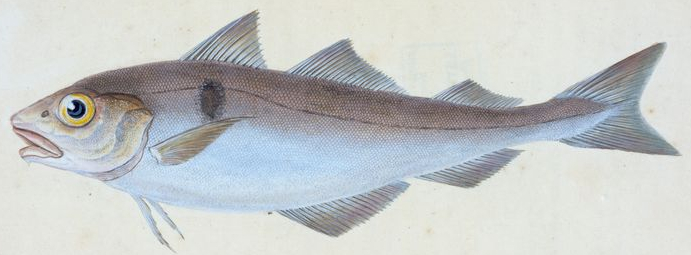
To kick off this new history blog, we will start with a little bit of fishstory. This is a look into some interesting legends surrounding the haddock. If you’ve never heard of haddock, it is a popular food fish with a strange name that is caught in New England and Northern Europe.
What is a Haddock?
Haddock (Melanogrammus aeglefinus) are fish in the cod family and occupy a similar range in the North Atlantic, roughly from New England to Norway. The haddock grows smaller than cod, is darker in color, with a black lateral line and a distinctive mark behind its head. This mark easily distinguishes haddock from cod, pollock and other relatives. It’s also the basis for some of the myths that we will explore.
Haddock as a Food Fish
Haddock shares a similar food history with cod. The fish has been caught off the British Isles, Scandinavia, Iceland and North America for millennia and is still a very important food fish. It is a white flaky fish with a mild taste. Haddock gained large appeal in the late 1920’s thanks to the flash freezing technology of Clarence Birdseye. In fact, before the world had Birdseye frozen peas, they had Birdseye frozen haddock.
In the days before refrigeration, it was not as familiar as cod. Salted or dried codfish was an important staple in Europe and North America, but haddock does not preserve well in salt. Haddock was eaten fresh during the winter and early spring by those who had access to the coast. When it came to haddock preservation, the best technique was smoking.

The Scottish fishermen of Findon learned, and perfected smoking haddock over local peat. Thus was born finnan haddie, a golden smoked delicacy used in many traditional recipes. Cullen skink is a Scottish fish chowder made with smoked haddock. Same with the original Arnold Bennett omelet, made famous by London’s Savoy Grill.
Haddock Lore
For a fish that played second fiddle to cod for centuries, haddock has quite a bit of lore attached. There may be more legends about haddock than there are for their bigger cod cousins. From the strange “thumbprint” mark, to the obscure name in English, to the legend that the fish is actually deaf, there is a lot to unpack when it comes to haddock.
These entertaining myths are probably just the tip of the iceberg, I am sure there must be even older legends from across the fish’s range. Several years ago I began research for my book on historic seafood cookery, which is when I gathered some of this information. My further research is limited to what I can find in digitized collections. Thankfully, there are quite a few digital collections to search through and I can only imagine how useful they would be if they had these resources in my college years.
The Mark on the Haddock
There are two competing myths about the thumb-print-like mark on the haddock. The first has to do with the devil, the other with a saint and both stories seem to originate in Scandinavia.

An Icelandic legend tells of how the devil tried to catch a haddock by reaching into the sea to grab a fish. The devil was able to take hold of a haddock, but the fish slipped through his fiery grasp. The haddock has borne the mark left from the devil’s hand ever since.
An alternative myth said to have originated in Norway has the haddock being blessed rather than cursed. Haddock, along with the peculiar looking John Dory fish are often identified with the fish caught by Saint Peter in chapter 17 of the Gospel of Saint Matthew.
“Among the superstitious, the Dory disputes with the Haddock the honour of having been the fish out of whose mouth St Peter took the tribute-money, on which occasion he is said to have left the mark of his finger and thumb on their sides, as both of these fishes possess this characteristic marking.”
The Natural And Economical History of the Fishes of the River District of the Frith of Forth. 1839.
Jesus instructs Peter to catch a fish in order to pay a tax, with the coin he found in the fish’s mouth. The mark on the haddock is from Saint Peter’s hand as he grabbed the haddock to take the coin. The story in the New Testament does not actually say if Peter caught the fish or not.
“This fish has a black spot on each shoulder , which resembles the mark of a man’s finger and thumb , from which circumstance it is called ” St. Peter’s Fish , ” alluding to the fact recorded in the 17th chapter of St. Matthew- ” Go to the sea and cast an hook , and take up the first fish that cometh up , and when thou hast opened his mouth thou shalt find a piece of money ; that take , and give unto them for me and thee ; ” and while St. Peter held the fish with his forefinger and thumb it received this mark.”
Natural History of the Salmon, Herrings, Cod, Ling, &c.: 1833.
Apparently the Norwegians of a few centuries ago didn’t realize the Sea of Galilee is far beyond the haddock’s range…and the “sea” is freshwater. In the area around Galilee, it is the tilapia, not the haddock or John dory, that is considered the fish caught by the Apostles.
To Be Deaf as a Haddock
This is an old Yankee expression for someone who cannot hear well. It is still an oft-used expression in New England and the Canadian Maritimes. American references to this phrase in print date to at least the early 19th century. A poem entitled “Yankee phrases”, printed in 1803 contains a stanza about deaf haddock.
“I fought her affection to win,
In hope of obtaining relief,
Till, I, like a hatchet, grew thin,
And she, like a haddock, grew deaf”Yankee Phrases: 1803
The origin of the phrase is much older, possibly originating in the West Country of England, which includes Gloucestershire. In a 1727 dialog entitled, An Exmoor Scolding by Peter Lock, there is a variation of the phrase. However it is written in the local Exmoor dialect. Later reprintings of this book give both the original and the contemporary English version of the phrase:
Th’art so deeve as a Hadidick in chongy Weather. (Exmoor)
Thou art as deaf as a Haddock in changeable Weather. (English)
From: An Exmoor Scolding: 1727
The belief that haddock are deaf seems to originate in old folk traditions from this part of Britain, including Cornwall, and brought to New England by early colonists. However, just to be clear, haddock are not deaf. They have a well developed auditory system that plays an important role in their mating cycle.
How the Devil Named the Haddock

Medieval and early modern Europeans were not afraid to fill gaps in their knowledge of the sea with some creative stories. When it comes to haddock, this is sort of the grand unifying legend that connects the others. Who knows how long this story has been told, but the version told here was found in a piece entitled, “Odds and Ends of Weather Wisdom and Fragments of Folklore” part of an anthology printed in 1875.
This legend from Cornwall not only explains why haddock are deaf, but how they got their name. Once again, it starts with the devil, who can’t seem to catch himself a haddock:
“…the haddock is said to be quite deaf, by the Cornish fishermen, because once upon a time when the devil was fishing, his bait was perpetually carried off by a haddock. Getting furious, the devil put his face to the water till his mouth almost touched the fish’s ear, and cried out:
‘Ha Dick! I’ll tackle thee yet.’
The sound was so loud that it cracked the drums of the fish’s ears, and ever since, he and his descendants have been stone deaf, and have always been called Ha Dicks, or haddocks.”
Odds and Ends of Weather Wisdom and Fragments of Folklore: 1875
Dick in this instance, is used similarly to how we use the term “Guy” or “guys” in modern English. Before “guy” became synonymous with an everyman there were expressions like: “Every Tom, dick, or Harry”.
Haddock Etymology
Legends are fun, but where did the name haddock actually come from? As you may have guessed, haddock has an uncertain etymology. The Oxford English Dictionary traces the word to at least the 13th century, possibly from a French origin.
However, the modern French word for haddock églefin, is supposedly a loanword from the Dutch. Wiktionary states the original word in Middle French esclefin, was originally borrowed from the Middle Dutch schelvisch. The modern Dutch word for haddock has been slightly modified to schelvis. This translates into somthing like “peel fish” which I speculate may be based on the small flaky texture of haddock when cooked.
So if the French got their word from the Dutch, was there another French word used for haddock? Haddock may come into Middle English as haddok by way of Norman-French hadoc, which stems from the Old French hadot. From here the trail goes cold.
If you enjoyed this look into haddock fishstory, let me know in the comments. Thanks for reading!
Sources:
Elworthy, Frederic Thomas, 1830-1907, and Peter Lock. The Exmoor Scolding And Courtship: (two Dialogues of the Beginning of the XVIII. Century) : Also The Somersetshire Man’s Complaint (a Poem of a Full Century Earlier) ; the Original Texts Edited, Collated, And Arranged, With a Complete Transcript In Glossic, the Vocabulary Enlarged, And the Whole Illustrated With Copious Notes. Bungay: Printed by Clay and Taylor, 1879.
Fraser, Alexander. Natural History of the Salmon, Herrings, Cod, Ling, &c.: With a Short Account of Greenland, Its Inhabitants, Land And Sea Animals, And the Different Tribes of Fishes Found On the Coast. 2d ed. Inverness: R. Carruthers, 1833.
Odds and Ends of Weather Wisdom and Fragments of Folklore taken from:
The Monthly Packet of Evening Readings vol. 20, J&C Mozley, London 1875.
Parnell, Richard, 1810-1882. The Natural And Economical History of the Fishes of the River District of the Frith of Forth. Edinburgh: Adam and Charles Black, 1839.
Anonymous: Yankee Phrases: 1803
https://www.etymonline.com/word/haddock
https://en.wiktionary.org/wiki/%C3%A9glefin#French
https://en.wiktionary.org/wiki/haddock#English
 The Historical Vagabond
Oh what fun! I’ve not come across the phrase ‘deaf as a haddock’ but may well adopt it!
A typical Yankee expression that used to be more common, but is still heard in my town. Thanks for reading!
I certainly enjoy haddock as a favourite for fish and chips and properly smoked haddock. I did not realise what an interesting history it had.
Thanks for reading. I was very excited when I learned these old expressions had some history behind it.
dear Justin
I could spend way to much time reading this.
And probably will.
For now- I am going skiing
Harold
Thank you Harold!