

The Monasterio de Las Descalzas Reales is easy to miss if you don’t know what you’re looking for. Right in the center of historic Madrid is this unassuming Royal convent with a sneaky good collection of art. The austere exterior, a short walk away from the Sol Metro, hides a still-active convent that was one of the richest in all of Europe. This was once the monastery of Habsburg princesses and the high-born daughters of European nobility: A nunnery for the rich and famous.
We visited the Descalzas Reales in 2001, my wife Danielle learning about it when we were on our convent and monastery kick. Our pension was the next street over, and we probably walked past the entrance a few times before realizing what it was. It was a whirlwind tour, conducted in Spanish, so I’m sure I missed a lot while translating for Danielle. One thing that intrigued us both was that our tour would miss parts of the complex because the Sisters were conducting a service. The fact that it is still an active convent with deep roots in Spanish Royalty has kept these blurry memories in my mind, waiting for a time like this, to learn more about it.
Founding by Joanna of Austria
Las Descalzas Reales was founded by Joanna of Austria (1535-1573), the youngest daughter of Holy Roman Emperor Charles V, and Princess of Portugal. Her royal marriage to her cousin (Habsburgs keep it in the family) João Manuel of Portugal lasted two years before he died. She returned to Spain, leaving her son, the future King Sebastian in the hands of her Aunt/Mother-in-Law.
Upon her return, she became Regent of Spain for her brother King Philip II until his return from England. Joanna had enough of the political turmoil and conflict as Catholics and Protestants held dueling “Reformations.” She exchanged a royal life for a religious one. In 1557 Princess Joanna took over the former royal palace where she was born, and created a convent for Poor Clares in the heart of Madrid.
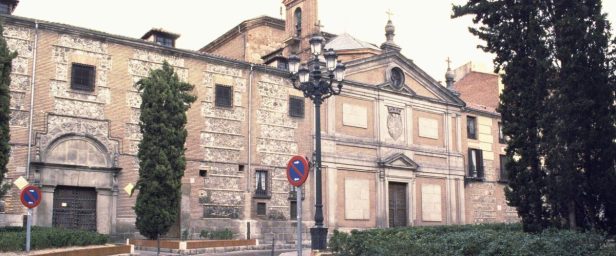
Former Royal Palace in Central Madrid
Credit: Patrimonio Nacional
The original construction phase was between 1559-1564 by Antonio Sillero and continued by Juan Bautista de Toledo, the famous architect of the monastery/palace El Escorial of King Phillip II. The monastery that emerged from the former palace was designed in the late Castilian Plateresque style, showing a heavy influence from the Renaissance and retaining some elements of the original building.
The facade and main entrance is classically symmetrical and austere, like a locked cabinet that never reveals what treasures lie within. Behind the facade, the original palace entranceway was preserved and is known as the Renaissance Staircase. This impressive entrance would be later embellished floor-to-ceiling with beautiful frescoes. The floor plan of the palace was modified to create dormitories for nuns, chapels and a serene cloister. The interior spaces of the convent were later redesigned in the 18th century by Diego de Villanueva. However, the facade, cloister, and the Renaissance Staircase were preserved, along with the 17th century wall frescoes.
Princess Joanna had the convent’s church designed in an Italian style, with a small oratory built as her personal chapel. Joanna of Austria was buried at the monastery in 1573 and her chapel was redesigned for her burial by Jacopo da Trezzo. Her funeral chapel is said to be on the same spot where she was born in the old palace. Her chapel is decorated with a praying funerary sculpture by Pompeyo Leoni.
The Royal Barefoot Sisters
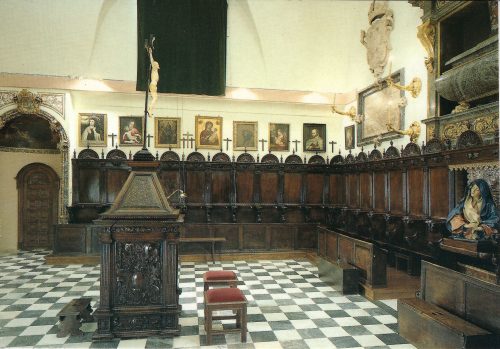
Image from old postcard
The convent is officially named El monasterio de Nuestra Señora de la Visitación but is better known as Las Descalzas Reales. It gets its name from the Descalzas Reales (the Royal Barefoot Sisters) that still occupy the convent. This is a “discalced” branch of the Order of Saint Clare that once went barefoot in imitation of Saints Clare and Francis. It grew into a movement within the Franciscan and other mendicant religious orders to accentuate their vow of poverty. Over time, it evolved into the more practical version that has discalced friars and nuns wear simple sandals all year round.
A Royal Habsburg Monastery
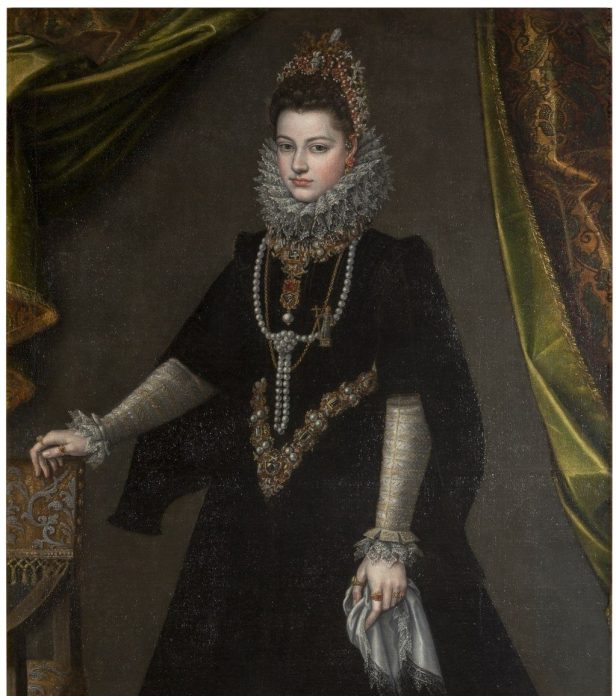
Lived briefly at Descalzas Reales and became a lifelong patron
Museo del Prado
Within the monastery’s royal quarter, Habsburg princesses would often spend a season or two cloistered away, wearing the habit but not taking the vows. Other royals spent their last years here in holy contemplation. For some royals, the cloistered life suited them, and took the vows to become full nuns. In total there were seven women of legitimate or illegitimate royal Habsburg blood that took holy vows and became Sisters. Among them, a few stories stand out.
In 1581 the Dowager Empress Maria, widow of Emperor Maximilian II returned to her native Spain and moved to Las Descalzas Reales. She came with her daughter, Margaret of Austria who was planned to wed her uncle King Phillip II of Spain, after the death of his previous wife…her older sister (yes the Habsburgs were gross). Margaret was said to be very pious and refused to marry her uncle/brother-in-law, instead taking the vows of the Poor Clares under Sister Margaret of the Cross (Sor Margarita de la Cruz).

Illegitimate daughter of Emperor Rudolf II
Apsley House Collection, London
In 1624, twelve year old Dorothea of Austria, the illegitimate daughter of Emperor Rudolf II arrived at the monastery via a grand procession. She was orphaned at a young age in Vienna, and was brought to Descalzas Reales at the behest of her aunt Sor Margarita de la Cruz. Her journey was almost cut short when her ship encountered a dangerous storm and later an attack by Barbary Pirates. At the age of 16 she took her vows as Sor Ana Dorotea de la Concepción. During her life as a nun, she published several literary works and also spent lavishly as an artistic patron for the convent.
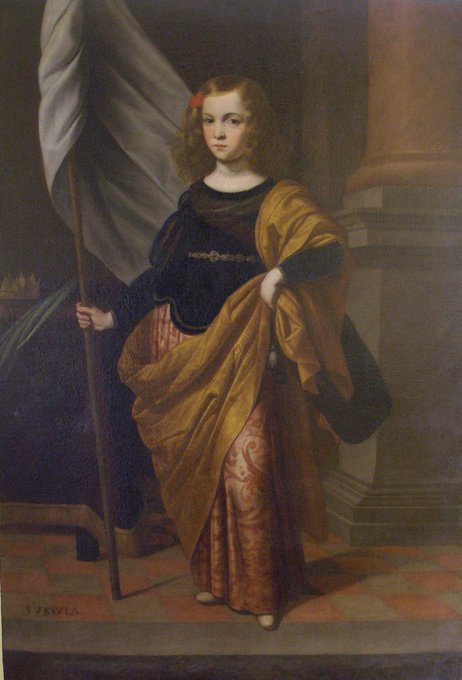
The line of the Spanish Habsburgs died out in 1715 with the passing of Sister Mariana de la Cruz. She was born Mariana of Austria, the illegitimate daughter of Cardinal-Infante Ferdinand of Austria and was brought to Las Descalzas Reales in 1646 at the age of five. She was mentored by Sor Ana Dorotea in her youth and although cloistered, kept in close correspondence with her Habsburg relatives in Austria and Spain. At her death, Bourbon King Felipe V decreed the title of Grandee of Spain (Grandes de España), the highest level of Spanish nobility, to all future abbesses of the monastery.
A Nunnery Full of Rich “Poor Clares”
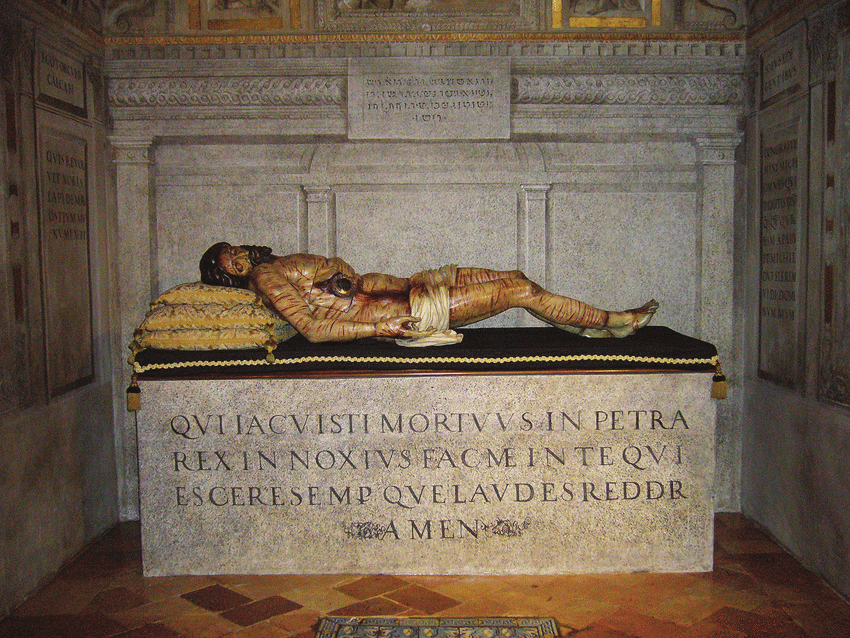
Credit: Patrimonio Nacional
The Descalzas Reales attracted wealthy widows and unmarried daughters (legitimate and illegitimate) of Europe’s elite. Many of them came to the monastery with large dowries, enriching the treasury and making it one of the wealthiest in all of Europe. These Poor Clares were also surrounded by religious and family paintings by Europe’s masters, the walls practically dripping with fine art.
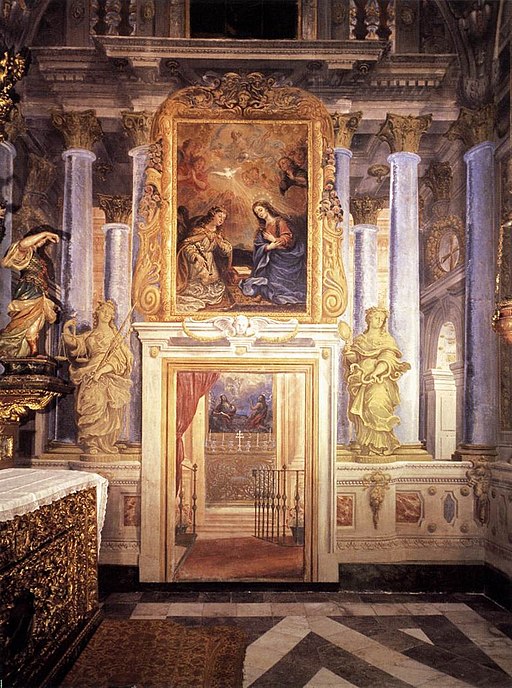
Decorated by Francisco Rizi (1678)
Public Domain
The ostentatious Renaissance Staircase area makes for a stunning entrance into the complex and was part of the original royal palace. It was completely covered in religious and allegorical frescoes in the 17th century by several artists including Bartolomé Román. At the top of the stairs, King Philip IV, Mariana of Austria, the Infanta María and Infante Felipe Prospero, overlook it all with approval, from their trompe l’oeil balcony.
It was more than just the trappings that were lavish. In 1587 King Phillip II hired Tomás Luis de Victoria, Spain’s most famous Renaissance composer as chaplain for his sister, the Dowager Empress Maria. Upon her death, de Victoria composed her Requiem Mass, his most famous masterpiece. He then became the chief organist until his own death in 1611. Tomás Luis de Victoria is one of the few men buried within Las Descalzas Reales, but in an unknown location.
The Art Collection at Las Descalzas Reales

Public Domain
The handful of remaining nuns in the convent are the inheritors of an incredible art collection donated by members of the royal family. Works by Peter Bruegel the Elder, Peter Paul Rubens and Titian were once on display only for the viewing of the nuns. Much of this artwork is dedicated to religious themes and are used as spiritual aids to prayer. Besides the religious art, there are 39 portraits of the Spanish Royal Family and relatives from other houses including rare portraits of members of the Polish-Lithuanian Commonwealth.

On right, behind glass is the Virgin and Child, by Bernardino Luini
Public Domain
During the Spanish Civil War, both the art collection and the nuns were removed from the convent. The buildings of the convent suffered bomb damage, possibly by German bombers, during the two-year siege of Madrid. Restorations and a new roof were completed after the conflict and the nuns and masterpieces returned soon after.
A few of the works that once hung in the monastery have been moved to other museums. There was once a painting of the Annunciation by Fra Angelico. It was painted in 1426 originally for an Italian monastery that sold it to a “favorite” of King Phillip III in the 17th century. The painting now hangs in the Prado and another painting of the same scene has taken its place in the convent.
Victory of the Eucharist Tapestry Collection

Credit: Patrimonio Nacional
The highlight of the monastery’s art collection has to be the Victory of the Eucharist tapestries. These unique works, twenty in total, were designed by Peter Paul Rubens and woven in Brussels by Jan Raes, Jacques Fobert, and Jacques Geubels. The tapestries were commissioned by Isabella Clara Eugenia, Sovereign of the Spanish Netherlands, and patron of Rubens, in thanksgiving after the Battle of Breda in 1625. She spent only a brief time at Las Descalzas Reales but continued her patronage over the years, donating the tapestries and other major works of art.
The Divina Guardería and Holy Relics of Las Descalzas Reales
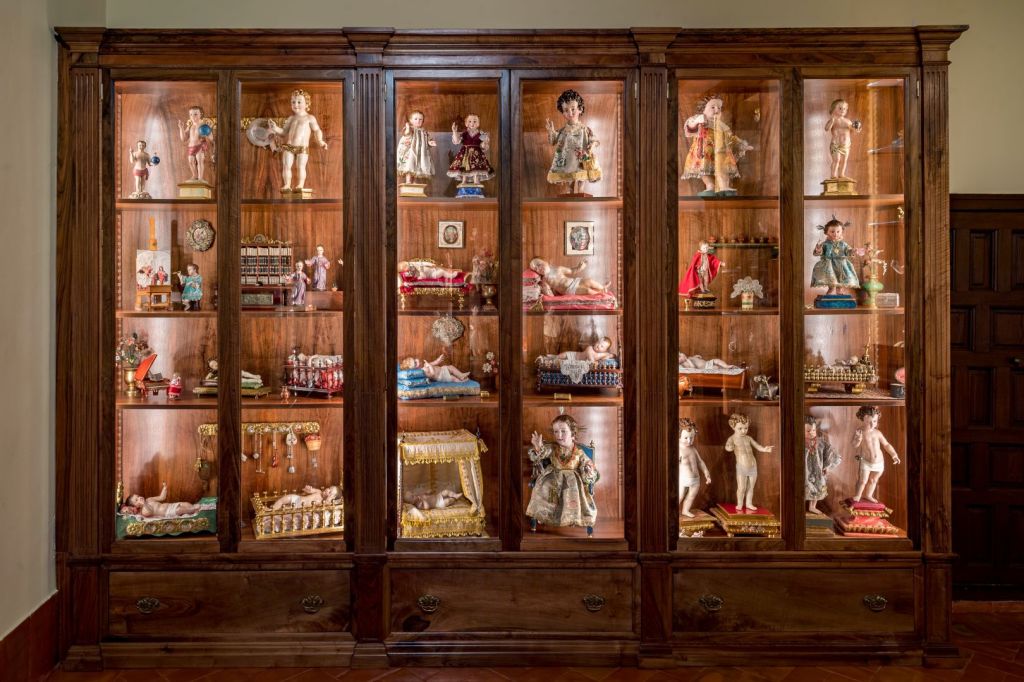
Credit: Patrimonio Nacional
Arguably even more unique than the Rubens Tapestries, is the Divina Guardería or “divine nursery”. This special part of the Treasury is a room that holds 120 figures of the infant Jesus. These were originally donated as part of the dowry wealthy families gave when their daughters became nuns. This special collection is still used by the sisters of Descalzas Reales in their religious duties and is not on display. However, the Sisters open the Divina Guardería and display other special treasures to the public during the Christmas holiday season.
The monastery is home to over 400 holy relics of numerous saints within its collection, many also brought in as part of dowries. One is said to contain bones from Saint Sebastian and another holds a piece of the True Cross. While the authenticity of relics is always pretty dubious in nature, I’m pretty sure that really isn’t the point of using relics as objects of faith. The collection of these relics would also take on political symbolism as well during the wars between Catholics and Protestants. The beautiful reliquaries commissioned to contain the relics, and much of the art collection for that matter, are examples of how the Catholic Church countered austere Protestantism in part, by doubling down on artistic grandiosity.
From Riches to Rags
The Order of Saint Clare emphasizes poverty, but by the 20th century the nuns of Las Descalzas Reales were at a dangerous level of destitution. The era of rich princesses cloistered away were gone, along with their dowries. The sisters lived in poverty, ironically surrounded by artistic masterpieces from the glory days of the past. They were restricted from selling any art or relics to help with their day-to-day lives. The dwindling number of nuns were like birds held in a guided cage, unable to support themselves.
Partial Conversion to Museum and Later Restorations

Credit: Patrimonio Nacional
It took a special dispensation from Pope John XXIII to convert a portion of the convent into a museum. Since it is still a Royal Monastery, the museum portion is under the custodianship of Spain’s Patrimonio Nacional and the few remaining nuns occupy the rest of the complex. The Monasterio de Las Descalzas Reales was awarded the prestigious Council of Europe Museum Prize in 1988.
Restorations and refurbishments have improved the visitor experience since the transformation into a museum. In the 1970’s the nuns moved to a smaller dormitory and converted their living quarters into a new gallery to highlight ten of the Victory of the Eucharist tapestries. A significant amount of work was done during the pandemic in 2020 and 2021. The forced closure allowed for a huge museum refurbishment on eight of its halls. More than 50 of the convent’s artworks underwent restoration, and a new LED lighting system was installed.
The Monasterio of Las Descalzas Reales is one of those rare places where you can see world famous art within its intended setting. Unlike the Prado or Reina Sofia, this is a reluctant museum in a way. Although some of the art has been arraigned for better viewing, what you are seeing was only intended for the spiritual benefit of the past and present Sisters of the convent.
Sources/More Information
Angeles Toajas, Maria. The Making of Juana of Austria: Gender, Art, and Patronage in Early Modern Iberia. United States, LSU Press, 2021.
Blockmans, Wim. Emperor Charles V: 1500-1558. United Kingdom, Bloomsbury Academic, 2002.
Kasl, R., Indianapolis Museum of Art. Sacred Spain: art and belief in the Spanish world. Indianapolis: Indianapolis Museum of Art, 2009.
Official Madrid Tourism: Descalzas Reales Monastery
Official Website: Monastery of Las Descalzas Reales
Saunders, Joan. Convent of Las Descalzas Reales, May 2007
Spanish Wikipedia Entry: Las Descalzas Reales
Stevenson, Robert Murrell. Spanish Cathedral Music In the Golden Age. Berkeley: University of California Press, 1961.
 The Historical Vagabond
A wonderful architecturally and historical monument of my Madrid! Thanks for the memories,nice post! Cheers
I’m very glad you liked it!
Love this Justin. You know how much I love religious art and statues. I will never get there myself so I will see it through your eyes.❤️
Thank you, one of the best “hidden” art collections in Europe and we had no idea until we went there.