
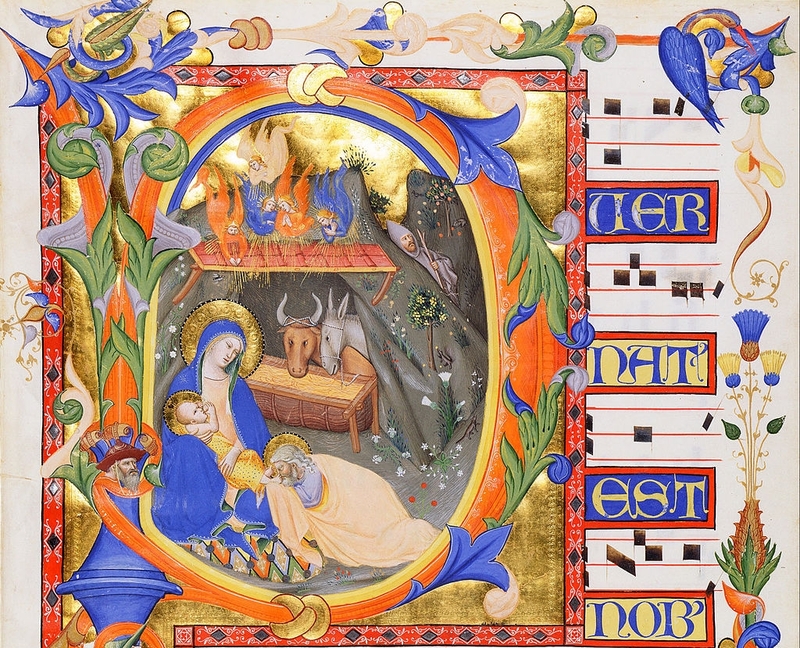
A year ago, I went down the rabbit hole of old and obscure Christmas carols. It was fun for me, and it sounds like it was fun for my readers as well, so it’s back by popular demand. Like the first edition, this will focus on mostly English language carols and songs. Some of these are Christmas songs for church services, others are more informal carols that were popular during the Middle Ages.
In today’s popular culture a carol is always a song associated with Christmas. However not all Christmas songs are technically carols, and carols were not always about Christmas. The carols of the High Middle Ages were originally associated with popular ring dances of the time. The revelers would sing the chorus while dancing and the cantor sang the verses between rounds. Carols, even Christmas ones, were always secular and not sung in church. Some carols had lyrics with lingering pagan elements, some celebrated the seasons, or even battles. The only non-Christmas carols that exist today in any form, are the Easter carols.
Ring dances and their carols fell out of style, but the Christmas themed carols survived. The Protestant Reformation’s emphasis on music kept many old carols and songs alive, now mostly translated into various European languages. English Puritan rule did not last long, but when they banned Christmas celebrations starting in 1647, it had a lingering effect on carols. The American Colonies followed suit, Boston even banned Christmas entirely from 1659 to 1681 and it was frowned upon until the early 19th century.
Caroling, its semi-pagan variant of wassailing and many traditional songs continued especially in the rural areas of England in the 18th century. It was not until the Victorians of the 19th century that Christmas carols regained their popularity in the English-speaking world. Many of the old tunes were rediscovered and countless others have been composed ever since.
For your listening pleasure, here are 6 more obscure, nearly forgotten Christmas carols that will have you thinking of yule logs, Medieval feasts and bowls of hot wassail. Make sure to break one of these out at your Holiday party and see what kind of looks you get!
Veni Redemptor Gentium: 4th Century
This is actually not an obscure song, since Veni redemptor gentium (Come, Redeemer of the Nations) is still popular with many congregations. However it is another ancient hymn that, similar to Jesus Refulsit Omnium, could be considered one of the first Christmas “carols”. It was written by none other than Saint Ambrose of Milan and is traditionally sung during Advent. Ambrose preached in a time when Arianism was still a competing version of Christianity. The very concept of Advent and celebrating the birth of Jesus on December 25th was officially codified during this time. This makes Veni redemptor gentium truly one of oldest songs associated with what we now celebrate as Christmas.
Veni redemptor gentium has been translated and modified over the centuries. Martin Luther liked it so much that he translated it into German and is still a popular version today. There is also an English version with different music, but the original version is my favorite. This is a song that makes you feel like your attending Christmas Mass at the end of the Western Roman Empire – I can almost smell the incense.
Anni Novi Circulus: 12th Century
I had to include a Sicilian Christmas song once I found one from the Middle Ages. While some of the Normans were consolidating their hold on England, their cousins were doing the same in sunny Sicily. Both groups brought with them poetic traditions from Normandy that were reimagined in their new lands. This song is for a New Year’s celebration and found in the Troparium de Catania, a 12th-century Norman manuscript.
Anni Novi Circulus is an example of a conductus – a religious song with original lyrics and music, instead of using a familiar tune or lyrics. Some of these were used during Mass, but this one was most likely used in secular processions or performances. It is so obscure that I could not find the lyrics, or the correct folio image on the Biblioteca Nacional de España website. However it has been rediscovered by various historical musical groups dedicated to preserving the music of the troubadours.
Gabriel fram Heven King: 13th Century
This Medieval carol, known in Latin as Angelus ad virginem is basically a poem put to music about the Annunciation as told in the Gospel of Luke. This might be familiar to any Chaucer experts, since this version is mentioned in “The Miller’s Tale”. It is traditionally sung for Advent with both the Latin and German versions still performed during Christmas time.
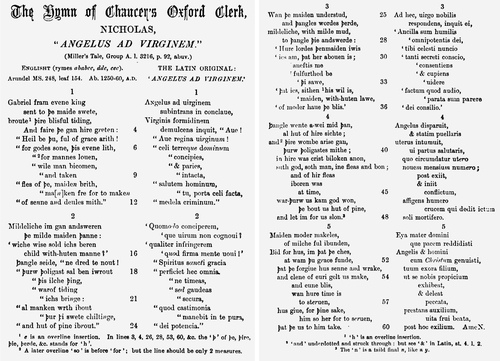
When Angelus ad virginem arrived in England, sometime in the early 13th century it was translated into Middle English as Gabriel fram Evene King, later modified to Gabriel fram Heven King. However it is not a direct translation. the English version faded in popularity by the late 16th century.
Nowel syng we now: Early 15th Century
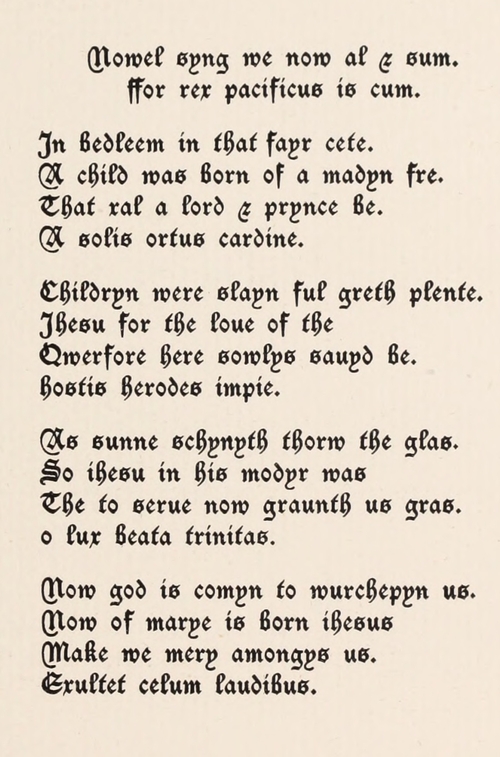
Nowel syng we now is one of several Medieval English Christmas carols found in the 15th century Trinity Carol Roll, the oldest collection of English polyphonic music. This is another example of a macaronic carol, like The Boar’s Head Carol from the original post. Carols like this are mostly in English with the final line of each verse and the chorus in Latin. The early carols within this collection are rare in that both the music and the lyrics were preserved.
Public Domain
This carol was popular in England long enough for the lyrics to be modernized. Today it is often known as Nowell sing we both all and some, reflecting slightly more modern language. Like many of these obscure carols, they are still sung and performed by church choirs as well as historical music organizations. It has a great Medieval feel to it that should really get you into the Christmas spirit.
Welcome Yule!: 15th Century
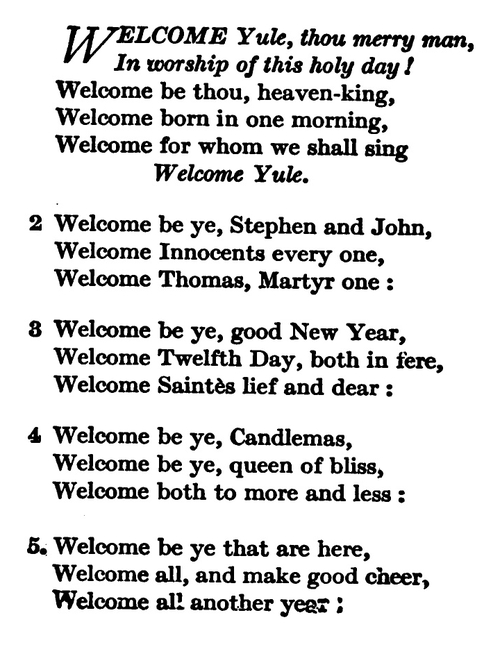
The earliest surviving copy of this traditional yuletide carol dates to 1430, in the collection of John Audelay. He was a priest from Haughmond Abbey, in Shropshire England that documented or created some of the oldest surviving English Christmas carols. It is unknown if Audelay wrote Welcome Yule! or just documented it as a popular Christmas/yuletide carol of his day.
From: Oxford Book of Carols
Welcome Yule! is a secular carol of merriment, sung in a festive way, yet is full of religious symbols of the holiday time. It certainly could have come from the hand of a priest-poet as a way to tell everyone to have fun, but remember who you are really celebrating.
Come, Mad Boys: 1642
This carol is considered one of the “new” carols of the 17th century, right before the Puritans banned Christmas in England. Come Mad Boys, Be Glad Boys is all about merriment and the celebrations held on Saint Stephen’s Day, December 26th, the 2nd day of Christmas. It’s time to be glad and celebrate with the “smoking bowl” of mulled wine, strong beer and mince pies.

From: Ancient English Christmas Carols, 1400-1700
Of all the versions I could find, some fast, some slow, this one fascinates me. I love how she sings of happy times, but in a way that recalls the bit of madness many of us feel during Christmas time. Manic, drunk, trying not to think of January’s credit card bill, yes this version fits today’s Christmas. This may be a strange one, but I might have to play it while pouring myself a second glass of tawny port.
Thank you to all for letting me go another round with these nearly forgotten Christmas carols. I must admit it is a lot of fun discovering these songs and blasting them at home while I cook as part of the “research” process. Let me know in the comments what the others say when you break out one of these festive songs. Do you know any strange or obscure Christmas songs? Send them my way for next year’s list!
Merry Christmas and Happy New Year everyone, thank you so much for helping this little history blog grow.
Sources/More Information
Dearmer, Percy, et al. The Oxford Book of Carols. United Kingdom, Oxford University Press, H. Milford, 1928.
Fuller-Maitland, J. A. English Carols of the Fifteenth Century: From a Ms. Roll In the Library of Trinity College, Cambridge. London: Leadenhall Press, 1891.
Furnivall, F. James and British Library. The Harleian Ms. 7334 of Chaucer’s Canterbury Tales. London: Pub. for the Chaucer Society by N. Trübner & Co., 1885.
Rickert, Edith. Ancient English Christmas Carols, 1400-1700. New and cheaper ed. New York: Duffield, 1915.
Parker, Elenor. Nowell Sing We. published on Corymbus.co.uk, December 22, 2015.


I like that Bad Boys carol, too, because it sounds like a good and accessible party, for good and bad kids alike – in contrast to the day reckoning that Christmas is often suggested to be. Santa: “Have you been a good boy or girl?”
That one makes me think Christmas of old must have gotten pretty wild at times.
Well they’re not as catchy as Frosty the Snowman 😊 Thanks for sharing this. Maggie
I really hope someone breaks these out for a party and records the looks on everyone’s faces…Thanks for reading!