
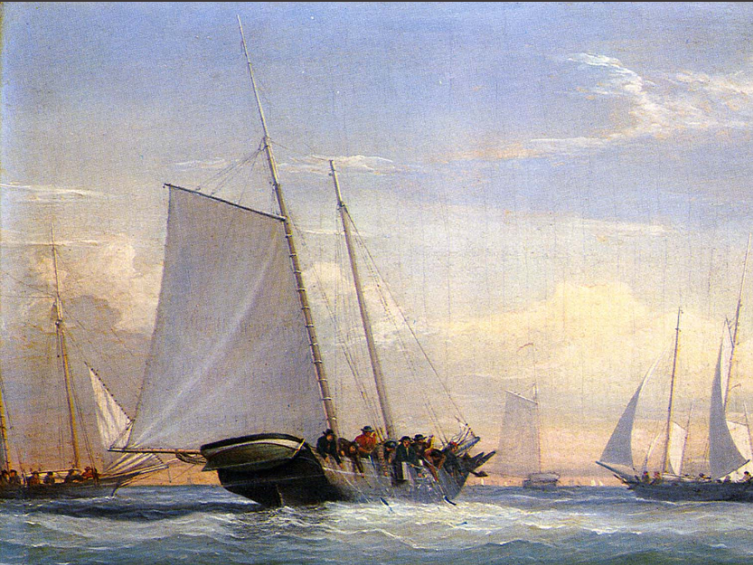
Editor’s Preface: This is part two on how and why Gloucester, Massachusetts lost so many fishermen in the 19th century. Be sure to read part one.
The fishing industry of Gloucester is almost constantly undergoing changes in its character and methods. Within the last thirty five years an almost entire revolution has been wrought in the business.
The Fisheries of Gloucester (1876)
The Grand Banks fleet of New England was the nucleus of the American fishing industry, beginning in the 17th century. By the 18th century hundreds of schooners, built to fish for months at a time, were on the distant grounds off Newfoundland for cod. At this time it was Marblehead, Massachusetts that was the great colonial and early American fishing capital. Gloucester had the second largest Grand Banks fleet until the British blockade of the Revolution left it in shambles. What was left of their fleet would dwindle and owners didn’t rebuild after the war. The start of the 19th century saw the port’s focus shift to inshore fishing and trade with Europe and Suriname.
Gloucester slowly began to refocus on fishing after the War of 1812, and each decade saw the fleet and shore-side infrastructure improve. A large fleet of rugged little vessels called Chebacco boats, fished the Gulf of Maine for cod, haddock, hake and seasonal mackerel. Year by year they grew the inshore fisheries and brought fishing back to Gloucester Harbor. Markets reemerged beyond local consumption. The fleet of boats and small schooners were increasing in size, and ranging farther offshore in the search for fish.
Gloucester’s rise to the top was sealed when a terrible storm, possibly a hurricane, wiped out Marblehead fleet in September of 1846. This marks the beginning of the end for Marblehead as a fishing center, however Gloucester was already starting to catch up by the 1830’s.
There are 198 vessels, 100 boats, 1116 men engaged in the fisheries of the district of Gloucester, and the value of the salted and fresh fish, annually taken, is estimated at $440,340.
Gloucester Telegraph: February 13, 1839
Gloucester was just beginning to rebuild her Grand Banks fleet by this time. A new model of “salt banker” came out of the Essex shipyards during this time and now took up space among the pinkies and merchant vessels. However the rebirth of the fisheries, its exponential growth, and incredible death toll, would not begin off the coast of Newfoundland. That story begins closer to home.
Fishing on Georges Bank
Credit: SeaWiFS Project,
NASA/Goddard Space Flight Center, and ORBIMAGE
via Wikimedia Commons
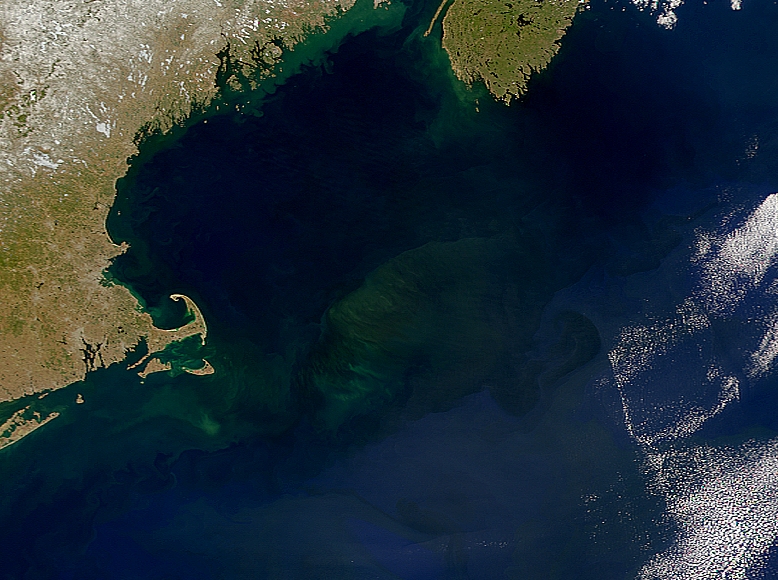
The 1820’s began with some daring Gloucester fishermen opening up an entirely new fishing ground. It would not be the bounty of the Grand Banks that would bring Gloucester to the forefront, it was Georges Bank. Originally called St. George’s Bank, this large underwater plateau rises up from the ocean floor, about 100 miles from Gloucester. Like the Grand Banks, it was teeming with cod, haddock and halibut. Unlike Grand Bank and the Cape Shore of Nova Scotia, Georges Bank was not much used as a fishing ground.
Strong tides, huge waves and shallow waters made Georges Bank notoriously dangerous in the days of sail. The area was not well charted until the late 1830’s and large merchant ships would founder in storms or even run aground on the shallows at low tide.
Between daylight and sunrise of the second day of our voyage, when more than a hundred miles from the nearest land, we found ourselves in shoal water, with fearful breakers just ahead. As quick as thought at the order was given to change our course, and yet was it almost too late. A moment more and all had been lost; for though the ship obeyed the rudder with an almost miraculous celerity, yet so near was the shoal, and such headway had she, that in turning, she rose high on a lofty surge.
New York Spectator: June 1, 1842
The belief at the time was that a vessel attempting to anchor on Georges Bank to fish would be pulled under by the current. Fishermen knew there were fish there, early charts mentioned cod and halibut grounds, but the risk was considered too great. However, the growing fleet of small to medium sized fishing schooners were in need of new grounds as the coast was fished out of cod and haddock. These vessels were mostly nimble double-ended types known as pinky schooners that were very seaworthy, but were not large enough to be profitable on the distant banks.
The Fisherman’s Memorial and Record Book declares 1821 as Gloucester’s first attempt to catch cod on Georges Bank. Three prominent Gloucester skippers: Samuel Wonson, of the THREE SISTERS, Elisha Oakes, of the EIGHT BROTHERS and Robert Marston, of the TWO FRIENDS, sailed out and proved you could safely anchor on Georges. After that, Georges Bank was Gloucester’s virtual private hunting ground, first for cod, winter haddock, and then halibut – the new darling of the New England Fisheries.
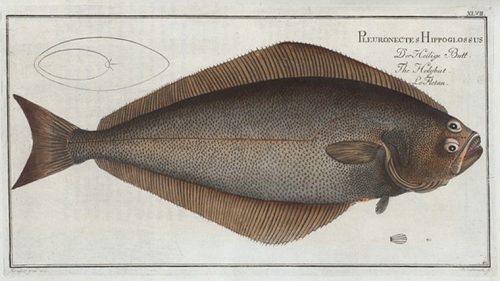
Atlantic Halibut: From Trash to Treasure
From: Allgemeine Naturgeschichte der Fische (1785).
Modern consumers will find it strange that such a valuable fish in today’s market was once unpopular, at least in North America. The giant fish was formerly considered trash fish compared to cod and was often not worth bringing in, the fish took up too much space for its value. Instead, halibut were often smoked over the hearth by the fishermen or brought home for their families to eat. Up until the 1830’s, less than 3000 fresh halibut were brought in annually for local consumption. The fish could not be shipped fresh at this point, and salted or pickled halibut was not at all popular. An exception in these early days was halibuts fins, which were trimmed and pickled in brine.
The Georges Bank fishermen of the 1820’s considered halibut a pest, swimming to the surface and chasing the cod away. After landing one or two large fish, they would kill and dump the rest in an attempt to catch cod. Bringing in any more would risk making the trip unprofitable. Thanks in part to some enterprising fish dealers, Halibut would undergo a transformation in the marketplace. By the next decade, halibut’s popularity was creating an underwater gold rush as markets emerged and demand rose.
The 1830’s saw vessels head to Georges Bank for halibut on a regular basis, and by 1835 it was becoming a mainstay of the Gloucester fishing fleet. Some halibut were brought in salted like the cod, and sold as “flitched” halibut. This product was smoked and became a popular salty snack item often seen in saloons and served the same role as free salted peanuts. However, the demand for halibut was not driven by the salted product, it was the growth of the fresh fish market.
Gen. Dearborn relates some interesting facts respecting the Massachusetts Fisheries, particularly the great additional number of halibut taken since the facilities by railroads furnished opportunities of disposing of them, at a distance, in a fresh state. But he has omitted to mention that the flesh is cut in strips from the large back bone, and the fins or edges are pickled and packed in barrels and kegs, and the other parts, dried, and some smoked, tied up in bundles like jerked beef, are sent all over the country.
Boston Courier: February 7, 1839
Even before the railroad arrived in Gloucester, the early rail networks connecting the large East coast cities were increasing demand for halibut. By 1839, about 16,000 fresh halibut, with an average weight of 50 pounds were shipped to New York City by rail and steamboat. Rail expansion also allowed for the transport of fresh fish to places where only salted fish could be obtained. Refrigerated box cars using block ice helped to expose consumers to fresh halibut, and now they wanted more of the large white fish. These market forces necessitated changes in commercial fishing, both in vessel design and preservation methods, over the next few decades.
Mackerel Rises in Importance
Meanwhile, another rush was on during this period, the mackerel fishery had taken full hold after decades of few or non-existent fish. This unpredictable boom-or-bust fishery was Gloucester’s saving grace at times when other branches of fishing were in a lull. The mackerel fleet was originally small and stayed close to home, but would eventually grow to a large fleet venturing as far north as the Bay of St. Lawrence. These fish were salted, much of it was exported to the southern United States and also to Europe.
This was all made possible by the creation of a special hook called a mackerel jig, shortly after the War of 1812. A Cape Ann fisherman named Abraham Lurvey is credited with encasing the shaft of a mackerel hook in lead and polishing it so it shined when pulled through the water. The mackerel are attracted to the shine and can be quickly hooked. This became more effective when combined with the use of a chum slick of minced bait fish. This method was revolutionary and created a seasonal fleet of small to medium sized schooners called the “jigger fleet.”
Another innovation arrived in the 1850’s to make mackerel fishing even more efficient: the purse seine. Year by year the mackerel fleet converted to this style of net fishing and the jigger fleet dwindled. Seining is best performed with large crews and swift schooners in order to encircle an entire school of fish.
Much like the halibut market, mackerel fishing vessels would have to change to better suit the new conditions. More fish could now be caught, meeting the growing demand. This demand was growing as a consequence of the railroad allowing Gloucester fish to penetrate deeper into the country. The Gloucester branch of the Eastern Railroad arrived just as all these forces were lining up.
The Railroad Connects Gloucester
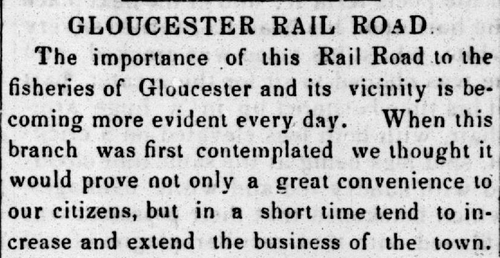
Gloucester was proving it could catch the fish, and now with their own rail line, they could ship it further afield. The tried and true cod was joined by the once-neglected halibut and the risky mackerel fishery was now steady and profitable. Ice and rail also allowed for the growth of the fresh haddock fishery beyond local markets and increasing its popularity.
Since the opening of railroad communication with Gloucester in 1846 [1847], but more particularly during the past dozen years, an immense business has been done in shipping fresh fish to all parts of the country, the orders being received daily by telegraph, and the fish being iced and shipped direct to distant customers.
The Fisheries of Gloucester (1876)
The Stage was Set for Disaster
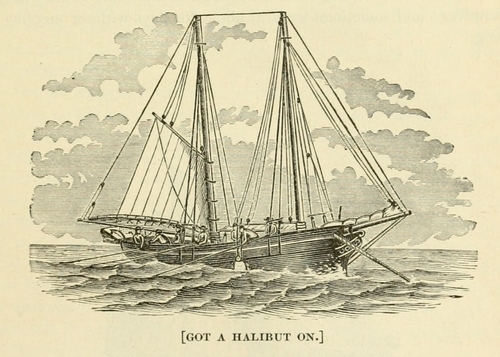
From: Fishermen’s Own Book (1882)
Up until the year the railroad arrived in late 1847, Gloucester losses at sea had been relatively modest. The next decade would see new types of fishing schooners, new fishing equipment, and the start of a tragic legacy of lost fishermen. The growing demand for fish, and an increasing desire for fresh fish, began to drive the growth of the local ice industry. With a larger proportion of the fleet devoted to fresh fish, new schooner designs emerged to bring the catch quickly to market. This need for new fishing vessels created a boom to the local shipbuilding industry, centered in the town of Essex, Massachusetts.
The salt fish market also grew on pace with the new Nation and saw changes as new markets demanded more fish. By 1860, American fishermen had adopted the “French style” of fishing of using trawls on the distant banks. Instead of catching cod and halibut from the rail of the schooner, the fishermen now set a ground line of hundreds of hooks. Trawl fishing was made very successful thanks to the development of the banks dory: a traditional flat-bottomed rowboat adapted for offshore fishing. This innovation spurred the development of numerous outfitting and fishing equipment manufactures as crews got large and required more gear.
On all fronts, the market forces at play demanded more fish, leading to rapid growth in the Gloucester fisheries. Schooners got larger and faster, with larger crews that required a mountain of supplies every trip ranging from bait to mittens. Dozens of ancillary industries sprung up to meet the needs of the growing workforce. Gloucester became a notorious fishing boom-town, with modest fortunes won and lost on land and sea. By the early 1880s, this new prosperity was being overshadowed by the tremendous cost in lives and property it took to earn these modest fortunes.
Part III will discuss the changes in fishing schooner design and fishing equipment that played a large part in Gloucester’s fishing disasters.
Sources/More Information
Cape Ann Advertiser, Gloucester Daily Times. Digitized by Sawyer Free Library/Advantage-Preservation
Down to Sea: Men Lost Fishing From Gloucester in the 1800s
Fitz Henry Lane Online by Cape Ann Museum
Dearborn, H. A. S. “Correspondence of Gen. Dearborn No. VIII.” Boston Courier, 4 Feb. 1839. Nineteenth Century U.S. Newspapers. Gale Primary Sources.
Goode, G. Brown: The Fisheries And Fishery Industries of the United States. Government Print. Office, Washington 1884-87.
Morris, John: Alone At Sea, Gloucester in the Age of the Dorymen (1623-1939). Commonwealth Editions, Beverly, MA 2010.
Nineteenth Century U.S. Newspapers, Gale Primary Sources via Boston Public Library
NOAA’s Historic Fisheries Collection/NOAA National Marine Fisheries Service
Proctor Brothers: The Fisheries Of Gloucester – From the First Catch by the English in 1623 to the Centennial Year 1876. Proctor Brothers Publishers, Gloucester MA 1876.
Proctor Brothers: The Fisherman’s Own Book. Proctor Brothers Publishers, Gloucester, MA 1882.
Procter, George H. The Fishermen’s Memorial And Record Book. Proctor Brothers, Gloucester, MA, 1873.
Simmonds, Peter Lund. The Curiosities of Food, Or, The Dainties And Delicacies of Different Nations Obtained From the Animal Kingdom. London: Richard Bentley, New Burlington Street, 1859.


This is an amazing story and it is very well researched and well told.
As a shipbuilder from Essex and operator of Passenger Fisherman from Gloucester I am very familiar with the story. Yet Justin Demetri is the one to tell it! He keeps it real and interesting.
Every day out on the harbor I quote him to my guests and he deserves great credit for the revival in the interest in the subject.
Thank you Justin, you have done it again!
Harold Burnham
2012 NEA National Heritage Fellow
Master Shipwright
Thank you so much Harold!
Justin,
Justin,
Thank you for introducing me the Marblehead’s legacy and that my favorite fish was once labeled as “trash.” Interesting how that designation changes through the years as I recall when skates and monkfish earned that reputation. Researching “trash” fish through the years would be an interesting essay. Thank you once again, well done. Mia
Thank you Mia!
Justin, I truly appreciate your take on maritime history. I’ve loved schooners and clippers since I was a kid, but never knew much about them.
P.S. Just wanted to let you know why I recently took you out of the notification loop. My email inbox fills up with nearly 1,000 notices every day, so I have to limit it to notifications from those who visit regularly. Good to see you back again, and thank you for being understanding!
Thanks Mitch I really appreciate that! And no worries, I’m getting so busy that I’m both reading and writing less. I’m part of a new museum in Boston’s North End so all my energies have been focused on that. Glad you reached out, you are one of the best writers out there. Take care!
Thank you, Justin. Hope your new museum endeavor is a smashing success!