
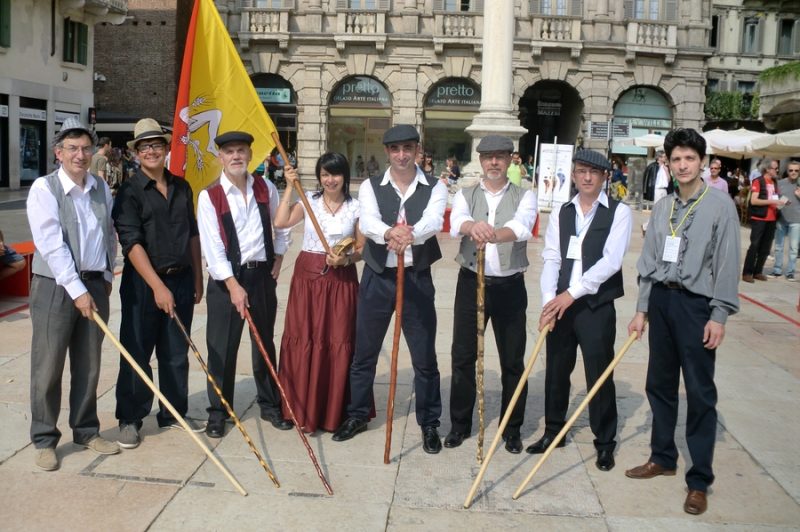
Sicilian-American families treasure the customs and traditions from their ancestral homeland. However, for all the wonderful things that are remembered, there is quite a lot that is forgotten. One set of traditions that I wish had trickled down to my childhood are the various Sicilian martial arts, especially the system of stick fighting known as Bastone Siciliano.
Martial arts were popular in my neighborhood. Boxing was big among Gloucester’s Sicilian fishermen since the 1920’s. Asian martial arts like Kung-Fu, kickboxing and Judo went nationwide thanks to Bruce Lee and by the 1980’s, The Karate Kid franchise saw dojo’s pop up everywhere. Karate and Ninjas were big, but if we knew there was a tradition of stick fighting from Sicily, all us kids would have stolen our mom’s broom handles for fighting sticks.
Unfortunately I started learning about traditional Sicilian martial arts after the point where my body no longer cooperates. Regardless, it is a fascinating world that mixes our colorful heritage with the arts of self-defense. With Sicily’s turbulent history, why wouldn’t the common people have a secret system for defending themselves? If any of Europe’s peasant cultures had a clandestine fighting style, it would be the Sicilians.
In the Crosshairs of Conquerors
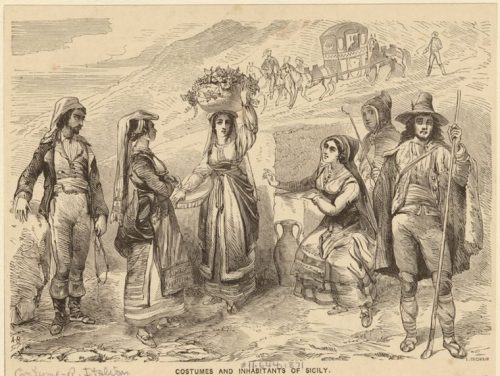
Credit: NYPL Digital Collections
The Sicilian people have endured waves of invaders going back thousands of years. The Phoenicians, Greeks, Romans, Arabs, Normans, French, and Spanish have all ruled the island to a greater or lesser degree and some, better than others. In the vacuum of such powers, elements of Sicilian culture began to form in order to take advantage of absentee rulers, hence the Mafia. For the average Sicilian peasant, there were pitfalls all around, covetous eyes wanting to take what little you have gathered for yourself and family.
A shepherd tending his flock in the lawless countryside ran the risk of bandits, the guard dogs of noble landowners, and the now-extinct Sicilian wolf. The bastuni, a simple but sturdy walking staff, ever-present in rural life, quickly doubled as a tool of defense. Over the centuries, this simple but effective form of defense evolved into a codified and honorable martial art.
Bastone Siciliano – Paranza Lunga: Origins

Credit: bastonesicilaino.com
The origins of this indigenous Sicilian martial art (vastuni sicilianu), which also goes by the name paranza lunga are naturally obscure. Very little was written down, even today, which makes researching very difficult. It originated in a time of need, from humble people, out of a simple shepherd’s walking stick. So of course, legends grew in place of a true origin story. One of these legends, similar to the story of the 100 Horse Chestnut Tree, involves a royal contingent traveling through Sicily.
Oral traditions tell of a King traveling through a rugged Sicilian pass with his royal escort. They were ambushed by a band of brigands and the King’s guards were defeated. All seemed lost…until, from the craggy heights above, a lone shepherd descended like a Sicilian Mr. Miyagi.
The shepherd wielded his walking stick, moving with a grace and ferocity that stunned the attackers. With swift, targeted blows, he drove the bandits off, saving the King and his retinue. One version says the shepherd refused reward, disappearing back into the hills like a true Sicilian badass. Another version says he was knighted on the spot. It is doubtful that this story is intended to be true, it acts more as a testament to the power of the bastone and the humble man who could wield it like a blade.
Development as a Martial Art
What sources there are, seem to agree that Bastone Siciliano/Paranza Lunga originated in the 13th century during the infamous Sicilian Vespers. When ruling Angevin French banned the indigenous population from carrying swords, the Sicilians picked up sticks and staffs, using techniques based on the broadsword, two-handed longsword, and pole-arms.
Techniques were passed from father to son, and taught to others in secrecy. From here the different traditions began to form across the island as the folk traditions began to be codified into secret schools. Similar to Japanese/Okinawan Karate, each Master taught their own styles and techniques. These began to coalesce into the forms seen today by the 17th century.
The bastone remained a weapon of the peasantry, but the wealthy Sicilian landowners found a way to exploit it for their own ends. Another legend claims nobles would entertain themselves by sponsoring bastone matches between shepherds and farmers for grazing rights on their land. If this is true, it is yet another example of what made the Sicilian peasantry distrustful of outsiders and authority.
Duels of Honor – Sicilian Style
Sicilian stick-fighting evolved from a simple self-defense system to a full martial art, complete with an honor code among wielders of the bastone. The practitioners, known respectfully as Tiraturi di Vastuni, consider it the most chivalrous of the island’s fighting styles. Mastering Bastone Siciliano demands restraint, finesse, and a deep understanding of distance and timing. These qualities made it ideal for settling disputes in honor-bound, semi-ritualized duels.
Firearms would render the stick obsolete in self-defense, yet it endured clandestinely, in the form of these ceremonial duels. The traditional styles continued to be passed on by elders into the 20th century. An integral part of this tradition, is learning how to craft your own fighting stick.
Crafting the Stick: From Wood to Weapon

Credit: Sikania in Movimento
Crafting a fighting stick was part of the training, like a young Jedi building their lightsaber. The traditional fighting stick goes by several names: bastone in Italian, bastuni or vastuni in Sicilian, depending upon the dialect. The preferred length is about 1.2 meters, just under 4 feet, enough to wield with both hands while retaining speed and control.
They were, and in some cases, still are, fighting sticks sourced with care, from the rugged Sicilian countryside. There are many species of tree or shrub that make for a good fighting stick. However, there are four species that are highly sought after for the bastone : wild olive (Agghiastru), bitter orange (Aranciu amaru), wild pear (Piru prainu), and the rare rosella (Rusedda). Each species is chosen for its strength and from the bit of folk wisdom that speaks of the “spirit” that resides in the wood.
Un bastuni bonu spacca ‘na spata – A good stick can break a sword.
Traditional saying of the Tiraturi di Vastuni,
Sicilian folk traditions play a big part in crafting a bastone, each unique to the particular Master passing on his knowledge. Harvesting the wood was done at specific times of the year, often in alignment with lunar cycles or weather conditions believed to enhance the wood’s resilience. In some families, it was said that if you gathered the branch at the wrong time, the stick would never “wake up” properly, it would remain a regular wooden stick and be no use in a fight.
Credit: Sikania in Movimento
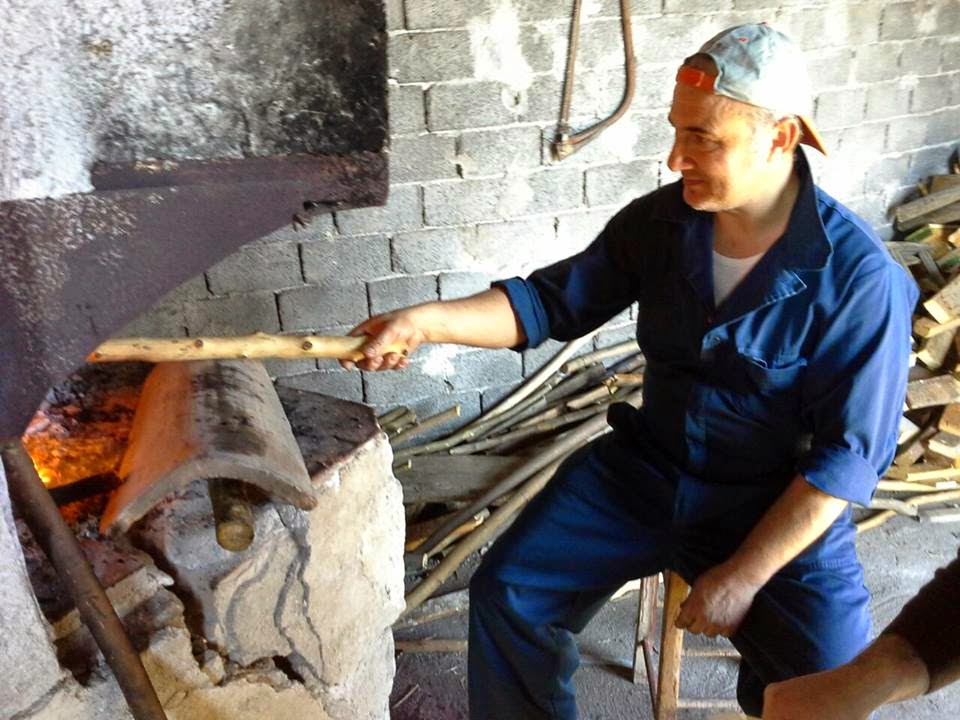
The preparation of the stick after harvesting involves a careful tempering of the wood with fire. The flames burn away the bark, remove moisture, and allows for crooks or bends to be straightened by hand. The wood is then left to season and mature, often for months. The end result is a deceptively light stick that is tough enough to survive smashing blows against stone or concrete.
Each bastone made in this fashion is unique to the creator. Some are smooth while other sticks are left with large, gnarled knots that can be used to devastating effect in combat. In skilled hands, the knots are used to target the wrists, elbows, and cheekbones, ending the fight very quickly. However, skill is the key word here. It is under the tutelage of a Master that really turns this walking stick into a deadly weapon.
Masters of the Stick: The Surviving Fighting Styles
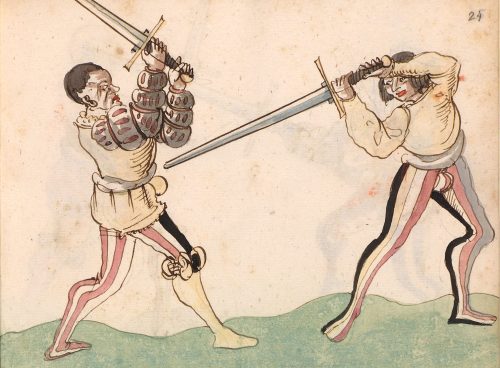
From: Wilhalm/Sollinger Fechtbuch (Cod.I.6.2º.2_24r)
From the clandestine schools of past masters, several styles of Bastone Siciliano survive today, known as Tirata. The most common styles are similar to the popular longsword techniques of the high Middle Ages and early Renaissance. German and Italian fencing manuals from that time show forms and positions still used in Bastone Siciliano. A two-handed high guard is used, with the stick kept in constant motion, travelling around the head in various serpentine circular movements known as Muliné, until it is time to execute a strike or parry.
The most enduring Tirata are the Cavalleresca, known for its refined and knightly style, Fiorata uses smooth, fluid, movements to hide deadly precision attacks. The Battuta school is known to be a rough and more forceful interpretation, while the Ruotata, of eastern Sicily, is known for its signature circular motions and big sweeping arcs of the fighting stick. Among modern practitioners, Tirata Fiorata and Tirata Ruotata are the most popular. All of these fighting schools practice the two-handed style, but the Giocata school from the Messina region, uses one-handed techniques.
To an observer, the swinging sticks and the exaggerated movements, make it looked like a dance. But this dance becomes deadly when the defensive movements quickly switch to attacks. Lightning fast blows to the head, face and throat or hits to the chest and lower abdomen, can all be put to deadly effect. Each of these schools are both a fighting style and a cultural fingerprint, shaped by local history, geography, and personalities of the past Masters. While they may differ in form, they share a common soul: the defense of honor, and the enduring pride of a people hardened by necessity.
Bastone Siciliano is Reborn as a Sport
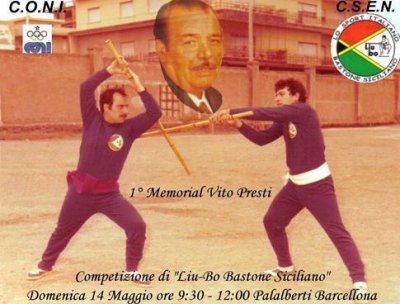
The traditions and skills of Bastone Siciliano almost disappeared as modern life took over Sicily during the second half of the 20th century. Life was less wild, even in the countryside, but when violence was called for, firearms or the traditional Sicilian stiletto were far less conspicuous. In the 1970’s, the traditional martial arts of Sicilian peasants and shepherds began to be codified into a contact sport before it was too late.
It started when researched sought out one of the last great masters, Vito Presti from the town of Barcellona Pozzo di Gotto. They documented the customs and traditions of this dying martial art and gave it new life with the help of Presti. Several Sicilian gyms, including one operated by Presti and his son helped to spread Bastone Siciliano to new generations of Sicilians and members of the Sicilian diaspora worldwide.
Liu-Bo: A Modern Form of Sicilian Stick Fighting
A popular variant of modern Bastone Siciliano has been codified by Judo Master Letterio “Liu” Tomarchio and is called Liu-Bo: A conjunction of the master’s nickname and Bo, the Japanese word for stick. Master Liu was inspired to create this hybrid martial art after his father, a then-70 year old Bastone master, deflected any blow thrown at him using a simple broomstick. Today Liu-Bo has spread in popularity throughout Italy and is recognized today by their National Educational Sports Committee (CSEN).
L’ Associazione Nazionale Bastone Siciliano was established in 2013 in part by Master Antonino Tomarchio in order to further promote this indigenous Sicilian martial art and the cultural traditions that surround it. Bastone Siciliano has emerged from the shadows to be taught in gyms and dojos. Like many martial arts, sparring and tournaments are co-ed and span all ages, since skill with the bastone is more about technique than strength.
Final Thoughts
This was a fascinating bit of research, and yet after two months I really don’t know much about Bastone Siciliano. It was very difficult to find images of traditional use and even the Italian/Sicilian sources often just repeated the same information. But then I had to remind myself: Sicily is a secretive place.
Even though Bastone/Paranza/Liu-Bo has transitioned into an organized, sanctioned contact sport, the old ways still persist. When reaching out to one organization about the traditional ways, I was told flat out that the true story of the Sicilian stick is not disclosed to outsiders.
Sources/More Information:
Associazione Nazionale Bastone Siciliano
ILUDUM – Science Center Catania: Leggendari Bastonieri Siciliani

