
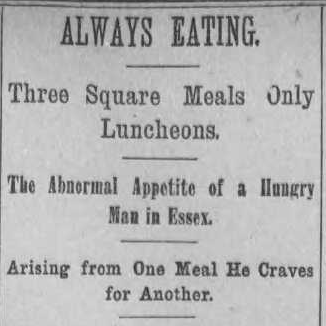
Small towns can produce some interesting people, and for my money, the town of Essex, Massachusetts has produced more than its fair share. This historic town, known to the world for its wooden ships and fried clams, has been home to the brilliant, the strange, the strangely brilliant, and the brilliantly strange. One of the town’s once-famous, now forgotten, eccentrics was an old woodworker named Samuel Morse. At the end of the 19th century, he became known along Boston’s North Shore as “The Hungry Man of Essex.”
I first came across the so-called “Hungry Man” while researching my article on Buffalo Bill Cody. He was certainly a person of note, showing up in the jottings like mentioning a celebrity sighting at a local restaurant. My first introduction to him was a single line stating the Hungry Man went to see Buffalo Bill, and was as hungry as ever. Whoever he was, he was famous enough that the Gloucester Daily Times assumed the reader would know. Well, now I needed to know more.
Samuel Morse: Essex Ship Joiner
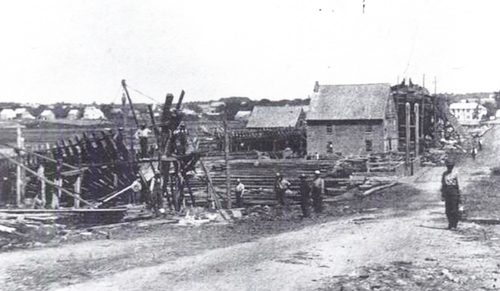
Shipyards along the Causeway in 1872
Credit: Essex Historical Society and Shipbuilding Museum
Samuel Morse was born into the booming Essex shipbuilding industry of the 19th century. Over a third of the men of Essex were employed in some way, in the construction of wooden vessels. During Morse’s career, Essex shipyards were pumping out wooden masterpieces at a torrid pace. They mainly took the form of beautiful fishing schooners for the Gloucester fishing fleet.
Each job on site held a certain level of prestige and at the top of the heap, were the joiners. The joiners, especially the inboard joiners, were the “aristocrats” according to late shipbuilder/historian Dana Story. They made top money creating the finished interior of the vessels, including fine panel work of cherry or birds-eye maple for the captain’s cabin. They didn’t even have to sweat it out in the shipyard like the rest of the gang. Inboard joiners usually worked at their own workshops until it was time to install their finely crafted works.
Your reputation for hard work was your job security in the old Essex shipyards, and the role you played defined your status. A man who did quality work, at the fast pace required, would never have to look for employment. Essex was (and still is) a small town, and back then, everybody knew everybody’s business. Word traveled fast and even an “aristocrat” inboard joiner could fall out of favor and get a bad reputation.
Strange Symptoms in His 60’s
On March 11, 1887 the Cape Ann Advertiser ran a wire story about a young boy, Henry Flower of Indiana, with an insatiable appetite. Doctors could not explain how a 14 year old could eat so much and not gain weight. This inspired Samuel Morse to send a letter to the Advertiser stating his own symptoms, which he claimed were worse than the Indiana boy.
The newspaper sent a reporter to learn more about Mr. Morse and ran the first story of his plight on April 22, 1887. He is described as a sixty-year old man of average weight and gives the appearance of a “well-preserved man of his age.” Morse states that he has suffered with an insatiable appetite for the last seven or eight years that has left him unable to work.
The first symptoms which he noticed was a feeling of extreme sleepiness at all times. Though taking his customary rest at night, he complained of a stupid feeling during the day, similar to a man who has been kept without sleep by overwork, which increased upon him until at times he would be obliged to thrown down his tools and lie down from sheer exhaustion. About this time he began to be troubled with boils on different parts of his body and also had a carbuncle appear on his shoulder, which was treated by Dr. Hull of Essex, who applied caustic, since which time he has had no trouble in this respect.
Cape Ann Advertiser: April 22, 1887
Once the boils were gone, Samuel Morse then became ravenously hungry. His symptoms now consisted of the unexplained hunger, extreme fatigue, and an intolerance to cold. Interestingly he also acquired an extreme tolerance to heat. Morse went on to describe how he could eat a hearty dinner and feel hungry again by the end. Like all Essex shipwrights, he was in bed as early as 7 PM, but was tormented by dreams of elegant dinners and feasts that often got him out of bed for another meal. He tried fasting, he also tried gorging himself, but neither had any effect on his condition.
A few days later, the news hounds at the Boston Globe had their own piece, which spread the story to a much wider audience and gave him the moniker of “The Hungry Man”. From here on, the local papers kept tabs on his dealings, often with the refrain of “he’s still hungry” or the like. He must have enjoyed the attention because he would occasionally stop by the newspaper’s office in Gloucester to give them an update.
On a visit to the Cape Ann Advertiser’s office in April of 1889, The Hungry Man told how his hunger has only increased since their original story. Morse told how he recently bought 4.5 pounds of lamb, cooked it into a broth (I assume he means some sort of stew) and ate it all in 2 hours.
Almost a Sideshow Freak: The Lynn Musee
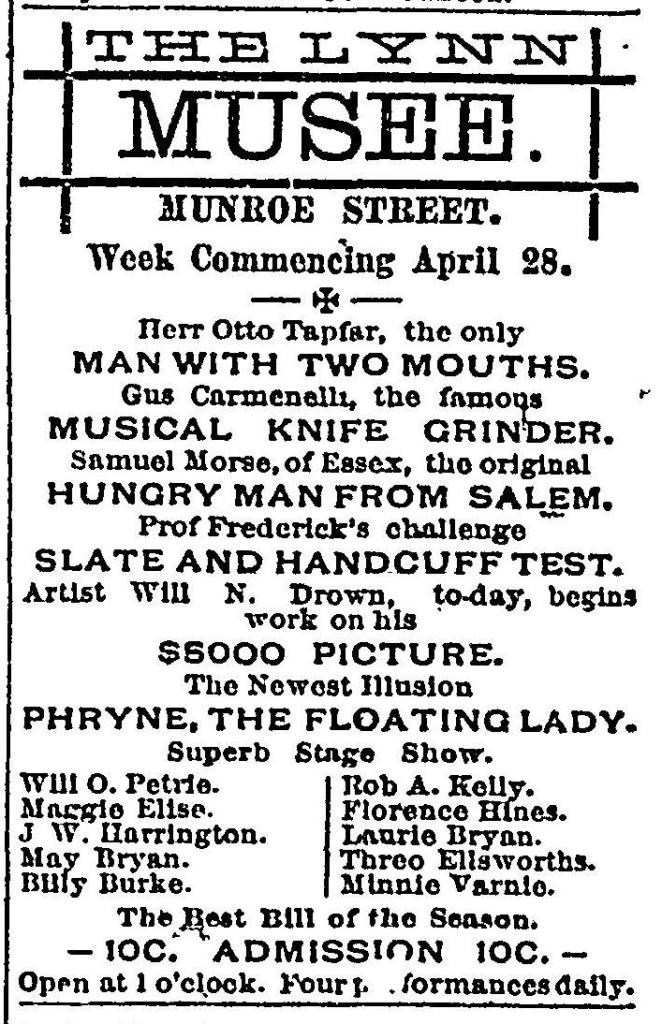
Lynn Daily Evening Item: April 29, 1890
The Hungry Man’s visit to the newspaper caught the attention of Charles E. Cook, the manager of the Daniel Boone Company – apparently a Buffalo Bill style show. They were performing at Gloucester’s City Hall when Cook learned about Samuel Morse from the recent article. Mr. Cook visited The Hungry Man at his home in Essex where he was convinced to showcase his condition for both entertainment and for the benefit of the medical community. A business contract was drawn up where Cook would pay The Hungry Man a weekly salary, room, board and transportation fees, in order to exhibit him.
Nothing else was heard about this until the end of April of 1890. A year after the contract was signed, it was announced that The Hungry Man would be exhibiting his “talents” at the new Lynn Musee. This was Mr. Cook’s short lived dime museum in Lynn, Massachusetts that exhibited sideshow “freaks” and other forms of entertainment. Samuel Morse, still under contract, was to perform at the museum under the name “The original Hungry Man From Salem.” However The Hungry Man never showed up and a month later sued Charles Cook.
Samuel Morse, said he was offered $40 per week but was never paid and so he took Cook to court for breech of contract. Cook as defendant, claimed he was defrauded by the supposed claims of The Hungry Man’s talents. He said Morse was faking his condition and did not show up because he could not perform as he claimed.

Francois Bildstein (1889) Public domain
The thing about dime museums, and their proprietors, is they were often shady venues run by shady people. They blurred the line between circus sideshows and actual museums and were known for defrauding the public with cheap exhibits or fake “freaks.” The Lynn Musee itself, is sort of lost to history, but the reputation of dime museums overall, was pretty bad. Needless to say, the courts were not very sympathetic to these types of entrepreneurs.
The Hungry Man’s council asked the judge to consider, how the owner of a successful dime museum could be defrauded by a ship carpenter who had never been 20 miles from home. The Judge decided in favor of The Hungry Man to the tune of $160 plus court costs. Charles E. Cook’s dime museum didn’t last much longer and was declared insolvent in October 1891.
Was The Hungry Man Sick or Just Lazy?
That was the question many in Essex asked. After all, it seemed to the townsfolk that he actually enjoyed the attention. In 1891 he wrote a letter to the Gloucester Daily Times to plead his case and kept the local press informed of his health on a regular basis.
Samuel Morse, the hungry man of Essex, has been heard from again. He states that food and liquids are perfectly useless, so far as satisfying hunger and thirst are concerned. Am perfectly wild after both without one particle of satisfaction. A perfect prostration of the whole vital forces from starvation. Science is puzzled and powerless to aid. This covers the whole ground, and nothing more can be said. In fact, it is a struggle for life.
Boston Traveler: July 22, 1892
Why would someone of his age just decide to get lazy? Morse already had a long career, was a widower with two grown children before his life changed. He was at an age when most “mechanics” of his day were ready to drop dead in their mid 60’s. However he seemed to get little to no sympathy in hard working Essex, where even the doctor didn’t believe him. He personally thought he was the victim of arsenic poisoning, but his symptoms were very different. Some called it a psychological condition, some just called him lazy, and others decided to show what they thought of “lazy” ship joiners.
Stones Thrown Through His Window.
Mr. Samuel Morse, the hungry man of Essex, claims that two stones weighing four or five pounds were thrown through his bedroom window, Tuesday evening, breaking three panes of glass and landing on the bed in which he was sleeping. Several stones had previously been thrown at the house, and he says that he proposes to have a loaded shotgun at his bedside hereafter for the reception of trespassers.
Gloucester Daily Times: May 18, 1895
Target of Quack Doctors
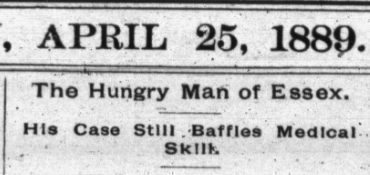
As his story spread, The Hungry Man was diagnosed by all types of medical professionals. Some more professional than others, and all of them ineffective. Over the years he claimed to have tried every patent medicine out there to no avail. Sometimes he sought this medical help, but more often he was contacted out of the blue by quacks.
In 1889 a doctor telegraphed his diagnosis of Bulimia and suggested taking a small dose of sodium bromide, along with abstaining from coffee, tea, and anything cooked in lard. Today bulimia nervosa is better understood and usually (but not always) associated with purging after overeating. However in the 19th century, it was only associated with rare cases of overeating. Bromides, including sodium bromide were common for various medical uses until banned in the 1970’s due to the effects of cumulative toxicity.
In 1893, The Hungry Man visited the dubious Frazier Medical Institute in Salem, Massachusetts where he baffled the staff. They told him only surgery would be able to figure out his strange condition. That same year, he shared a letter he received from a “prestigious” Chicago doctor who stated his hunger was caused by the “millions of microbes” that was infecting his system and stealing his energy. He claimed he could cure the condition in a month, but Morse never said if he tried his remedy.
Supposedly “Cured” by the Kickapoo Indian Medicine Company

Public Domain
By February of 1895, Morse he had lost so much weight that he was down to only 103 pounds. He had spent hundreds of dollars on treatments and medications that didn’t work. He was diagnosed with everything from nervousness to parasitic infection, and his fellow townsfolk still didn’t believe him.
In September, the Kickapoo Indian Medicine Company had brought their traveling medicine show to Gloucester’s Stage Fort Park. The Hungry Man visited and was diagnosed by Dr. Johnstone as having an enormous tape worm. The “doctor” claimed he was apprehensive about removing the parasite due to Morse’s age of 66, but gave him medications to remove the worm. The result was supposedly the removal of a tape worm that had been there so long, it was causing The Hungry Man of Essex to waste away. There was absolutely no skepticism in the Gloucester Daily Times, which took the account at face value.
The Kickapoo Indian Medicine Company was a fraud operation, that sold snake oils called “Indian Sagwa” and “Indian Worm Killer” that were mostly made up of booze and laxatives. Nothing that would actually help a tapeworm infection, if that what was truly ailing him. However the placebo effect of “sympathetic medicine” is very strong and well documented, so it is no surprise Samuel Morse felt like the procedure worked.
The Manchester Cricket reported on September 21, 1895 that The Hungry Man was feeling much better after getting the “tape worm” removed the week before. A week later in the Gloucester paper, Morse stated he had gained 15 pounds, his appetite seemed normal, but was not gaining strength as fast as he hoped. Unfortunately this didn’t last too long as he was reported to be as “hungry as ever” a few months after being treated.
For the next two years, the local newspapers would report on his comings and goings, but his notoriety was fading. In the summertime, The Hungry Man would take the electric trolley to Gloucester to visit his friends at the newspaper and deliver baskets of freshly picked blackberries. The last time we hear of Samuel Morse out and about was on June 7th, 1898. Buffalo Bill was in town and The Hungry Man was seen enjoying the spectacle at Stage Fort Park, he was as hungry as ever.
Final Days of The Hungry Man of Essex

Frank Cousins Collection
Phillips Library – Peabody Essex Museum
The Hungry Man’s story take a very sad turn shortly after his visit to see Buffalo Bill. In early August of 1898, Samuel Morse was taken to Gloucester for safekeeping, where the local doctors: Hallett and Quimby declared him insane. He was committed to the infamous Danvers Insane Asylum. From here the trail goes cold behind the frightening Gothic facade of one of America’s most notorious asylums.
In his final months of life he did actually travel more than 20 miles from home. Morse was labeled “incurable” and relocated to the Foxborough State Hospital, better known historically as a home for alcoholics. Samuel Morse, The Hungry Man of Essex died January 17, 1907 at approximately 80 years of age and was buried somewhere on the hospital grounds. There are no records to determine where he would have been buried or if the grave is marked.
Thoughts on The Hungry Man’s Condition
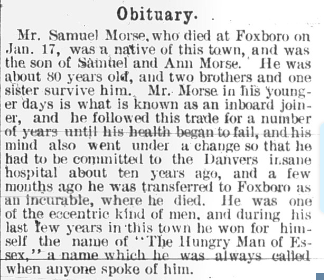
Gloucester Daily Times: February 6, 1907
I am not a doctor, but I play one on this blog. My first thought on what ailed The Hungry Man of Essex was some sort of parasite, but probably not a tapeworm. A tapeworm infestation would probably not cause such a mystery in the medical community since they were fairly common. His symptoms, especially the incredible appetite (known as Hyperphagia or Polyphagia) didn’t sound like a tapeworm, or other parasitic flatworm or roundworm.
Bacterial infections that I researched also didn’t seem to have the firm link to hunger. Morse’s personal belief in arsenic poisoning produces telltale signs, especially in lower doses and extreme hunger is not one of them. Diabetes seems to be the most common cause of polyphagia but the rest of his symptoms don’t line up. There are also hormonal and mental disorders that can cause polyphagia. The combination of fatigue, mental decline, and hunger reminded me in some ways of endemic thyroid conditions that I learned about in my anthropology studies.
Was it Grave’s Disease?
Samuel Morse may have been suffering from a type of hyperthyroidism, possibly Grave’s Disease, an autoimmune disease that affects the thyroid. Some of the symptoms of Grave’s Disease are insatiable appetite, weight loss, and severe fatigue that were The Hungry Man’s biggest complaints. The condition has a wide range of seemingly unrelated symptoms, making it hard to diagnose even today. Some sufferers get obvious signs like a goiter or the distinctive bulging eyes as seen in the late, great, Marty Feldman. Most people don’t get diagnosed until later in life, and it is much more common in women than men.
Grave’s Disease is still not well understood, but is treatable with medication. Samuel Morse lived in a time when the condition was known, but only the most obvious cases were diagnosed correctly. The Hungry Man suffered with no hope of relief, in a town where gossip was currency, and hard work was mandatory. Societal pressure to conform to the Essex way of life, must have been crushing. He thought he was cured, only for symptoms to return, which must have pulled him further into depression.
Sources/More Information
AIHP Entry: Kickapoo Indian Medicine Company
ALWAYS EATING.: Three Square Meals Only Luncheons. The Abnormal …
Boston Daily Globe (1872-1922); Apr 26, 1887; ProQuest Historical Newspapers: The Boston Globe
Cape Ann Advertiser, Gloucester Daily Times. Digitized by Sawyer Free Library/Advantage-Preservation
History of Danvers State Hospital
Lynn Daily Evening Item, Digitized by Lynn Public Library/Advantage-Preservation
Story, Dana. Frame-up! The Story of Essex, Its Shipyards and Its People. United States, Barre Publishers, 1964.

