
Buffalo Bill Cody brought his version of the Wild West to the Wild East of Gloucester, Massachusetts on at least eight occasions starting in the 1870’s. Even in the early days, Buffalo Bill was one of the most famous men in America and packed theaters nationwide. At its height, Buffalo Bill’s Wild West was at a level of world wide fame seen today in the likes of Taylor Swift or Beyonce. If Buffalo Bill came to your hometown, you knew you were on the map.
Gloucester was definitely on the map when it came to entertainment. For a small city of under 30,000, all sorts of distractions filled the City Hall and the later downtown theaters. During the fall and winter theatrical season, the crowds came out to see dramas, comedies, musicals and burlesque. Numerous fairs and circuses came to town on a near-annual basis including Barnum & Bailey, but nobody shut down Gloucester and the surrounding towns quite like Buffalo Bill could.

National Portrait Gallery, Smithsonian Institution
With the exception of some theater critics, Buffalo Bill’s popularity was practically universal, and that included the hardened Gloucestermen of the nation’s largest fishing fleet. The tall tales of the wide plains and impossibly tall mountains of the American West were the polar opposite of the Gloucester fishermen experience. The rough and tumble mix of Canadians, Irish, Portuguese, Scandinavian and Yankees that made up the 19th century Gloucester fleet, might have seen a kindred spirit in the dramatized version Buffalo Bill “winning” the west. A man who, at least on stage, seemed to have stared death in the face.
Conversely, staged Indian raids, hammy melodramatic acting, fine horsemanship and expert shooting may have been just lighthearted fun for men that might not return from the next trip. If there was an East Coast town that needed a distraction, it was Gloucester.
Little did the rest of America know, but the fish that fed them was paid for with the lives of hundreds of Gloucester fishermen. A town of widows and orphans, Gloucester lost more of its young men on the fishing grounds than on the battlefields during the years of the American Civil War. For America’s Oldest Seaport, the deaths didn’t subside when the guns fell silent. In fact, things got worse in the 1870s.
For Gloucester’s young and old, for the new widows, the kids who lost their fathers in the last gale, for the men who had to set their hooks among the bones of their brothers, and for everyone else that shared in these all-to-common tragedies, Buffalo Bill provided world-class escapism.
1870’s: Buffalo Bill’s Stage Shows in Gloucester

Library of Congress
Years before Buffalo Bill shows became a world traveling extravaganza, the part-time Army scout was packing the house in places like Gloucester’s City Hall Auditorium. These theatrical melodramas were known as the Buffalo Bill Combination shows and did not have the large casts and live animals the Wild West shows would be famous for.
Buffalo Bill the Play: April 1872
The year 1872 is well documented as the beginning of Buffalo Bill’s stage career. Following the success of Ned Buntline’s dime store novels about Cody, a play “Buffalo Bill” was created by Fred G. Maeder. Cody himself did not act in the original performances and it is possible that other theater groups staged their own versions of “Buffalo Bill” plays. One of these early shows, may have taken place in Gloucester.
The Cape Ann Advertiser on April 6, 1872 mentions a performance of the “thrilling sensational play Buffalo Bill” by Lanier’s Dramatic Company. Two shows were held at the Tabernacle Hall, giving “unbound satisfaction.” This was most likely a local short-lived theatrical company since there are no other references to them in local newspapers. A few nights previously, Miss Fanny Herring’s Dramatic Company performed at the same hall. Fanny Herring was a well known performer from her time at New York’s Bowery Theater and would later accompany Buffalo Bill on stage in his border dramas.
A few days later, someone named “Buffalo Bill” showed up in neighboring Rockport, Massachusetts. Although it seems unlikely this was actually Buffalo Bill Cody, the quote below may require further investigation:
Last Monday Eve Buffalo Bill drew a good many small bills from the pockets of the dear people, who went in crowds to the Town Hall to witness his delineations of wild life.
Cape Ann Advertiser: April 12, 1872
Buffalo Bill and Captain Jack: December 1876
On December 27th, 1876 the Buffalo Bill Combination, supported by Captain Jack, performed at Gloucester’s City Hall. It was advertised as his first appearance since he returned from the late Indian War and included a performance of The Right Red Hand.This was the story of Buffalo Bill scalping Chief Yellow Hand during the Battle of Indian Creek, which took place that July.
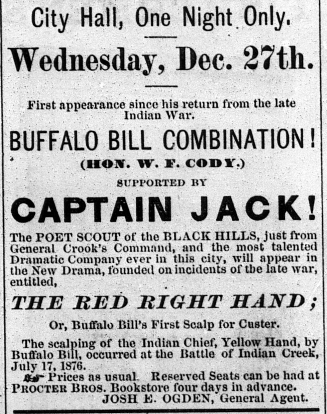
Cape Ann Advertiser: December 22, 1876
The Buffalo Bill Combination presented a fine bill at City Hall on Wednesday evening, opening with Fanny Herring’s laughable sketch, “Stage Struck,” followed by the new Western drama, “The Red Right Hand,” in which Buffalo Bill, Capt. Jack Crawford and Miss Fanny Herring appeared, with an able support. A large audience was in attendance, and the entertainment gave good satisfaction.
Cape Ann Advertiser: December 29, 1876

Cape Ann Advertiser: December 22, 1876
Gloucester’s entertainment scene had a backdrop of extreme tragedy that few American towns could endure and continue to exist. By the time of Cody’s first documented visit in December 1876, Gloucester was reporting 116 fishermen lost for the year, nearly 100 of them going down earlier that month. Sadly, news traveled slowly and by January 1877 the final tally was much worse: 212 men and 27 vessels gone, leaving 54 widows and 112 children.
Buffalo Bill in May Cody: October 1877
Cape Ann Advertiser: October 26, 1877
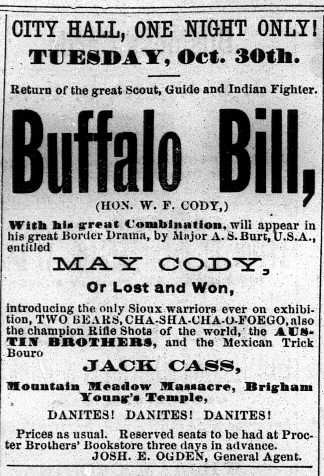
In October of 1877 Buffalo Bill returned with a new show to Gloucester’s City Hall. May Cody, the real life sister of Buffalo Bill, played the all-important damsel-in-distress in a show that blended fact and fiction to events that were followed by the public at large. The second act included a reenactment of the infamous “Mountain Meadow Massacre” where Mormons and their Paiute allies killed 120 members of a wagon train in 1857. This dramatic version has Buffalo Bill swoop in to save May Cody from a polygamous marriage with Mormon leader Brigham Young.
The show also introduced two chiefs of the Sioux Nation and champion riflemen known as the Austin Brothers that gave the “best of satisfaction” to a full house. As seen in the announcement above, Jack Cass, a Mexican trained donkey was part of the show. This donkey was Buffalo Bill’s first real foray into using animals in his performances.
Knight of the Plains: November 1878
BUFFALO BILL – The very king of all sensational stars, will appear in his highly attractive drama of “Knight of the Plains, or Buffalo Bill’s Best Trail,” on Tuesday evening next. He will be supported by his own Dramatic Company, which has been carefully selected and are pronounced by the press to be first-class organization. Genuine Pawnee and Nez Perces Chiefs appear in the drama, with all the necessary effects for the faithful portraiture of Indian life on the plains. The very novelty of the entertainment, aside from its undoubted merit, should pack our City Hall to repletion.
Cape Ann Advertiser: November 15, 1878
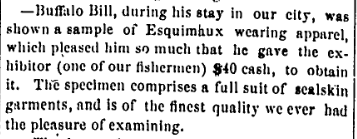
Buffalo Bill was back a year later with a new performance called Knight of the Plains on November 19th 1878. As part of the 1878 tour, Buffalo Bill and his troupe of scouts and Indians held a street parade featuring his military band. During his brief stay in town, Cody also picked up a unique souvenir from the fishing fleet:
The November 22nd edition of the Cape Ann Advertiser also states that the packed house at City Hall was the last performance for two of the native Pawnee performers: Little Warrior and his wife, Young-Grass-That-Sprouts-In-The-Spring. The two were part of a contingent that were summoned to Washington D.C. in September, with Cody acting as their Government agent. After the Gloucester performance they took the train to Boston and then sent back to their reservation.
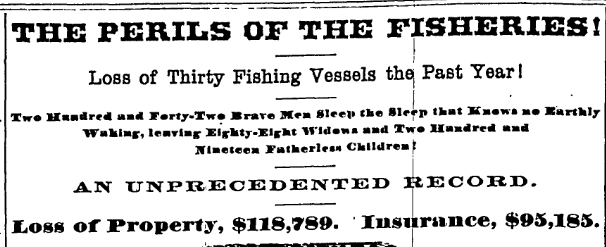
The years 1877-1878 were not as disastrous as the previous ones in terms of men lost at sea. Gloucester lost “only” 39 men 1877 and 35 in 1878. The fleet counted its blessings, and hoped for the best. Instead 1879 was the worst anyone had seen to that point and arguably the worst year in the Gloucester fisheries in both loss of life and capital. A February gale took out 143 fishermen alone, and by the end of the year 249 souls and 30 vessels were gone.
Buffalo Bill did not tour Massachusetts in 1879, but returned in 1880 with a new show.
Buffalo Bill’s Visits in the 1880s.
Buffalo Bill’s first visit to Gloucester in the 1880s featured a performance of “The Prairie Waif” and some “fancy shooting” by Cody himself, which according to the local press, was a huge success. Cody also hired Gloucester’s Charles Prindall, a sailmaker by trade, as Assistant Manager for the 1880 New England circuit. Their friendship would endure for years, with Prindall even naming a son after Buffalo Bill.
Last evening City Hall was packed to witness the grand entertainment given by the “Buffalo Bill Dramatic Company” and band of Cheyenne Indian Chiefs. It was an immense success. The drama of “The Prairie Waif” proved of most thrilling interest, while the scalp and war dance of the Indians possessed a weirdness which held the spectators almost spell-bound.
Cape Ann Advertiser: December 3, 1880
The performances of “The Prairie Waif” were the biggest yet for Buffalo Bill with a cast of 24 including a contingent of Cheyenne Indians as part of the performance. It was written by John A. Stevens for that season, but became the longest running of the Buffalo Bill melodramas. These bigger shows and larger troupes were a harbinger of what would evolve into the larger Wild West style shows.
Meanwhile the Gloucester fishing fleet had a bit of a reprieve in 1880 and 1881 after the tragedies of the year before. 1880 saw only 41 men lost at sea, leaving 18 fatherless children. Another 56 men were lost in 1881.
The Prairie Waif: March 1882

Buffalo Bill returned March 31, 1882 for a repeat performance of “The Prairie Waif.” It all started off with a noontime street parade featuring Sioux and Winnebago Chiefs in their “gorgeous war trappings”, and Buffalo Bill’s silver cornet band. One of the headliners for the performance was Harry E. Burgess, billed as the “Boy Chief of the Pawnees.” According to an article in the Oakland Tribune, he was made the youngest Pawnee Chief at the age of 12, under the name Silvery-Water.
By the time Buffalo Bill returned, over 115 fishermen were lost, adding at least 50 widows and 113 fatherless children to find other means of support. It is hard to imagine another town in the country where such a huge portion of Buffalo Bill audience would die before he returned.
You may wonder how they kept on fishing, but Gloucester was a boom town, except the gold was fish, and attracted an endless stream of young men to fill in the losses. Some were just here for a season, many settled down, and many others died at sea before they could make the decision. With the very real proposition of death, the Gloucester audience may have enjoyed Buffalo Bill differently than the big city crowds or locales closer to the “Wild West” he was dramatizing.
20 Days or Buffalo Bill’s Pledge: March 1883

Credit: The Jay T. Last Collection of Graphic Arts and Social History
Huntington Digital Library
The 1883 East Coast tour featured a new melodrama called Twenty Days or Buffalo Bill’s Pledge. It was billed as the “Sensation of the season replete with startling specialties and original scenic effects.” Among the cast of 25 was a young Loie Fuller, who would later become famous for her work in modern dance and choreography. She played the role of Miss Pepper, an impoverished pioneer woman who gets rescued from a pack of wolves by Buffalo Bill.
This was the final year of Buffalo Bill’s theatrical performances. What came next was the world famous, Buffalo Bill’s Wild West, with its huge cast of cowboys, Indians, horses and even a buffalo herd. For now at least, Buffalo Bill outgrew Gloucester’s salty downtown. His popularity was only growing, and when the Wild West came to Boston in 1884 it was announced in the Gloucester newspaper. Back then, there were both steamboat and train service to Boston, so many Cape Ann locals came out to witness the brand new spectacle.
1890s: Buffalo Bill’s Wild West in Gloucester

Credit: Illinois State University, Public domain
Buffalo Bill returned to Gloucester in July of 1895 with his world famous Wild West show. Since the last visit in 1883, Gloucester lost an estimated 1082 fishermen. This staggering number fortunately also marks the beginning of the end for these dark days. By the late-1880’s improved vessel designs reduced, but did not eliminate, the losses.
Meanwhile Buffalo Bill’s show was now far too big for City Hall and would be performed outside at Stage Fort, site of the landing of the Dorchester Company in 1623 and today a popular harborside park. This is the extravaganza that modern readers imagine Buffalo Bill shows were like: Part stage show, part circus, part menagerie. There truly was nothing like a Buffalo Bill show at its zenith.
Major John Burke, the general manager for Buffalo Bill, arrived a few days before the event, describing it as an experience far beyond anything that has appeared in Gloucester before. Riders from all over the world have now joined over 100 Native Americans to show off their horsemanship in big-top tent that could fit 20,000 spectators under electric light.
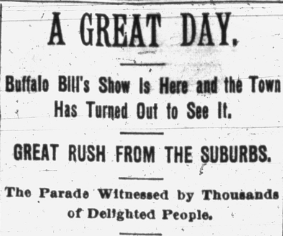
On the morning of July 10th the show arrived by rail on 52 cars. A good portion of the town including every child in the surrounding area, converged to watch the unloading at Gloucester’s train station. The Gloucester Daily Times mentioned a train of 700 people arrived at the station from Rockport shortly after Bill’s train. Apparently, the Rockport granite quarries and the Essex shipyards closed so everyone could see the show. For at least one day, the industries of Cape Ann were shut down as if it were Sunday.
Buffalo Bill’s grand parade started at 10AM and made quite an impressive spectacle:
Nothing like it was ever witnessed in our streets and probably its equal will not appear for many years. It was led by the redoubtable Buffalo Bill in a carriage drawn by two beautiful white horses, a fitting lead for such a wonder procession. Then followed in grand cavalcade, introducing the rough riders of the world. Indians, cow-boys, Mexicans, Cossacks, Guachos, Arabs, Scouts, Guides, American Negroes and detachments of fully equipped regular soldiers of the armies of America, England, France, Germany and Russia.
Gloucester Daily Times: July 10, 1895
The man led from the front and his schedule seems exhausting. After supervising the unloading at the depot, then leading the parade to the Park for setting up, Buffalo Bill met the members of the local Business Association at 11AM and shook the hand of approximately 1000 people before holding two sold out shows.
English Lancers, French Dragoons, German Cuirassiers and Arabian Bedouins, joined by veterans of the US 7th Calvary provided an impressive display of horsemanship. Horse racing, lasso contests, even the classic frontier “Indian raids” like the old shows were now done in grander fashion. Another highlight was the marksmanship of Buffalo Bill, Johnny Baker, and of course “Little Sure Shot” Annie Oakley.
Those who didn’t make it in, had the sideshows, toy balloons, lemonade, peanut and popcorn vendors to keep them occupied. After the evening show, the adult crowd followed the Wild West troupe back to the station to give Buffalo Bill a rowdy, but fond farewell.
A Prayer to the Great Spirit
Public Domain
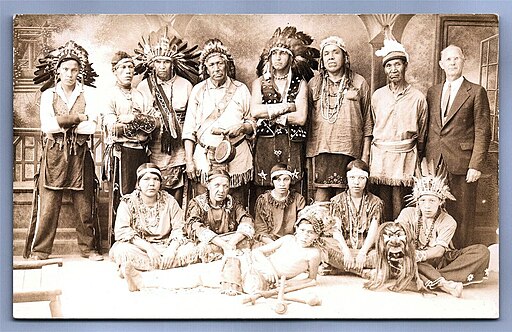
Earlier that day, after the parade made it to Stage Fort, Buffalo Bill said he witnessed the Indians in his troupe do something they had never done before at any venue. They went to the top of what is now called “Tablet Rock” and held a prayer to the Great Spirit. This same spot was also sacred to the indigenous Agawam people that originally called this area home and overlooks Half Moon Beach, site of the first European settlement.
As stated above, the losses at sea would improve, but any given year could be a disaster for the fleet. Over 200 fishermen would be lost at sea before Buffalo Bill returned in 1898.
Buffalo Bill’s Final Visit: June 1898
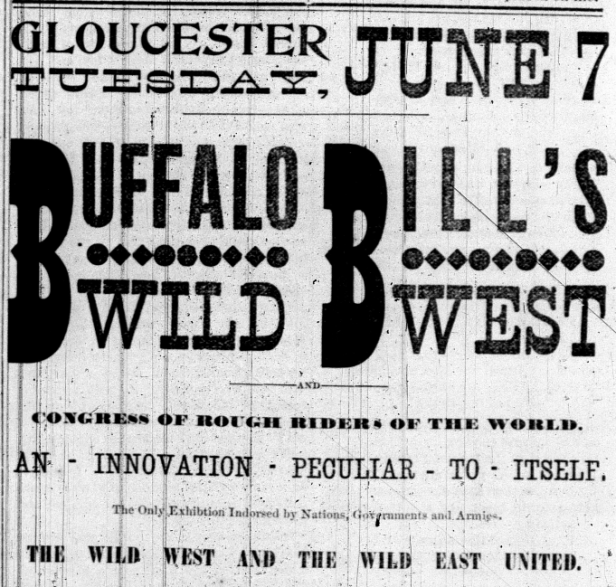
The Spanish American War was underway by the time Buffalo Bill started his tour, but he was ready to serve if called upon by the Army. The City was filled with patriotic fervor and was being represented by the USS Gloucester: J.P. Morgan’s former steam yacht converted to gunboat. The old fort at Stage Fort was refurbished with new artillery, so a new location was chosen for Buffalo Bill’s Wild West in the Riverdale section of Gloucester.
Once again, the entire surrounding area shut down once the train arrived at the depot. However, there was a slight delay as the train had a near-serious accident on the way to Gloucester from Newburyport. The Buffalo Bill parade led to Brown’s Field in Riverdale where the enormous enclosure was set up. Streetcars ran from downtown every 7.5 minutes, their busiest day on record. People streamed from every corner, on bicycles, through the pastures on foot, and even paddling down the Annisquam River. The Gloucester Daily Times states it was “indeed a motley crowd.”
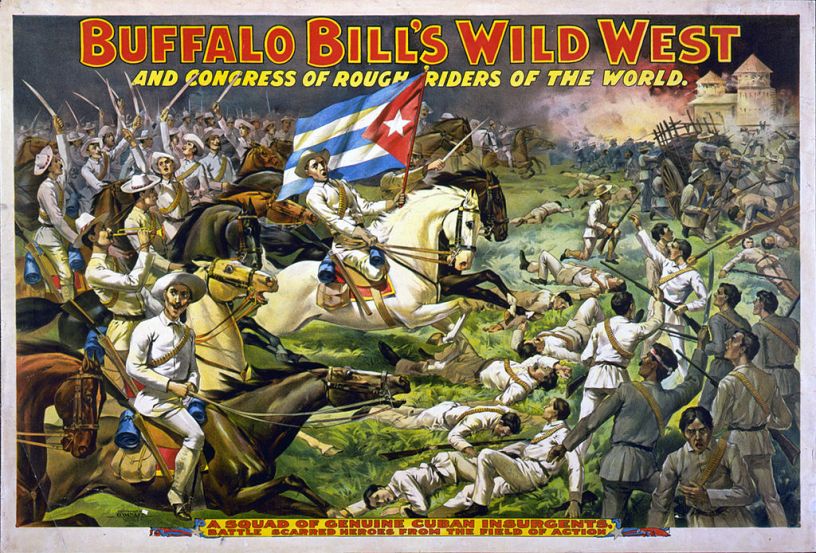
A motley crowd was par for the course in 1890’s Gloucester and wouldn’t deter the entire family going out and witnessing one of the world’s greatest entertainment spectacles. It was even bigger than the last visit in 1895. A cast of 1,100 men and horses, the biggest version of the Wild West yet with new groups of Cossacks, Moroccans, Wild West cowboys and women horse riders. The giant reenactment of Custer’s Last Stand alone included 800 performers. With Cuban independence one of the rallying cries of the war, Buffalo Bill also featured the “Hero Horsemen of the Cuban Patriot Army.” It was billed as a source of great entertainment, valuable education and overt patriotism by the local press.
Conclusion
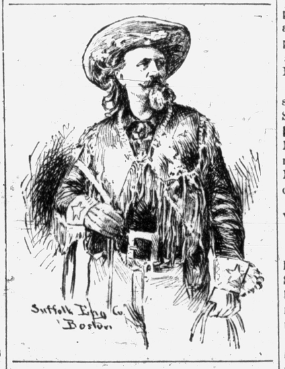
In these last decades of the Age of Sail, Gloucester was a stoic remnant of the Wild East just as Buffalo Bill represented the final days of the Wild West. Antipodes of a world that was vanishing right before people’s eyes.
There is much more to Buffalo Bill Cody than just a showman, much more than can be described here. Exaggerated or not, he did witness real struggles out West, he cared about the plight of the Natives he once fought, the buffalo he once killed, and a way of life gone forever.
It’s hard to imagine he was oblivious to what was happening to the people of Gloucester between visits, even if the rest of the country was. The Gloucester press called him a “Friend to our City” anytime he showed up in the national news. Buffalo Bill Cody must have found a mutual respect in an audience that at times were knowingly heading out to sea and to their deaths… just for fish.
A big Thank You to the staff at the Buffalo Bill Center of the West for shedding light on some of the clippings I found while doing this research.
Sources/More Information:
Buffalo Bill Center of the West
Cape Ann Advertiser, Gloucester Daily Times. Digitized by Sawyer Free Library/Advantage-Preservation


What a huge amount of research! And so interesting too.
Thank you for reading! That was a fun piece to research.