

Editor’s Preface: To belong to a fishing family is to be part of a larger, international community that knows what the ocean can give…and what it can take away. Our community was reminded of this yet again on January 30, 2026, with the tragic loss of F/V LILY JEAN . This series of posts is dedicated to her crew: Capt. “Gus” Sanfilippo, Paul Beal Sr., Paul Beal Jr., John Rousanidis, Freeman Short, Sean Therrien, and NOAA observer Jada Samitt.
The history of the Gloucester fisheries has been written in tears. No other industry by sea or land, sustains such a drain upon its resources and employees. Other callings may shorten life, but none show such constant and wholesale destruction.
The Fisheries of Gloucester (1876)
The number of Gloucester fishermen lost in the second half of the 19th century is simply staggering. By the time George H. Proctor published the Fishermen’s Memorial and Record Book in 1873, the death toll from fishing was akin to war. Gloucester had already lost 41 men by June 1873, and the next six months proved to be even worse. 174 men were lost, Gloucester’s darkest year up to that date.
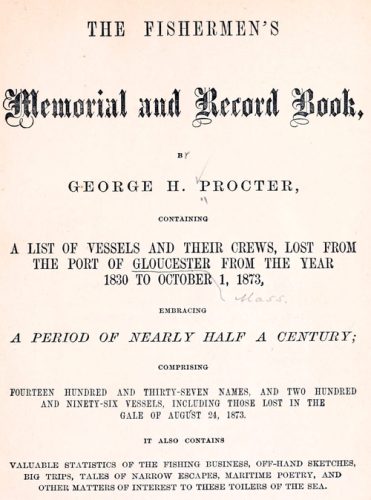
George H. Proctor (1873)
Public Domain
The losses at sea were unlike anything that had come before, and only trending worse in the early 1870’s. The previous decade saw Gloucester lose more of its young men fishing than in battle during the American Civil War. Tragically, the deaths at sea continued long after peace was made at Appomattox.
There were two hundred and eighty-two lives lost in the fishing business from this port during the four years of the war, while the record of those who have been killed, or died in the service, is less than half that number. It thus appears that our town suffered more from the perils of the ocean than the ravages of war – a fact which would hardly be credited, did not the statistics prove it.
The Fishermen’s Memorial and Record Book (1873)
The Nation knew of Gloucester, it was the City of Fish, its fleet was the largest in the Western Hemisphere and its salt cod was shipped nationwide. The notoriously salty port attracted equally salty personalities, entertained by big time shows like Barnum and Buffalo Bill Cody. The general public knew fishing was dangerous, any work done on the ocean was not taken lightly. But it is hard to imagine anyone removed from the fishing ports could truly understand what New England fishermen had to endure.
Sadly, the tragedies at sea were taken by the public as the price of doing “business in great waters”. The biggest of the tragic storms would be picked up by newspapers, via telegraph, but it wasn’t headline news. It was just part of the American fabric, read about on back pages just like Gloucester people read about coal mine disasters or the Indian Wars.
The Fishermen’s Memorial and Record Book was both a memorial to those that had been lost and a collection of stories and fishing information to show that the losses were not in vain. It was not only targeted at the local fishermen and their families, it was also printed with the intention of letting the public at large understand what was happening out on the banks.
The book proved very popular and was followed up in 1882 with a sequel, The Fishermen’s Own Book. The mounting losses, coupled with the overall growth of the industry necessitated a bigger book, but of the same format. The two volumes, along with the Proctor’s 1876 pamphlet The Fisheries Of Gloucester, provide unmatched insight into what was happening on the fishing grounds, and back at home.
The Effects of the Mounting Losses
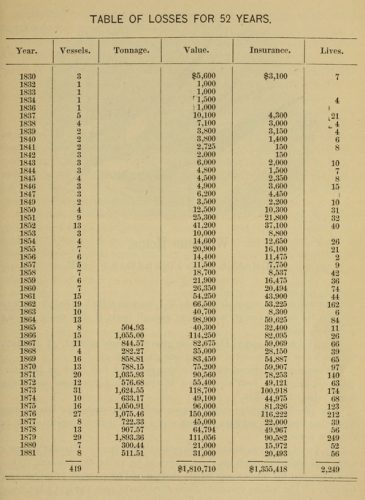
1830-1881
From: Fishermen’s Own Book (1882)
By the 1870’s, the Gloucester fishing industry could expect to lose at least 3% of its workforce on any given year. Not every year was a disaster, but every year brought some losses, and every loss was potentially disastrous for the families affected. Every vessel lost on Georges Bank, every dory gone astray, every man washed off a bowsprit, sent ripples through Gloucester in the form of struggling widows, orphans, elderly parents, and young siblings.
In the 1860’s an influx of immigrant fishermen began to arrive, most of them fishing people. These new arrivals from Nova Scotia, Newfoundland, Scandinavia, Ireland and Portugal, were now part of the annual losses. Now the disasters on the fishing grounds sent those ripples of tragedy far beyond Gloucester itself. When friends and family fished together and were lost at sea, it could devastate the small struggling villages of Maritime Canada, that relied on money sent from fishing in “the Boston States.” Newfoundland would not see losses of young men like this again, until the trenches of the First World War.
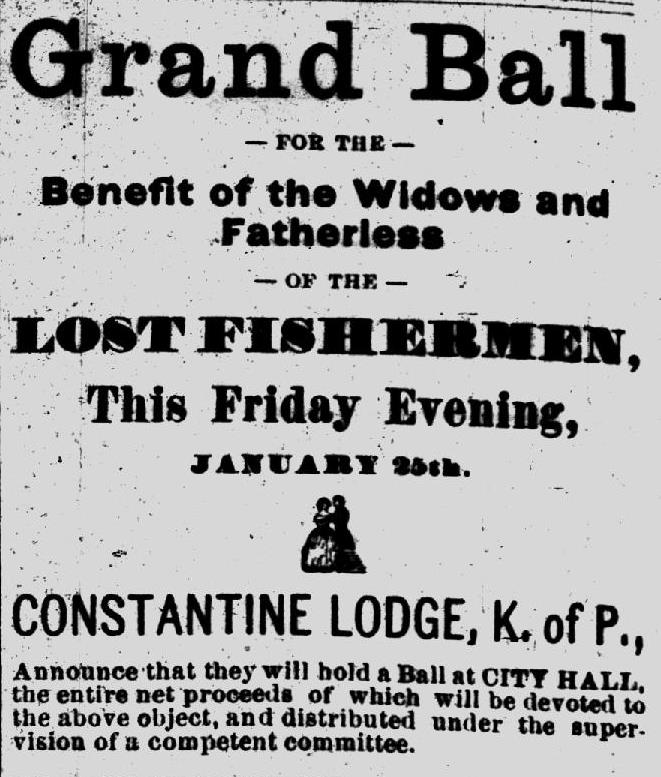
Cape Ann Advertiser: January 25, 1884
The local charitable organizations did their best to help, but when a storm takes out half a dozen schooners and over 60 men, there was far too little to go around. As changing seasons brought new losses, those still struggling could easily be forgotten in the face of more immediate needs. Widows made ends meet by running or working in fishermen boarding houses, or running a laundry service. Others would run clandestine bars along the waterfront known as “kitchen barrooms” where a fisherman could spend his hard earned money on drinks, gambling and prostitutes before he even made it up the street.
This says nothing of the countless men who would come home severely injured from mishaps at sea, no longer able to support their families. The rest of their days could be like purgatory: an existence somewhere between living and dead as they transition from provider to burden. They wandered the saloons, wharves and their old haunts, some finding salvation in religion, others succumbing to “demon rum.”
Accident on Georges – Mr. William Corday, one of the crew of schooner PESCADOR of this port, was severely injured during the gale of the 16th inst., on the Banks. He was on deck at the time, when a sea boarded the schooner, knocking him against the mast with great force. His head was very severely bruised, several of his teeth knocked out, shoulder dislocated, one of his ribs broken, and one side completely paralyzed. The schooner immediately returned to port, arriving here on Sunday, when the unfortunate man was taken to his boarding house, where he was attended by Dr. Bergengren. He Still remains in very critical condition, but hopes are entertained of his recovery. he belongs in Newfoundland where he has a family.
Cape Ann Advertiser: March 25, 1870
It is difficult to imagine such tragedy, year in and year out, and still have a workforce willing to take the risks. The men were well aware of what lay in store for them out there, no matter the season. This was the concept of “high risk, high reward” taken to the extreme. Many men took a winter fishing trip to Georges Bank just to give it a try, and became full time “georgesmen” once they saw how much they could earn. Stakes were high and options limited to those who have a family to support and have only known the ways of fishing.
In the late 19th century, attitudes would eventually shift away from the fatalistic “cost of doing business” mindset when it came to commercial fishing. The death toll out of Gloucester began to trend down by the 1890’s, with safer vessel designs eliminating the biggest threat of disaster. However, winter storms, collisions and the ever-present risk of being adrift in a dory, all continued to take their share of fishermen well into the 20th century.
How Did Fishing Get so Dangerous?
As I pen these lines there comes to my memory many of those men with all the hopes and expectancy that I myself had of returning to their loved ones at home, but who were destined to sail their last trip. The survivors of these storms often had many harrowing tales to relate on their return home, of hardships and narrow escapes, etc., but though the memory of shipmates gone down, and friends who would ne’er return was sad to think of, more difficult and more trying was the story they had to bring to the newly-made widow and to the fatherless children; for while these men could face death themselves without a tremor, the sad tidings they must take to the house afflicted, and witness the anguish of the widowed mother, was sufficient to make the stoutest among us tremble.
Captain Sylvanus Smith: Fisheries of Cape Ann (1915)
Fishing is always dangerous, but what happened, starting in the 1850’s, that made it so deadly? The losses of men and property add up to far more than just having a larger fleet. It wasn’t probability, it was due to a series of economic and technological changes within New England fisheries – primarily concentrated in Gloucester – that created this situation. The business was growing, but it was a reactive, uneven growth, where “prosperity” was paid for in fishermen’s lives. However the growth of the fisheries and the ensuing tragedies, were the product of events from the previous decades.
Part II will cover the major changes to the Gloucester fishing: new fish, new grounds and new markets.
Sources/More Information
Cape Ann Advertiser, Gloucester Daily Times. Digitized by Sawyer Free Library/Advantage-Preservation
Down to Sea: Men Lost Fishing From Gloucester in the 1800s
Fitz Henry Lane Online by Cape Ann Museum
Dearborn, H. A. S. “Correspondence of Gen. Dearborn No. VIII.” Boston Courier, 4 Feb. 1839. Nineteenth Century U.S. Newspapers. Gale Primary Sources.
Goode, G. Brown: The Fisheries And Fishery Industries of the United States. Government Print. Office, Washington 1884-87.
Morris, John: Alone At Sea, Gloucester in the Age of the Dorymen (1623-1939). Commonwealth Editions, Beverly, MA 2010.
Nineteenth Century U.S. Newspapers, Gale Primary Sources via Boston Public Library
NOAA’s Historic Fisheries Collection/NOAA National Marine Fisheries Service
Proctor Brothers: The Fisheries Of Gloucester – From the First Catch by the English in 1623 to the Centennial Year 1876. Proctor Brothers Publishers, Gloucester MA 1876.
Proctor Brothers: The Fisherman’s Own Book. Proctor Brothers Publishers, Gloucester, MA 1882.
Procter, George H. The Fishermen’s Memorial And Record Book. Proctor Brothers, Gloucester, MA, 1873.
Simmonds, Peter Lund. The Curiosities of Food, Or, The Dainties And Delicacies of Different Nations Obtained From the Animal Kingdom. London: Richard Bentley, New Burlington Street, 1859.
Smith, Sylvanus. Fisheries of Cape Ann: a Collection of Reminiscent Narratives of Fishing And Coasting Trips, Descriptive Stories of Sandy Bay And the Harbor, Also Some Interesting Comment On Fisheries Legislation And Cause of the Decline of the Fisheries, With a Prophetic Glimpse Into the Future. Gloucester, Mass: Press of Gloucester Times Co., 1915.
 The Historical Vagabond
Wireless communications may have helped, too, although a small fishing vessel definitely didn’t have its own “Marconi station”. By the time the “Titanic” sank, wireless operators not only informed potential rescuers, but the press picked up the news, too ((although often inaccurately). The sea probably felt less distant than before the radiowaves.
Sadly most of these men were lost before radio was invented. It would not be until World War II that ship/ship and ship/shore radio were standard on American fishing vessels.