
I spend more time reading historic newspapers than I do modern ones, it helps you realize things have always been crazy. You also realize how dangerous everyday life was in the 19th century. Last spring I was researching a bad accident that took place at Burnham Brothers Marine Railways in 1856. However, on the same page of the Gloucester Telegraph, I learned of an even more tragic accident at the circus earlier that week.
John Burrows the circus driver, who broke his back on Tuesday morning, was still alive yesterday, although the lower part of his body remains paralyzed.
Gloucester Telegraph: May 17, 1856
With a laconic update like that, I had to know more. As I tracked down the events of this horrible accident, I fell down the rabbit hole of early American circus history. What I uncovered is the story of Flagg & Aymar’s International Circus: the first traveling circus established in Massachusetts and arguably, the unluckiest show on earth.
The history of the American traveling circus seems like it would be filled with tragedy, and trust me, it is. However, the sheer amount of bad luck this troupe faced in a mere six months of existence stands out, at least to this modern observer. The circus hardly leaves a trace in the historical record, but many of the performers were famous in their day and were American circus pioneers.
Early circus history is not well documented, not surprising for an industry that survived by blurring the lines between truth and fantasy. The circus industry pretty much invented “clickbait” so everything must be taken with a grain of salt. Time has certainly obscured some facts, but even back then, circus stories in the press seem a little less credible than the rest of the news.
The Early American Circus
The modern concept of a circus developed in England as an equestrian show performed inside a ring. The size of a circus ring is still based upon these early performances and so is the attire of the Ringmaster, who still dresses in modified riding gear. Jugglers, tumblers, wrestlers, acrobats and clowns would entertain the audience during the breaks. This is the circus formula that arrived in North America in the late 18th century.
These early American circuses did not travel, performances were held in purpose built structures for the run of the show. Like many Old World concepts, the circus took on a new “American” style to become the famous traveling shows of Barnum, Bailey and others later on. The biggest innovation of these early days was development of the “Big Top” performance tent that made traveling shows possible.
Traveling Circuses and the Big Top
There originally was a distinction between a circus performance and an animal show, called a menagerie. It didn’t take long however, for circuses to travel with menageries before merging together. In a clever bit of practical marketing, the early traveling circuses turned their arrival in town into a grand parade of horses, wild animals and marching bands. It was common for the throngs of people to follow the parade all the way to the circus grounds to watch the Big Top go up.
The early American circus troupes were often fly-by-night operations that ran for a season or two before folding. This makes researching circus history difficult since shows and performers are not well documented. That same group of performers would often regroup with a new manager and keep on traveling under a new name. The show must go on, as they say.
Flagg & Aymar’s Circus was one of these early troupes that vanishes from the record, only to show up under a different name in late 1856. The majority of these same entertainers also worked together the year before under a different name. In all three cases, the stars of the show were the once famous, now forgotten Aymar family of acrobats and equestrians.
The Aymar Circus Family
Flagg & Aymar’s Wayside Wanderer (1856)
Credit: AAS Historical Periodicals Collection
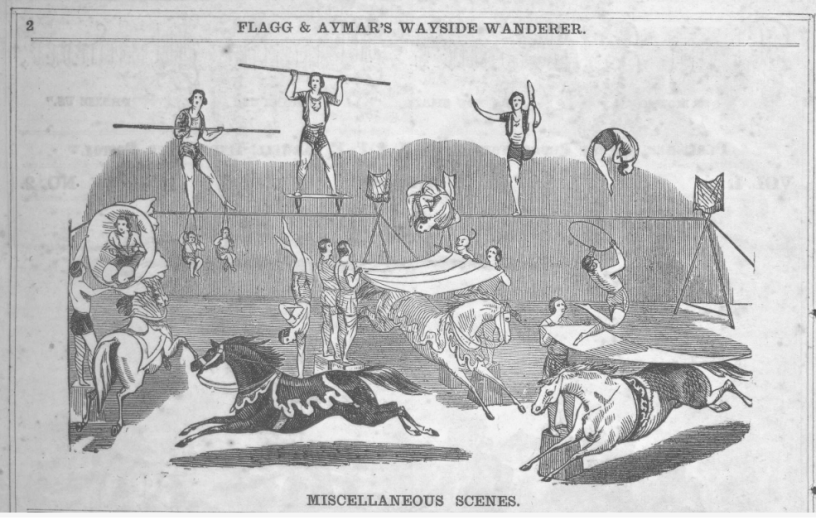
William T. Aymar and his brothers Walter, Lewis, Albert and John, hailed from Patterson, New Jersey and became one of the first families of the American traveling circus. The Aymar brothers were acrobats and equestrians trained by the eldest brother John, starting out in the 1840s. John was famous for his ability to do a double somersault over four horses. Sadly, his famous leaping ability, would lead to his tragic in-ring death.
Details are fuzzy of course, but in 1843 while performing in England, John P. Aymar attempted a triple somersault over the horses, without a springboard. This was a feat he supposedly accomplished at least once previously, but this time he landed on his forehead, broke his neck and died in the ring. In October of 1843 a circus performing at New York’s Bowery Theater featured Mrs. Aymar the “youthful widow of the late John P. Aymar, recently killed in England.” The show must go on…
Flagg & Aymar’s Wayside Wanderer (1856)
Credit: AAS Historical Periodicals Collection
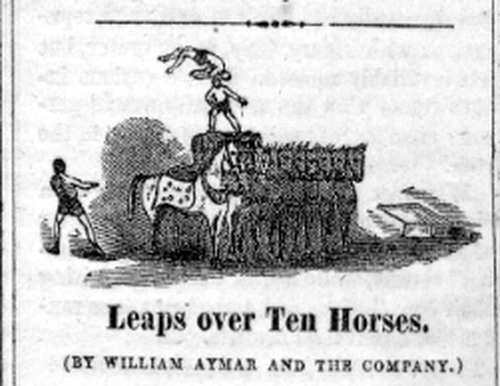
William and Walter Aymar were part of the first circus to travel overland to perform in California, and later they performed in South America. William Aymar would evolve his act to become a famous clown, but was originally known for his acrobatics like his late brother. His signature move was to somersault over 10 horses, using a springboard.
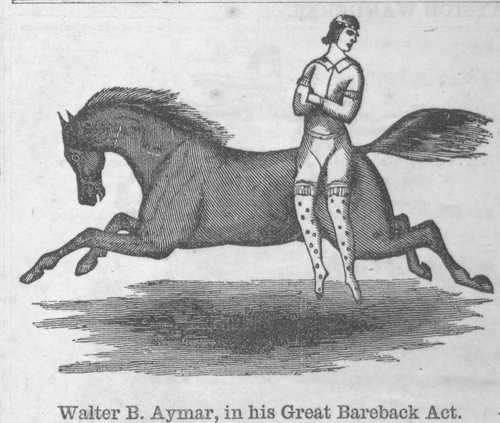
The surviving Aymar brothers performed in various circuses across the country through the late 1840s to the mid 1850s. William and Walter’s wives and children would also join the family business as trick horse riders, clowns and acrobats. In 1855, they were headlining Washburn’s Great Indian Amphitheater and Circus, a show that advertised Native American performers decades before Buffalo Bill Cody. In the winter of 1856 William, Walter, Albert and their families, decided to head out on their own with a brand new show.
Jacob B. Flagg: Omnibus Operator and Financial Risk Taker
Jacob B. Flagg was not a circus man, but was definitely not afraid to try new things. Flagg originally ran a grocery store in the Boston suburb of Roxbury, before getting into transportation without any prior experience. In July 1851, he and a business partner bought Boston’s popular Old Line omnibus service better known as the “Roxbury Hourlies”. They apparently ran it very successfully, until Mr. Flagg started getting distracted with ideas of the circus sometime in early 1856.
How it all came about, is not known, but it seemed like a good match. Aymar and family could bring in the talent, while Flagg could handle travel logistics. This is speculation of course, since none of this is documented, but the Boston area media began to take notice by April.
We take great pleasure in predicting a complete success for this new enterprise. The senior partner is Mr. J.B. Flagg, who has made himself so universally popular in this vicinity as the proprietor of the Old Line of Roxbury and Boston Omnibuses; the junior, Mr. Aymar, bears a name identified with all that is excellent in the equestrian business. May this truly New England concern be as successful as we predict.
Boston Transcript: April 23, 1856
Flagg & Aymar’s International Circus
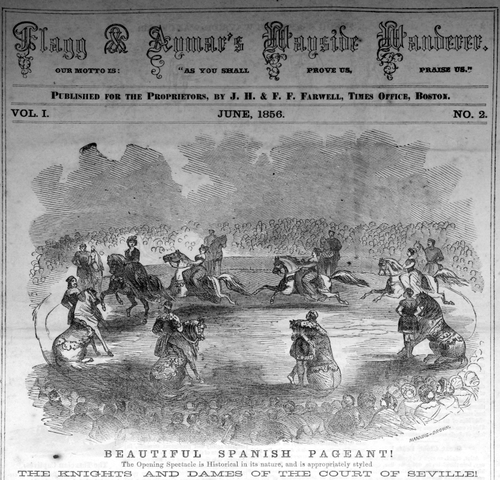
Opening act of Flagg & Aymar’s International Circus.
Flagg & Aymar’s Wayside Wanderer (1856)
Credit: AAS Historical Periodicals Collection
Flagg & Aymar’s International Circus was the first traveling circus ever organized in Massachusetts. In a surviving pamphlet titled Flagg & Aymar’s Wayside Wanderer, they boast about how they spared no expense in creating this show. “The Maine folks will be astonished.” declared the Boston Evening Ledger.
Compared to the sorry state of other traveling shows, Flagg & Aymar had all new equipment, costumes, riding gear and the best trained horses. The New York Clipper reported the new circus cost $60,000 to “fit up.” They considered themselves a higher class of show than the lewd, drunken circuses that were ready to fight their way out of town. The most impressive part of it all may have been their Big Top, or “Oriental Pavilion”, claimed to be the largest in the country at the time.
Its swelling outlines are pagoda-like, reminding one of the Asiatic style of architecture, and as the snowy mass of canvas towers up and is boldly defined against the natural background of green hills and blue sky, the effect is beautiful in the extreme. It is considered to be the largest canvas ever spread in America, and it is supported in such a manner as to defy the assaults of anything short of a whirlwind, in the shape of a storm. Thus security, extent, ventilation, shade, shelter and beauty combine in this peerless pavilion.
Flagg & Aymar’s Wayside Wanderer (1856)
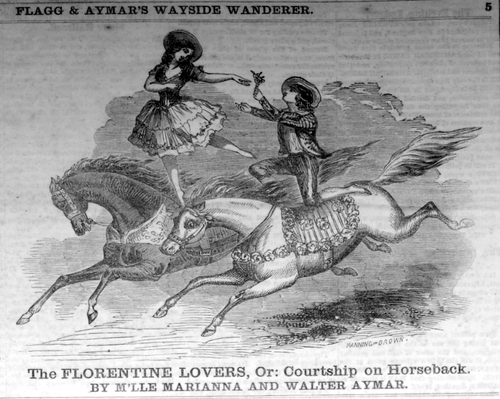
Flagg & Aymar’s Wayside Wanderer (1856)
Credit: AAS Historical Periodicals Collection
The tent and the gear may have been new, but the talent consisted of seasoned veterans of the traveling circus. In fact, much of the troupe, including the entire Aymar family, and the circus band, were all performing together the year before in Washburn’s Great Indian Amphitheater and Circus.
The Aymar men were joined by Arthur Sylvester, John Derr, Eugene Fernando and Lewis Moor. The Aymar ladies along with M’lle Marianna and Mrs. William R. Derr made “a galaxy of female equestrian talent which has never been equalled.” Acrobats Henry Harris and Samuel Jackson, clowns George Knapp and Mr. Cane and John Butler the strongman rounded out the troupe.
Flagg & Aymar’s grand procession into town was led by Harry Gaul’s Bugle Band, riding in their circus bandwagon: a magnificent swan chariot. Circus historians state that these huge, horse-drawn bandwagons were often the single most expensive piece of equipment for these early traveling circuses.
The season started off in grand fashion with a parade through the streets of Boston, on the way to the fair grounds in Roxbury. The shows were part of Boston’s larger May Day celebrations for 1856. Jacob Flagg must have been raking in money with both hands as his omnibuses did brisk business getting people to see his latest business venture.
Flagg & Aymar’s Unlucky 1856 Season
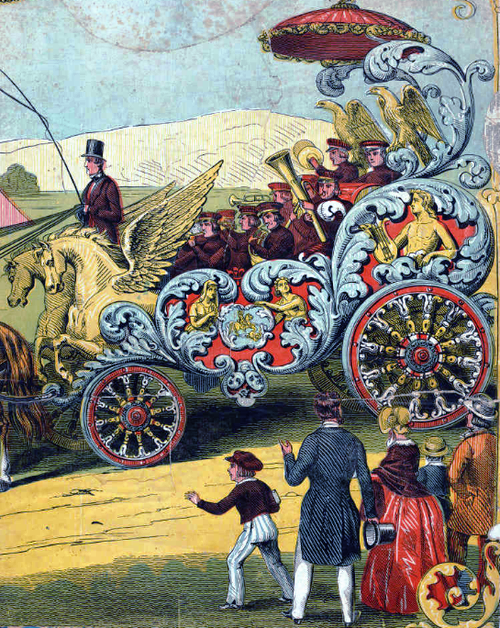
Section of large circus poster, artist unknown (1850-1855)
Credit: RISD Museum
Shortly after the Boston performances, Flagg & Aymar were on the road, but it didn’t always go smoothly. In early May they arrived in Lowell, where the newspapers declared they were a circus company which, “has no superior in the United States.” The procession through town to the fair grounds was impressive, the actual performances less so:
The Circus. Flagg & Aymar’s circus performed yesterday afternoon to a full house, and last evening to a crowded one – that is, if we call a canvas-tent a house. There were all of three thousand people present last evening. The performances were nothing extraordinary.
Lowell Daily Citizen: May 7, 1856
Ouch! Adding to the insult in the press, it was also reported that two youths stole a $100 violin from the sideshow. By May 12th, they had made it to the fishing port of Gloucester, Massachusetts, where things did not go smoothly.
Tragedy in Gloucester
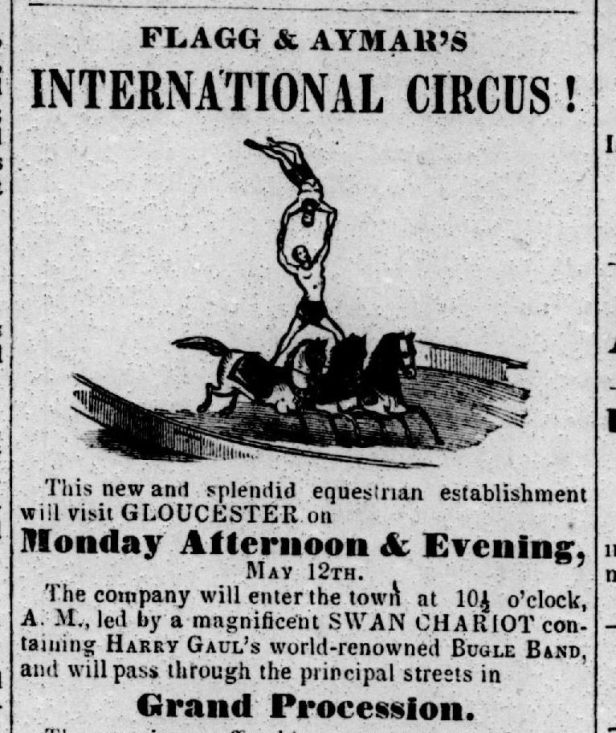
Flagg & Aymar’s Circus arrived in Gloucester the morning of Monday, May 12th, and paraded as usual, to the fair grounds. The first accident of the day happened after the parade, while the workmen were setting up the tent. A child was playing around the tent when a worker dropped a plank and hit him on the head. The boy was “stunned and senseless” for a few minutes, before recovering.
Sometime in the afternoon, the wind picked up and blew over their expensive circus tent. The local paper does not elaborate on the circumstances, but several people were injured by the center pole coming down. Edward Ayres was struck on the head by the pole and “severely bruised, but fortunately escaped without injuries of a serious character.” Of course, this is long before concussions were understood, and if you weren’t bleeding out of your ears, you were fine.
The story that originally got me interested in this unlucky circus occurred early on Tuesday morning as the wagon train left town. At about 2:30 AM, John Burrows, one of the wagon drivers, lost sight of the road in the darkness and drove off the embankment.
The wagon was overturned upon the left arm of the driver, whose back was broken by the fall. He was imprisoned in this situation until released by Capt. Harty and Mr. John Roeper who heard the noise made by the upsetting of the wagon and the cries of the wounded man. After unloading the wagon they lifted it from his arm, and conveyed him to the house of Mr. David Smith. We learn from Dr. Hildreth, who has the patient in charge, that there is little prospect of his recovery, his body being entirely paralyzed below the fracture.
Gloucester Telegraph: May 14, 1856
Burrows would live nearly six agonizing weeks before finally succumbing on June 22nd at the Gloucester Alms House. It must have been a horrible death, made even worse in that he died alone in a strange town.
The show must go on. Flagg & Aymar kept on going up the coast, performing two shows nearly every night. Accidents and horrible injuries, which were all reported in New England newspapers, would not stop them:
Flagg & Aymar’s Circus, though they employ no railroads and shrink from no fatigue, are possessed of such immense bodily powers as to enable them to do anything, in the way of athletic prowess, within a hair’s breadth this side of a miracle.”
New Hampshire Gazette: May 15, 1856
Flagg’s Financial Troubles
Flagg & Aymar were drawing good crowds during their shows. News reports mentioned how much money they were making along the Maine coast, but financial troubles started almost right away. In an act of robbing Peter to pay Paul, J.B. Flagg started funneling money from his transportation business, to his circus.
By early June, the Boston Post reported that Flagg & Company have suspended payments to their creditors. At some point in all of this, his partner in the omnibus line died. Tickets for the now defunct Roxbury Line were honored by Boston’s Metropolitan Railroad and Flagg was declared insolvent. He would spend the next few years dealing with his creditors in court.
Struck by Lightning
The end of June 1856 saw Flagg & Aymar performing in southern New Hampshire, heading towards Boston when the next big calamity struck. On the night of June 26th the circus was traveling from Nashua, New Hampshire toward Concord, Massachusetts when they were overtaken by a severe thunderstorm in Tyngsborough. The circus did the worst possible thing and took shelter under some large trees. Lightning struck, blowing a wagon to splinters, killing four horses, and injuring two men.
July Fourth Performances: Boston Public Garden
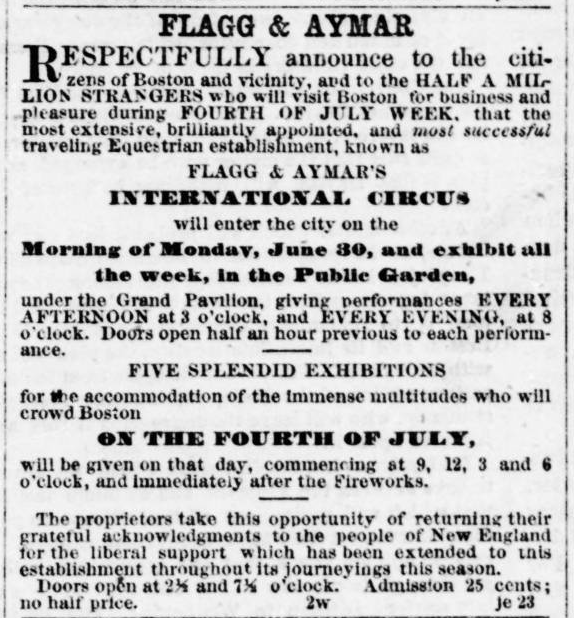
The peak of Flagg & Aymar’s short existence occurred during the week of July 4th. Their grand procession arrived in Boston on June 30 and headed to the Boston Public Garden. The circus performed twice a day and did five shows on the Fourth of July. But the bad luck followed this very unfortunate circus. The Boston Journal reported a windstorm went through Boston the night of June 30, leaving Flagg & Aymar’s big circus tent once again on the ground, and this time “quite badly torn”.
The Public Garden shows were apparently well attended. The Boston press reported Flagg & Aymar were raking in the cash and apparently were spending it freely as well. Along with this good news, the Boston Post casually throws in this nugget without any further reporting:
The trifling accident with the gas the other evening was unavoidable – but then this circus has less need of gas than is customary.
Boston Post: July 2, 1856
This may have to do with some of the extra activities they were putting on, most likely a balloon ascension that was advertised along with fireworks. This was not part of the usual Flagg & Aymar show, so it is possible they had a “trifling” accident when using hydrogen gas (think Hindenburg) to fill their balloon.
Not everybody in Boston liked the circus, or the crowds it attracted. One refined Boston lady was annoyed by the scene Flagg & Aymar brought to the usually tranquil Boston Public Garden.
But not long ago, we found the white tents of a Circus pitched there, with all its attendant shows and nuisances—the crowd of low, idle, ill-dressed people, that always collect around such resorts, and one or more of the entrances disfigured by a temporary frame-work of boards, covered with gaudy placards, on which men and women too were represented, pirouetting on flying horses and performing many “daring, marvelous, and unparalleled feats”
The Boston Olive Branch: July 19, 1856
Respects to a Fallen Comrade
The circus had finally hit a patch of good fortune performing without a reported incident for the rest of July. Flagg & Aymar were heading to shows in Vermont when they made a stop and paid respects at the grave of a man named Potter. It was reported that Potter performed with the circus at some point but was later shot and killed during a “fatal affray” in Bernardston, Massachusetts.
The Wheels Fall Off: A Death or Two in Schenectady
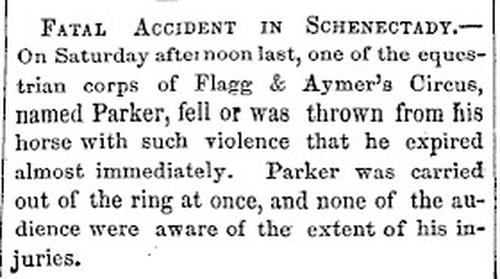
Flagg & Aymar’s International Circus performed in Schenectady, New York on August 16, 1856. Within a day or two, various New York papers reported on the death of one, and maybe two members of the circus. The Schenectady papers first reported the death of one of Flagg & Aymar’s attaches but with sketchy details. The man was named either Barker or Parker and died from “bilious colic” after working the show. He was either from Vermont or Rhode Island and he either died suddenly, or had been ill for a time.
About a week later, another report started spreading through New York State newspapers and beyond. This story says a Flagg & Aymar equestrian named Parker died in the ring so violently and quickly, that the audience was unaware he was already dead. Are both of these stories true? The trail goes pretty cold from here, but it’s fairly certain that somebody died at the Schenectady show.
Flagg & Aymar’s Circus was advertised to perform in Oneida, and then Chittenango New York, to finish the month of August. It is unclear how many shows they performed under the old management, and by September the same performers were in Rochester under a new name.
Enter John Robinson
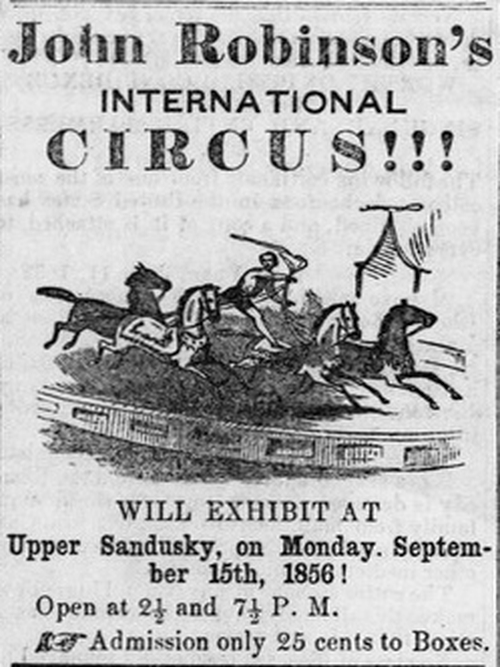
John Robinson was a literal and figurative giant in American circus history. He was a former equestrian performer who in his prime could kill a horse with one punch. Robinson would get into management by the 1840s and started the Robinson & Eldred Great Southern Circus. In 1856, he planned to retire and sold his half of the circus to his partner Gilbert Eldred. Retirement didn’t take, and by August of that year he was in upstate New York, purchasing the now defunct Flagg & Aymar’s International Circus – lock, stock and barrel. The gear, tent and the performers were all the same, he simply renamed the troupe John Robinson’s International Circus and continued their tour.
The final casualty of Flagg & Aymar’s 1856 season was the death of bugle bandleader Harry Gaul. The once-famous musician didn’t make it through 1856, dying at the age of 42 in December. The Boston papers reported “about fifty musicians, and Van Amburgh’s large company of performers, marched in procession to his last resting place, the grave.”
Legacy of Flagg & Aymar’s Circus
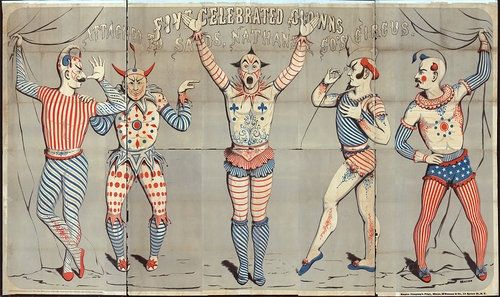
Library of Congress
The performers of the Flagg & Aymar Circus, including the Aymar family continued with Robinson, at least until the end of 1856. Robinson still used the old name for a brief time, giving it second billing under his own show. In January 1857, Robinson’s company was touring the southern states as a combined show: Robinson’s Great Southern Circus with Flagg & Aymar’s International Circus. The show had 60 men, 100 horses, an “Asiatic” menagerie bought from P. T. Barnum, and the late Harry Gaul’s band on the swan chariot.
The members of the Aymar family would go on to perform with numerous other circuses, both separately and together. The Sands, Nathans, and Co. American Circus had William T. Aymar on the bill in early 1857 as an “equestrian grotesque.” He continued to perform as a clown, equestrian, acrobat and dramatic performer for numerous circuses until 1881. An in-ring accident while riding a buffalo caused severe lung hemorrhaging, and eventually led to his death. He spent his last years an invalid living with brother Walter, dying at the age of 53.
Brother Walter Aymar often performed with William and would later operate his own circus. Alfred Aymar also continued to perform into the 1870s. It would be too exhaustive to list here all the different shows the Aymar brothers performed in or produced. Their sons and daughters kept up the Aymar circus traditions until the end of the century.
The John Robinson Circus endured long after the death of “old” John Robinson in 1888. Robinson’s Circus became one of the biggest and oldest circus companies, tracing its origins to Flagg & Aymar’s unfinished 1856 season. The family would continue to operate the circus until they sold out in 1916. The Ringling Company would eventually acquire the John Robinson’s Circus brand and hold performances into the 1930s.
Final Thoughts
My research started with a horrible accident in my hometown, but ended with a much deeper appreciation of early circus performers. The circus business has always had a mixed reputation at best, but its importance to American popular culture is still with us, even if we are unaware. Flagg & Aymar’s International Circus was an unlucky and somewhat tragic, flash in the pan of a circus. However its threads, and so many early circuses like it, are still embedded within the tapestry of American entertainment.
Sources/More Information
A CIRCUS ACTOR’S CAREER.: THE DEATH OF THE WELL-KNOWN PERFORMER WILLIAM T. AYMAR. New York Times, 20 Mar. 1883: 8. ProQuest. 26 Apr. 2025 .
American Antiquarian Society Historical Periodicals Collection through Boston Public Library
Billboard 1924-06-28: Volume 36 Issue 26
The Boston Olive Branch: July 19, 1856
Boston Post, Boston Transcript, Lowell Daily Sun: Newspaper Archive through Boston Public Library
Cape Ann Advertiser, Gloucester Daily Times. Digitized by Sawyer Free Library/Advantage-Preservation
Chronicling America digitized Newspapers from Library of Congress
Digitized New York Newspapers: NYS Historic Newspapers
Maine Farmer 1856-06-05: Volume 24 Issue 24
New York Herald, 23 Oct. 1843. Nineteenth Century U.S. Newspapers from Gale Primary Sources
Parkinson, Bob. John Robinson Circus, Bandwagon: The Journal of the Circus Historical Society. Volume 6 No 2, March 1962
Springfield weekly Republican (Springfield, Mass.), August 16, 1856
Vermont Phoenix (Brattleboro VT), August 16, 1856
 The Historical Vagabond
Wacky times. This reads more like fiction than reality, difficult to imagine spending your life on the road like that when serious accidents are not just a risk, they are likely to happen. Great post. Maggie
Thanks! It must’ve been a tough life in any early circus, but this one was cursed.